Showing posts with label Purple Sandpiper. Show all posts

Wednesday, 3 June 2015

February 2015

Long time no see yet again!

Slipping further and further behind as ever, but I still do intend to catch up with myself


The month started with the usual work party and Upton Warren on the 1st, where the standout highlight was 13 Jack Snipe and 18 Commons. A fairly low total for Common Snipe but a half decent count for the Jacks.

A mess of local birding followed, without seeing very much, including regular failed attempts at gulling around the Stubbers area, which returned no reward. So it was gratefully received on 7th when a day out was offered in south Wales, with a whole host of scarcities to keep up occupied. First of was the stunning Little Bunting at Forest farm country park, which showed superbly throughout the visit. Perhaps too well!

Due to the awkward position for digiscoping I often had to go to the furthest point away in the hide, which meant I was looking through a fence for most of the time, but the bird performed admirably!


 After our fill, and wanting to avoid the increasing crowds, we moved out from the country right into the center of Cardiff for the regularly returning drake Lesser Scaup, which was located without too much fuss swimming about with a large group of Tufted Duck. Having chosen to reside at the furthest point away from the viewpoint, and with strong and cold winds, we didnt stay around long, moving onto Newport RSPB.


The RSPB site itself was very quiet, a good number of waders on the estuary being the saving grace, featuring Grey Plover, Bar and Black tailed Godwit. A quick tea break led us to see Peregrine and Kestrel from the Cafe, which signalled the start of a bit of a raptorfest!.

Moving around to the Goldcliff Pools, we quickly located the wintering Spotted Redshank, a few Pintail etc. All was quiet untill from over the top of the hide can a raptor. Dropping low over the water in front of us a white rump gleamed. Ringtail Hen Harrier!!

She gave a good show for a couple of minutes, hunting around the pools, before drifting off over the seawall back towards the RSPB center.


While following it in the scope it dropped down, and while trying to pick it up again, another raptor appeared, another Harrier! But this was 4th raptor species in only 15 minutes, a juvenile Marsh Harrier! But no, it wasn't to end there, a male Sparrowhawk bombed past the hide only seconds after. With 5 species of Raptor on show in a matter of 30 seconds (Marsh, Hen, Buzzard, Sprawk and Kestrel) it was pretty good going. With most of the birds having gone into hiding, we left the hide, and while talking to a local birder about the enduring raptorfest, our 7th raptor species in 30 minutes appeared, as a female Merlin zoomed past us!! What a way to spend half an hour!

To finish the raptor extravaganza, we decided to take in some Owls, and an hour or so later, we were watching 4 Short-Eared Owls hunting over a weedy field, often at point blank range! But it didn't end there, a quick scope job of 3 distant raptors proved them to be Red Kites, Raptor species number of for the day, a superb days winter birding!


The very next morning, and I was out again, this time heading north into Cheshire, looking for my 2nd yank in 2 days. Heavy fog shrouded us as we arrived at New Brighton, and visibility was very restricted. We perserveered however, and after an hour or so, decided to try our luck with the Snow Buntings down the road, to return back to the marina later.
The Snow Buntings didn't prove too hard to find, as a pair shuffled about on the Wallsey end of the beach. Not wanting them to bother them too much in the cold weather we moved off, and then we heard that the Laughing Gull had just been refound. Perfect.


 A minute drive back down the road, a trudge across the beach out to the lighthouse, and there in the still thick fog was the 1st winter Laughing Gull, standing out like a sore thumb. Good views were had as it ran about on the beach with the Redshanks and Turnstones, but the fog did prove very annoying.

However it was great to watch it flying around etc, showing off extremely well just how dark its plumage was! 


A bonus 6 Purple Sandpiper out on the breakwater was a nice addition, but with limited time, and as the previous day, the freezing wind, it was hard to stay out too long.

We retreated to Burton Mere RSPB, almost entirely to see the roosting Long-Eared Owl, which was showing superbly on the track to the IMF hide.


A Spotted Redshank overflew the site when we checked the scrape, but it was otherwhys fairly quiet, particularly when compared to my last visit here!

Checking West Park revealed that Med Gull PNU9 was still present, with its hood becoming increasinfgly prominent on the 9th, with it last been seen on the 17th.


With the Water Pipits having returned to Doxey Marshes, it would have been rude not to visit, hence on a dreary 11th, i was stood scanning Pipits and Wagtails. Once reaching the right location, it didn't take too long to locate a Water Pipit, and by the time I left a few hours later, I was confident that there were at least 2 on show, with probably more.


The 'resident' 2 Barnacle Goose were often flying around and a good variety of wetland birds was present, including 10 Goosanders, 4 Little Egret and at least 6 Water Rail. A number of Stonechats were flicking around near the Water Pipit site, and some great views of Cetti's Warbler were had.

A patch visit on 15th revealed 2 hard to find patch birds, with both Little Grebe and Water Rail being present, both of which went on to stay around for a few weeks. A good flock of 119 Lapwing were also in the quarry.

The 21st saw my annual trip over to Draycote Water. Despite having a good number of good birds, we managed to dip the drake Smew, but a couple of hours getting wet, cold, and hailed upon proved worthwhile with a Black-Necked Grebe, a flock of 25 Tree Sparrows and the Greylag Goose flock containing a pair of White-Fronted Goose and a Pink-Footed Goose.

The last birding trip of the year took me to North Wales, where an early morning drive around the mountains saw us seeing a lekking flock of 22 Black Grouse! Very good, but distant views were hard in the breezy conditions, but it was great to watch them strutting their stuff on the grassy slopes.


2 Red Grouse, and a flyover flock of 3 Crossbill were the only other notable birds present in this very hostile, cold place!

A seawatch from Old Colwyn included the expected masses of Common Scoter, including a partially leucistic bird, but we failed to find any Surfs. We did however find 3 Velvet Scoter, with a nice cast of 7 Red-Throated Diver and 10 Red-Breasted Merganser. A flock of 5 Whooper Swan flew west far our at sea, which proved for a rather awesome, if random sight!

With a showy Iceland Gull being up the road it wasn't a hard decision to go take a look, and from the car as we pulled in you could see the bird, down on the sand, being thrown copious amounts of bread by a couple of photographers. I wasn't going to complain, as within a minute I was getting views like this. Absolutely stunning!


A drake Red-Breasted Merganser was showing well on the same tidal pool, until it and the Iceland Gull was flushed by a rampant Dog, much to everyones annoyance.


 A check of the Scoter flock proved difficult, with distance and increasingly strong wind proving a problem. Needless to say, no luck here either.

With a few hours still remaining of daylight, and on the way home, we dropped into Venus Pool, where a Ringtail Hen Harrier had been hanging around. We had seen it briefly just north of the site on the drive down, but it proved elusive once we reached the site, and having given it a really good time, we only saw it once briefly for a matter of 20 seconds. We were however entertained by a large flock of winter Finches/ Buntings, which included around 100 Yellowhammers, 15 Reed Buntings and a flock of 17 Corn Bunting. The latter a very good record for the site!

MB

Thursday, 30 January 2014

The Brixham White-Billed Diver! +Everything else!

2/01/14
With what can be regarded as no less than ridiculous numbers of Divers been seen in and around Brixham Harbor, and with 4 species of said genus being possible, it would have been rude not to take an offer given to me on the 31st to head down there.
So in the early hours of the morning, after finding my first Tawney Owl for the year, which perched 10ft away from me, it was towards the meetup point at Upton Warren. 2 car loads of us were heading down, a mixed composition of birders and photographers, and following a smooth journey down, we arrived at the carpark near the breakwater. Even scanning from the car, 3 BLACK-THROATED DIVER were immediately obvious, as were GREAT-NORTHERN DIVERS, Turnstones, Oystercatchers and Shags.

This was going to be good!

For what was a relatively short walk to the end of the breakwater, it took a really long time, as i paused and scanned every few steps. Great-northern Divers everywhere, Turnstones pottering about everywhere, Kittiwakes flying past and Rock Pipits feeding on the rocks!

It was around halfway along the breakwater a 1st winter BLACK GUILLEMOT popped up in front of us at very close range, giving stunning views as it fed just off the rocks. Easily the best views of the species i have had, with each of my previous ones having been distant.

I was then distracted by the 3 BLACK-THROATED DIVERS which had swam in closer, and my scope was then aimed at those.


A GREAT-NORTHERN then joined in with the fun:


While watching this variety of sea-birds, Jarad called out the ICELAND GULL as the wintering 1st winter bird started to circle nearby before flying off out to sea.

It really was all going on!

Catching up with the remainder of the 'Crew' i was told that our main target for the location was showing, and within a few seconds i was onto the WHITE-BILLED DIVER as it fed near to some boats fairly close in. From this range that yellowy bill really stood out to the Great Northern it was feeding with.

It was somewhat of a privilege to get such good views of a species like this. It is rare to see one this far south, but to have such amazing views as we did though made it probably once in a lifetime.


After about 10 minutes, the bird dived, but was never seen to resurface, and we didn't see it again after that! (And neither did anyone else!)

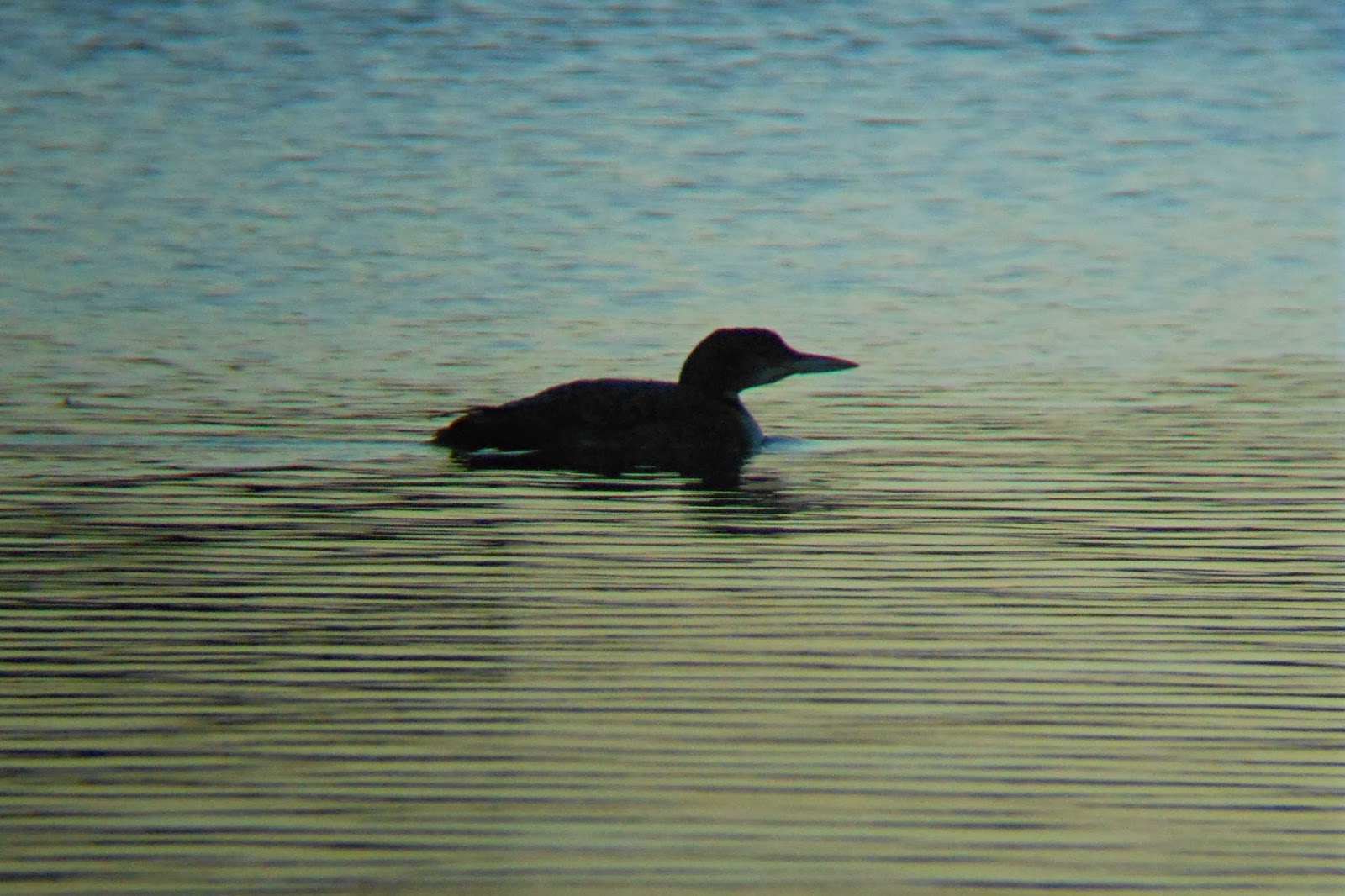
We spent some time scanning from near the end of the Breakwater, with PURPLE SANDPIPERS, Turnstones and even a Grey Seal giving up close and personal views immediately adjacent to us. 


2 SLAVONIAN GREBE were picked out on the far side of the Harbor which was the first grebe species of the day, and again, a good bird to find. With the Harbor being well covered, a lot of the birders in the group turned and scanned the sea, and we were quickly picking up the likes of Gannet, Fulmar, Razorbill, Guillemot as well as even more Divers!

All were Great Northern bar a single RED-THROATED DIVER, which flew in from the west and pitched down on the sea on the opposite side of the bay.

After we all had our fill of the excellent location, the walk back to the car started, being equally slow to the walk there.
Again we were treated to amazing views of Black-Throated and Great Northern Diver alongside the Black Guillemot.


 It was while watching this mix-match though that a smaller bird surfaced adjacent to them, which was easily recognizable as a RED-NECKED GREBE! Again, excellent views were had as it fed close by. It was somewhat bizarre to have seen the two rarest of the 'regular' British Grebes before either Little or Great-Crested!


We then took the short journey to a well known winter feeding station for CIRL BUNTING'S, where we had stunning views of this attractive farmland species as it fed on seed put out by birders to sustain them throughout the winter. A flock of 20 eventually came down to feed, and all at close range. The surrounding area produced Yellowhammer and 3 Chiffchaff before me and Jarad went off to scan the sea and Beach.


The beach was quiet, as it was covered in dog walkers, but just behind the surf we were treated to good views of 2 BLACK-NECKED GREBE as they fed in the very shallow water, at times being completely submerged by incoming waves. Further out in the bay, the 4th Grebe species of the day was picked out, as a large raft of 100+ Great-Crested Grebe was visible. A RED-THROATED DIVER was also offshore here, along with yet more Great-northern Divers!

With the afternoon drawing in, we decided to drive the short distance to Dawlish Warren to hopefully catch up with the wintering Bonaparte's Gull.
The walk out to the end of the Beach was long and hard, but we were entertained by Dark-Belled Brent Geese, a small flock of Common Scoter and 2 Great-Northern Diver. A pair of Stonechat were feeding on reeds on the Golf course.


We eventually got to a point which overlooked the Estuary, and we were treated to views of 10 RED-BREASTED MERGANSER as they fed on the incoming tide. The 3rd SLAVONIAN GREBE of the day was picked out distantly, as was a female Goldeneye. Small numbers of Little Egret, Dunlin, Reshank and Curlew were feeding in the shallows and a Ringed Plover flew past calling.


But one thing was obvious. There was an almost complete lack of Gulls, and it was only as the light began to fade that the large flocks in the distance started flying towards us. A single adult MEDITERRANEAN GULL landed on a sandbank, but unfortunately we were unable to locate the American interloper.
With the light fading, and a 3 hour car journey back we gave in as a rainstorm hit. As we walked along the Beach 15 Turnstone flew in, ending the day nicely.

A big thank-you to Vern for the offer for the Day, and to 'my' carload of birders for the banter. Twitching as a group certainly makes it much better! A great day, and a great start to the years birding!

MB

Thursday, 19 December 2013

Northerners, Yanks and Sibes

10/11/13
With news of a Penduline Tit in south wales, plans were arranged with Neil Duggan to head down there and see this stunning example of a male bird.

For those who would be interested, Neil has recently joined the local Blogsphere and can be found here, so therefore, if you want to read about my birding exploits a month before i get around to posting it, or want to follow the birding exploits of a fellow local birder, head over there!

As if by coincidence, Martyn Y (Formally of 'Adult Plumage', 'Regional Birding' and 'Blurred Birder' fame- So many in fact that i'm not even sure which ones which anymore!), Kay D (The Lover of Black Redstarts (Ochruros) ) and Richard P (Local Birding) were also heading down to Newport Wetlands.

While on the M5 though, we heard news of Great Grey Shrike in the Forest of Dean, and with Two-bar Crossbills reported the day before it was worth the effort! Being only a few miles off the M50 it was worth the effort, so with no news having come out from Newport, we took a diversion.

Arriving at Woorgreens was greeted with confusion.

Where do we go?

As we walked up to the somewhat picturesque Woorgreens Lake, i heard the familiar 'glipping' of Crossbills as a flock of 15 flew over. Sadly that proved the be the only view we had of Crossbills, and no-one else found any rarer ones either! 2 Wigeon were the only birds 'of note' on the pool. 

But anyway. To cut a long story short. We saw nothing. The Shrike did a bunk and didn't reappear for the rest of the day. We plodded around the Woorgreens/ Crabtree Hill area for a good couple of hours, but other than calling Brambling and Marsh Tit it was very quiet species wise.

Having contacted the other 'midland crew' down at Newport, it seemed as if the Penduline had done an overnight flit!
Not going to plan!

Right, what now? How about we cross the Estuary to Slimbridge WWT? Some nice birds around there, AND, if the Penduline was to be refound, we would be in a decent position to head down there via the Severn Bridge and the extortionate £6,20 toll charge!

As a lover of all things weird and wacky, my main priority was to get to the Rushy Pen to see the Purple Sandpiper. Within minutes of being on site we entered the Peng Observatory, and upon inquiring about the Sandpiper i was guided onto a wader at the back that looked suspiciously like a Redshank.........

So i then set about scanning the shorelines. Within a few minutes i came to the conclusion that it wasn't there!
At this point, i remembered reading on the site wardens Twitter that the bird was showing down to a few feet from the office buildings. Moving to the opposite side of the 'hide' i poked my head around the corner, and there is was! A mere 10ft away! Insane! A 1st winter PURPLE SANDPIPER!

Not being able to get my scope on the bird due to the somewhat awkward angle, i lifted my camera to my bins and took a few shots.


And its a good job i did! Very soon after, a brief chase form a coot pushed it out, further into the middle and it was then relentlessly hounded by Jackdaws until eventually, it just gave up and flew out towards the Estuary.
And that was it, gone. A far to brief sighting.

So then we walked to the Zeiss Hide, via the 'decoy' area. No Chiffchaffs were showing, so we moved on. A completely packed Zeiss hide were all looking out across the Teal flock. Of which there were a few.....


Yeah, a few in the 2000-3000 range!

And why was everyone looking? Its close new world cousin, a yank interloper was present among the ranks.

After some scanning, i eventually picked up the drake GREEN WINGED TEAL, its vertical white stripe making it stand out quite easily once you knew the basic area it was in. Sadly though, it was very inactive, no doubt well and truly knackered after its long haul across the Atlantic.


The birding from here was actually very good, as thousands of birds were present. Two GCP Common Cranes were wading in the shallows, which, as always, was an awe inspiring sight! However, the more interesting 'stuff' were the smaller birds, most particularly the waders!
Among the small flock of Dunlin we were informed a Little Stint was present, and after some time, a winter plumaged LITTLE STINT emerged from the flock and fed along the shallow waterline.


 Soon after, a winter plumaged SPOTTED REDSHANK was found, wading in deep water at the back of the flash, and, on occasions, swimming quite actively! A flock of Golden Plover flew over, with a small number of Black-tailed Godwit and 6 Ruff.
In the Reedbed, a Cetti's Warbler was showing superbly!

With news of a Great-nothern Diver just down the road, we started to leave, moving again via the 'decoy' area to look for Chiffchaffs. We met up with a searching birder and walked the boardwalk. At the end i became aware of a gathering of birder/photographers on the opposite side of the hedgeline looking towards us.
And it soon became apparent why, as a striking Chiffchaff popped out of the ivy at close range. And by striking i mean a smack in the face obvious SIBERIAN CHIFFCHAFF. Very white underparts with an almost pale grey/light brown back. Actually a very attractive bird!
If i needed any more convincing, the bird spent some time calling, sounding almost like a Bullfinch, and it was joined by a Common Chiffchaff, just further emphasizing how different it was!

Having bagged a good 'cast', we took the last minuite decision to check the Holden tower, where we quickly locacted the Dark-Bellied Brent Goose out on the Saltmarsh, and 23 Eurasian White-Fronted Goose.

So, with the light now fading fast, we decided to hot foot it down to Sharpness Docks, after a while of moving around, we eventually found ourselves at the SARA building, watching a stunnning GREAT-NORTHERN DIVER showing very well on the tiny pool adjacent to the old lifeboat station.


What a way to end the day!
MB