Showing posts with label Red Kite. Show all posts

Wednesday, 24 June 2015

March 2015- Alpine Swift, YBW & RND

A lot of uninspiring 'patchworking' of multiple sites was very similar to the latter of last month. A Little Grebe and Water Rail remained on Patch on 1st. 
It was brightened up with a very unexpected site first at Parkes Hall Reservoir on 4th though, when a drake Shelduck was present. Something I didn't expect at all while heading out for an evening walk!


The first highlight of the month came on 6th, when news emerged late evening of a Yellow-Browed Warbler at a sewage treatment works just outside Sedgeberrow, near Pershore. It was in county, so it wasn't too hard a decision to head over there the next morning. It didn't take long to get out first views. A really smart winter gem!
It seems as if these things are now yearly in Worcestershire, which is an anomaly compared to the track record of other midlands countys.

Cracking views were had as it initially used the barbed wire fence adjacent to the sewage beds as a launching post before dropping down to feed on the pans. As it warmed up, insects became more active, and the bird followed them out into the trees, and it spent the latter half of the visit feeding up higher in the trees.


It wasn't exactly far to Ashleworth Ham from here, and with the sporadic appearances of a drake Green winged Teal we gave it a go. Sadly no yank Teal, but a top class list of winter birds. A very good variety of dabbling ducks, and a very good flock of Common Gulls. It didn't take long for my curiosity of the Gull flock to materialize, and it took a matter of seconds to locate one of my targets, a Mediterranean Gull, a rather pretty 2w bird, but soon more Common Gulls flew in, and with them, an adult Mediterranean Gull, Nice!


A Red Kite flew low over, which added another unexpected bonus to the day.

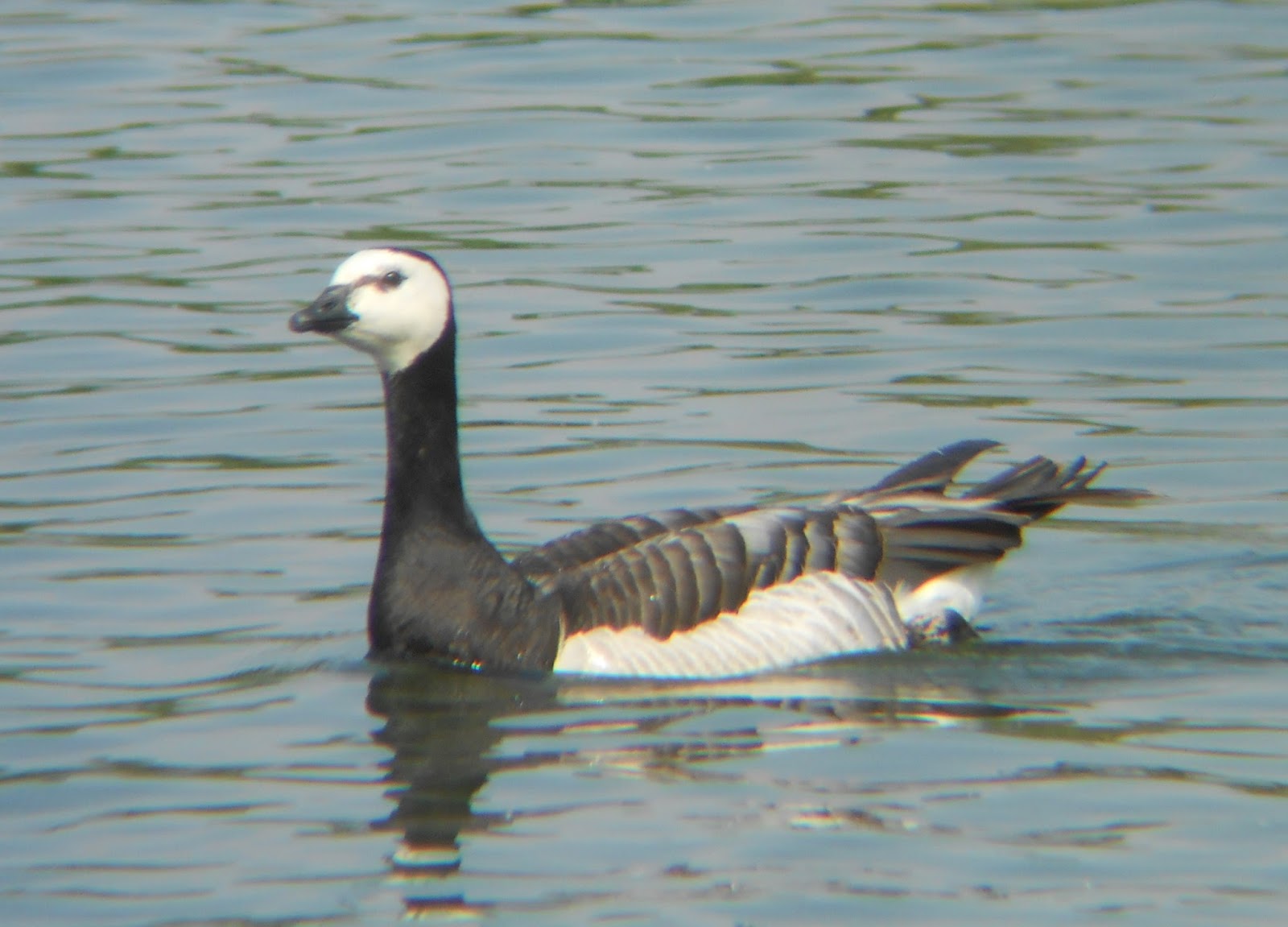
On the 8th,a Barnacle Goose joined a few Canada Geese on the patch. Interestingly, a bird also appeared around this time 2 years ago. Similarly, the both stuck around for some time, and this bird became a permanent fixture of the patch for a number of weeks.

Sometimes in birding you have surreal moments that you simply can't begin to comprehend what just happened, and the 9th March was one of those days. A fairly typical day, a number of lectures, and just a bit dull weather wise. Nothing in the slightest to get exited about right?

With lectures over, I was out into the courtyard and out of reflex the first thing I did was look to the skies, a couple of Feral Pigeon, typical... But as I glanced up, the unmistakable shape of a Swift rose up from behind the building opposite me!!
A Swift in March is always going to hit the 'PANIC' button, more so for the fact I didn't have my bins in hand and I couldn't see any sort of plumage details on it due to the white sky. It was merely a silhouette, but instantly it was obvious it was big and bulky. A few seconds, a couple of flaps, and it was across the top of the building and towards the Church/town centre.

Other than the certainty it was a Swift, which one?!?

Wanting to get people looking to the skies, a panicked tweet went out on my twitter and texts sent to all locals who may be in the area (including a number who were working in the office buildings around me!) in the hope it would be picked up/ people would run out of work.

Minutes of anxiety followed, I now had bins in hand and was scanning the skies, please tell me that wasn't it! As a gut feeling I knew it was an Alpine, but I just couldn't say it with that view.
A minute turned to 5 minutes, 5 turned into 30.

I was now standing around the opposite side of the church, facing towards the town, skies darkening by the minute. And then there it was, 35 minutes after I first saw it, a large Swift came cruising down the road below the height of the buildings, initially with its wings tilted showing its upperwing, then banking to show me its underside, with its huge white belly patch. ALPINE SWIFT! Absolute frigging MEGA! I watched it until it disappeared behind a building and I ran to get a better viewpoint, tweeting about its reappearance as I ran (hence the barely comprehensible message). The first birder arrived only 5-10 minutes after this, and as they arrived so did the rain. And  that was that. It disappeared. Did it roost before the rain? Did it push off ahead of the weather system? Who knows. I stuck around until after dark, and spent most of the next day looking, but nothing, the skies above Wolverhampton returning to the Feral Pigeons and F-15s.


With my enthusiasm levels up high, it didn't take much effort to wake up early on the 14th and get out on patch, and I was in for yet another treat. The Barnacle Goose was still around, but I was anxious to check the quarry, and it was a good job I was, because as I arrived I picked up two waders on the mud at the far end of the flood. RINGED PLOVERS!! Getting the scope on them, I then realised that there were infact 3 waders, a pair of Ringed Plover and a Dunlin! Absolutely mega patch birds! They fed on the mud for around 30 minutes, before taking flight, climbing high and flying off north. Exactly what I had been waiting for when the quarry flooded last autumn!


A late evening visit to Upton Warren that evening gave me a showy Redshank and a Green Sandpiper, the former being a species I don't see regularly at the site anymore.


The next morning (15th) I was out on patch again, and I again found a good number of decent patch birds, with the highlight being a drake Teal, which came off the 'Wigeon lake' at Blackstone. A Snipe also flew out from the edge of the pool and the Water Rail scurried along the edge of the willows. 2 Yellowhammer gave me a flyover and it was a 3 goose day, with Canada, Barnacle and a flyover flock of 3 Greylags.

On 17th, I journeyed over to Sandwell Valey RSPB to meet with a couple of Uni friends. A few hours of walking around Forge Mill and the RSPB area gave us a few nice birds. My First Little Ringed Plover of the year, a flock of 20 Barnacle Geese, 3 Parakeets and a Jack Snipe in the marsh.
Perhaps the most unusual addition being a Harris Hawk, which repeatedly flew over the RSPB area.

I have been watching Parkes Hall regularly, to not much reward, however on the 18th, a Red Kite flew south over Tenacre Fields. The first in the area for me!


After a fairly standard patch walk on 21st, and working in the afternoon, I was able to drop into Upton Warren flashes for the roost. All pretty standard stuff until late on when a superb adult summer Mediterranean Gull dropped into roost. What a looker!


With news having emerged that a drake Ring-Necked Duck had turned up at Priorslee Lake, Shropshire the previous day, we journeyed up there the next morning. News hadn't been released so we were going in blind but it was great to see on arrival that the bird was still present, and showing increasingly well as the morning progressed. Much better views compared to my previous (and only other) RND in the UK, a very distant bird on the Ouse Washes.


On our success we took a punt to go looking for a specific species, and a while later we were out searching. Not really hoping for much due to it getting towards mid morning it was somewhat shocking to find our targets within a few minutes of leaving the car, and we were soon getting crippling views of 3 Woodlarks, with a 4th singing off in the distance! You really couldn't have asked for much better, feeding in short grass right next to (and often on) a public footpath. Easily the best views I had managed of this species to date!


It then went quiet for a few days, visiting my usual local sites for not a huge reward. So instead I used the lull to practise some digiscoping skills, and this Chiffchaff obliged.


With the month coming to an end, and with migrants arriving, I journeyed over to Ryders Mere with a friend on 26th. Originally we had planned to drop into Stubbers Green but the Brent Geese had flown off, and following an uneventful stop, we carried on to the Mere. A good selection of birds were present but we knew out main target was on the marsh so we walked over there. It didn't take long before the female Garganey flew past us, and over the next hour we had a number of brief views. We walked to check elsewhere, but while doing so I saw a duck in the distance briefly which circled the Marsh. "Looked like a Mandarin" I thought to myself, but given the view it wasn't even worth calling.

We however walked back past the Marsh, and instantly there on the water was a drake Mandarin! Apparently only the 3rd site record and a couple of local patchworkers were soon on their way to twitch it! As we waited for them to arrive, the Garganey flew in, and swam about with the Mandarin for a while, before swimming off into the rushes. We stuck around until the first birder arrived, but as he approached, the Mandarin had flown. It seemed to drop down again in the distance, so following a brief search, the bird was refound on a 'puddle' at the north end of the site. Job done. Everyone was happy.

I was back in the home county on the 28th and again it was time for a roost session at Upton Warren. Again quiet until another Mediterranean Gull, this time a 2s dropped in to roost. Equally as stunning as the adult the previous weekend. Those primarys are just... Wow!


The last birding day of the month was spent on patch, and my effort was rewarded with a very good view of a female Merlin, which barrelled through the Quarry as I was unsuccessfully trying to find a few waders. I wonder why with this bundle of anger and feathers bombing around. Needless, a very good patch bird, and I left the patch very happy that day.

MB

Wednesday, 21 January 2015

The long awaited catch up!

So, with my coursework having been completed within the last hour, and with only the two exams worth of revision to go, I think it is about time I should start writing again...
Right.
 
So, back to October we go.
 
26/10/14
Having had such a good time on the last RSPB fieldtrip, it perhaps wasn't too hard of a decision to join them again for their trip over to Titchwell RSPB. Who would complain at that.
 
On the way over as we drove past Guyhirn, I managed to pick up 2 of the Cranes that had been resident in the area for some time. Another birder beside me saw a further 8 standing in the field, however they were distant and the views weren't great from the moving coach.
 
Arriving at Titchwell I did exactly as I was hoping to do, and walked straight out to the beach to do some seawatching, and I was greeted with the rather joyous sight of a large numbers of others with the same idea. If a Skua went past today I was going to see it!
 
Immediately obvious was the large number of Gulls, and among them were a single adult Mediterranean and 8 Kittiwakes. A flock of Common Scoter were bobbing about on the troughs but the first highlight came as I saw a lone Scoter flying in from the east. Head on initially, it moved parallel to the beach revealing bring white secondarys. I was soon shouting a drake Velvet Scoter was going past! Luckily, there were a number of boats of varying colours offshore, so getting the crowd (particularly the ones sitting adjacent to me!) onto the bird was straightforward.
 
Next up was another self find. A small Grebe popped up in the breakers close inshore to the beach further west than the viewpoint, but being strikingly black and white It was obviously one of the 'rarer' small Grebes. Considering I have little field experience with 'Slav', it was immediately obvious as a winter plumaged Slavonian Grebe due to structure. The entire crowd got onto the bird and it continued to show for much of the afternoon and made for the best bird of the day.
Among the regulars (Gannet, Red-Throated Diver, GC Grebe, and both Guillemot and Razorbill) we also picked out a female Red-breasted Merganser on the water fairly close in, and a further 4 flew past, going west.
 
With no Skuas I moved back onto the reserve for the Gull roost. The usual assembley of waders was present, and 6 Marsh Harriers were buzzing the reedbed. It was here I also caught up with an old friend, as the same female Stonechat that got me onto the Penduline Tit on my last visit was feeding in the same area of reedmace. Sadly, no Penduline today though. Scrutiny of the increasing gull flock produced 2 Yellow-legged Gulls before I had to head back to the coach.


1/11/14
 
I had visited Steart Marshes WWT just a week previously in the hope of catching up with the juvenile Pallid Harrier, having dipped, we returned on the first day of November, but again our luck was out. A good showing of Raptors (Buzzard, 1 Sprawk, 7 Kestrel, 3 Peregrine) was highlighted by 2 Merlin, including a great view of a female as we arrived, which barrelled fairly low over our heads.
 
 
With the bird having not shown again, we moved around the Huntspill Sluice. As we neared Bridgewater we heard the unthinkable.. The Pallid had just shown again (Insert relevant word of choice). Being stuck in traffic we couldn't go anywhere and carried on in the hope it would be viewable from the opposite side of the Parrett River. It wasn't, and we dipped it again. At least 1 female Red-breasted Merganser was feeding in the shallows, which gave slight compensation for the dip. It was from here while scanning for a ochre coloured bird of prey a superb sight of 3 Merlin chasing each other took place low over the saltmarsh. A good count of Avocets were also viewable form here, with 296 being visible among the huge swirling flocks of other estuarine waders.
 
 
Any other day without having dipped a Pallid Harrier and this would have been a good day!
 
2/11/14
 
That annoyance from dipping was relieved somewhat where a standard patch thrash led to the chance discovery of a female BLACK REDSTART! Standing scanning the Lapwings and Gulls within the now flooded quarry, I neglected to look on the small patch of ground adjacent to the hedgeline behind me. Having counted the Lapwing (32) and scanned through the Gulls to little avail, I turned around to see a bird flick up onto the top of a hawthorn in the hedgeline.
 
Getting my bins onto the bird which was only around 50ft away I was slightly perplexed to begin. It was head on, and just a slightly silhouetted greyish brown thing. There just wasn't any marks in this view, but it soon moved slightly, and I saw the quivering red tail!
 
I span to get my scope on it, aimed it at the bird, and just as I got it into focus it flew up, across the quarry, hesitantly at first, but it kept going.... And going..... And going. I kept on it until it was nothing more than a speck, when it suddenly dived down in the vicinity of Burlish Top. I spent the next 3 hours plodding around Burlish, Burlish Top, Moult Plesent etc, but I failed to refind this incredibly brief first for the patch.
 
Presumably this was the bird which then was found on the other side of the golf course a week or so after on the WFC Building.
 
6/11/14
A Uni fieldtrip led us across Wales to Aberystwyth, and we stopped at a number of sites on the way over. One of these was the Bwlch Nant yr Arian Red Kite feeding Centre, where we had excellent views of around 200 Kites. A female Goosander on the pool was also a nice surprise.


Moving onto Aberystwyth for the Starling roost, we stood near the pier and watched the aggregation grow, which despite not being the biggest Starling roost I have ever seen was still fairly spectacular.
 
 
As you would expect though, as we stood, I began to notice large numbers of Gulls roosting offshore, and being the fanatic I am, I just had to go through them. My efforts were rewarded when I picked up an adult Mediterranean Gull fly in from the south and drop onto the water in front of us. Nice!
 
The weather the next day was little short of vile, heavy rain and strong winds. A Rock Pipit pottered along the beach, and I had a flight view of what was probably one of the 5 Black Redstarts in the area as it flicked off the old college building and onto the castle.
 
MB

Wednesday, 25 June 2014

Dotterel, Partridges, Grouse, Flycatcatchers and a bit of Med.

18/04/14
It was late on the evening of 13th that news emerged that a large flock of some stunning passage waders had dropped onto a regular stop-off on the Long Mynd, and sensing my angst to get up there, Liz, Rob and Luke came to my rescue, and within an hour, plans were arranged for a dawn journey up onto the stunning Shropshire hills.
 
Unfortunately, I usually miss Dotterel passage, but this year the birds arrived on a day I was able to drop everything.
 
Following a bit of driving around, we soon located a suitable looking field up on one of the peaks of the Mynd, just down the road from Pole cottage, and even from a distance, a couple of birders could be seen.
 
We were soon informed that the entire flock of DOTTEREL were still present! All 12 of them!
 
Even though the light was poor, we had amazing views of the birds as they trotted around the sheep grazing field. Of the flock, 8 were males/ winter plumaged birds, but the remaining 4 were all stunning summer plumaged females, truly stunning birds,
 the mixture of slate grey contrasting strongly to that vivid orange belly and bright white face and breast markings!


Soon however, the sun started to come out, and the light improved, showing just how stunningly beautiful these high plateau breeding waders are!


Even from early on, it was clear the birds had migration on the mind, being very flighty, taking off and circling, sometimes up to a great height, calling , but always eventually dropping down, often giving binocular filling views as they flew past the ever growing crowd.


While watching the Dotterel flock, a few raspy clucking calls from behind us in the heather gave us prior warning to a short fly past of a pair of RED GROUSE before they dropped back down into the undergrowth, and no doubt then going off scuttling away along the ridge.

 With the crowd now growing  rapidly, we moved on to another site in the hills, where we managed to find a nice and early male PIED FLYCATCHER, singing his heart out from adjacent to his chosen patch of trees.


In the distance, a spiral of soaring Raptors guided us onto a loose 'flock' of 4 Red Kite, 2 Raven and 8 Buzzard, not at all a bad combination!
 
Our last check of the Shropshire hills led us onto the Stiperstones, where we managed to 'connect' with even more summer migrants, with both Tree Pipit and Redstart singing. The heather held a few Stonechats, and 2 Red Grouse gave stunning views as they flew past us and over the ridge and the adjacent valley proved superb hunting grounds for another 2 Red Kites.
 
Moving onwards again, we moved to Venus Pool, where a long staying Mediterrenean Gull was showing on the water, a rather poorly marked 1st winter bird, but it gave good views in both flight and on the water. A single Little ringed Plover was scuttling around one of the islands and a late male Pochard was on the water.
 
 
With the pool being generally quiet however, we decided to walk around, down to the river and back. In doing so, a male Yellow Wagtail flew over our head calling.
 
On our walk around some nearby fields, a pair of GREY PARTRIDGE flushed out of the set aside ahead of us, before flying off and landing on the set aside on the opposite side of the field. It was great to see this species in particular, as it is one I do not regularly see at all!
 
As it was on the way back, it would have been rude to not drop into Chelmarsh, and we were rewarded with a singing Lesser Whitethroat, which was showing in the hedge adjacent to the parked car. 2 Whitethroat were also showing here which added to the passerine interest of the day. The reservoir had low water levels, and 4 Common Sandpipers were wading the edges. A surprise female Goosander was also roosting on the water.
 
 
Following on from a great days birding, we split our ways, but we were all reunited as soon as a few hours later, when we turned up to Upton Warren to try to see the reported Savi's warbler.
 
A couple of hours later, a few singing Sedge, Reed and a single reeling Grasshopper Warbler was all we had to show, but the banter was brilliant and ended a great day perfectly.
 
MB


Wednesday, 19 February 2014

#The Midlanders are coming! (Yet again!)

25/01/14
The opening month of the year is always an exiting one for me! And it was with great excitement when 3 of the 'crew' from our last #TheMidlandersAreComing expedition exchanged plans to thrash the North Norfolk coastline. Any birders dream!
 
So, around 4am, the journey started from deepest Worcestershire, and having met the other 2 of our crew, Gert, Neil, Mike and me started burning up some rubber eastwards!
 
Our first destination was one of Royal stature, as we pulled into the small, country roads of the Sandringham Estate. Needless to say, the shady atmosphere was on heightened by a number of cars being parked at awkward angles on the verges and the regular slow drive pasts of a number of similarly shady looking vehicles, with many occupants gazing anxiously down the roads.
Our reasoning for being there on those country roads, surrounded on all sides by large rhododendrons was perhaps no less shady. We were in search of a glimpse of the gaudy Golden Pheasants which inhabit the area.
Having sat in the car for 30 minuites, the sun now up high in the sky, and with no sign of anything 'Golden' we decided to leave, as, if i am honest, the sight of lines of non-native hedgerow were boring us.
So we drove up to the coastal 'resort' town of Hunstanton, where there was significantly more in the way of wildlife!
Our arrival was greeted by thick fog, but from the car we spied 2 Dark-bellied Brent Goose on the beach, as well as Redshank and Bar-Tailed Godwit.Having found a suitable parking spot however, we walked the promenade north, where we were greeted by the presence of a stunning flock of around 150 Dark-belled Brent Goose, with their evocative call piercing through the fog!


From the far north end of the Promenade, we quickly found at least 5 Fulmar on and around the cliffs, but we quickly became distracted when the fog started to lift by the sea. Around 30 Bar-tailed Godwit were feeding at various points along the tideline, as were numerous Sanderling, Redshank, Oystercatcher and Turnstone. A single Ringed Plover flew past, and Dunlins were also moving through.
 
With the fog having now, we were able to scan the sea, and soon our list of ' desirble' birds was increasing. 20 RED-BREASTED MERGANSER were feeding offshore, as were a few Great-crested grebes. Good numbers of Teal and Wigeon were flying past distantly, and these included 4 Shoveler, a single Goosander and oddly, 2 Mute Swans! Certainly the latter i was not expecting on a seawatch!
 
Next up, it was further north east along the famous coast road. Holme Dunes.
 
On the pool immediately opposite the car park a Greenshank was feeding, a species i have never previously caught up with in January! The pool also hosted healthy numbers of Little Egrets, Redshank and a couple if Bar-tailed Godwits, with more on the tideline. A wisp of 4 Snipe flew over us and our first Grey Plovers of the day were feeding from the wet sand.
 
 
Hundreds of ducks and geese were feeding in the fields behind the beach, mostly comprising of Wigeon and Teal. The Greylag flock held a single Pink-footed goose, but my main highlight was getting decent views of at least 3 MARSH HARRIER, including one pristine, stunning male! In my opinion, Marsh Harrier are one of the best breeding birds we have in Britain, and i still always get that moment of excitement when i pan onto one!
Bring on the day they're breeding in the midlands!

A single Buzzard, Sparrowhawk and a fly through Peregrine completed the bird of prey list for the site!

Next it was onto the site of our first twitch. Burnham Ovary, where a certain Buzzard was currently in residence. It felt somewhat blasphemous driving past Titchwell RSPB without stopping, but our plan was to take shape!

Our scanning for Buzzards was fruitless, with only 4 Commons seen, but it was more than made up for by 2 stunning RED KITE which drifted in and hunted over 'Gun hill'. In common with the aforemented Harrier, Red Kite must go down as one of the most graceful birds to watch, gracefully swaying its tail from side to side to adjust its trajectory as it sweeps low over open fields, and this time having a backdrop of the North Sea!
 
 A single Barnacle Goose was feeding in the fields, as was a large flock of Brent goose,but with time wearing away, and with their being no sign of our main target, we took a unanimous decision to head inland.
Why?
A long staying party of PARROT CROSSBILLS have taken up residence in a wood just on the edge of Holt country park. However, before we had gotten to far from Burnham we drove past Holkham, where we managed to 'tick' Egyptian Goose for the day without even slowing the car!
 
 With some excellent map reading skills from Mike, we arrived at the location of Edgefield woods without any problem!
 
A short walk later and a small crowd appeared staring into the tops of pine tree's. It took a matter of a few seconds to realise where the birds were, and soon after, we were all getting decent, if often obstructed views of 4 PARROT CROSSBILL as they fed in the tops of the tree's


 They really were quite a pain to get a decent view of! Looking almost vertically to see a bird jump from one branch to another! Occasionally however, the birds would appear in the open, showing off their massive bulk, which, even though there were non for direct comparison obviously dwarfed Common Crossbill (2 flew over calling)


Having all been satisfied with this life tick, and having got decent views, it was time to head off again. We had to pay homage to the Norfolk birding gods.

Titchwell here we come!
We rushed straight to the beach, which was sadly looking very different to the last time i was here! The recent tidal surge had all but destroyed the dunes, so much so that it is not an exaggeration to say there were non! The power of the sea!

Luckilly however, the surge did not damage the main reserve, unlike the fate of many other reserves along the coast.
 
The sea was practically dead. Around 100 Common Scoter could be seen offshore, and 30 Goldeneye in nice and close, but otherwhys it was painfully hard going.
 
We started walking back towards the Parrinder hide, birding as we went, and the birding soon picked up! A good selection of waders were present, including Oystercatcher, Avocet, Grey Plover, Golden Plover, Lapwing, Sanderling, Turnstone, Dunlin, Redshank, Black and Bar-tailed Godwits, Curlews and a very good sized flock of Ruff (28!). A single Knot joined the Lapwings on the freshmarsh briefly, but nothing could prepare us for the next 10 minutes.
 
We were guided onto a female SCAUP, and soon after one of our group picked out a nice 1st winter MEDITERRANEAN GULL on the islands.
 
 
Marsh Harriers were circling over the reedbed looking back towards the south, when all of a sudden, the hide was lashed by horizontal rain!


In the distance, a huge flock of around 6000 Pink-footed Goose battled past as the storm grew ever worse, and it was only a few seconds before the first lightening bolt struck the floor, illuminating 9 roosting Marsh Harriers as they were spooked from the reedbed.
 
It was surreal to be watching these gorgeous Raptors battling against the wind and rain, and to often share the same field of view as a lightening bolt striking the floor, a memory that I'm sure will stay with me for a long time! Absolutely amazing!
 
However, just as quick as it arrived, the storm had moved east, and we were again treated to gorgeous clear weather, and a stunning sunset.
 
 
Stunning isn't it,
 Look at those stripes on that hat!
 
If you would prefer a version without the addition of a 'Suited birder', see the additional option below.

 
But no!
 
It didn't end there, we moved down the track slightly, to where the reedbed joins the path, and we stopped and scanned. And its a good job we did, as soon after, our model from the above photo was calling out the presence of a stunning ringtail HEN HARRIER! In the fading light, its pale rump patch stood out like a beacon, and as we watching this gorgeous, rare, and sadly persecuted bird of prey, a BARN OWL flew across and started hunting in the same field of view!
 
This is what Norfolk is about folks!
 
What a way to end the day!
 
With the sun now set, a cheeky Suffolk cider in a nearby Thornham pub finished the day off nicely. 98 species, great company, and great location. That's what birding is about!
MB

Thursday, 3 October 2013

Patch Migrants

11/08/13
A momentous discovery in patch terms, i was very happy to find an adult SPOTTED FLYCATCHER flycatching off one of the hedges wedged between Lickhill and the riverside fields, a likely location for migrants on patch. I enjoyed a good period watching it, being my first patch SpotFly for around 5 years! The last record being of a juvenile around the same time of year.


However, been stationary at this one spot paid extra dividends when not long after the discovery of the Flycatcher i spotted a large raptor flying up from the south, towards me. As it got closer the long winged look got me immediately interested, and as it circled to the right flicked its wing up, revealing a long and forked tail.

RED KITE!

Not the patch rarity that is SpotFly, but a great bird to see, and one i always love to see on patch, usually on a yearly basis. I got a few minutes viewing before it circled off, and flew back south.


It was also great to catch up with a stunning singing Marsh Tit at a regular patch area, and i managed to get some stunning views as it fed around the Willows.


 15 Mandarins were still present along the river, of which 7 were drakes of varying ages (Juvenile males can be separated from females).

(One of the juvenile drake Mandarin Ducks)

 An impressive 25+ Chiffchaff were counted, but only 2 Willow Warbler and a single Whitethroat.
MB

Saturday, 27 July 2013

Some fill in's

18/06/13
A trip down to the Capital to the London Natural History Museum had a spot of birding as we headed down the motorway. 30 Red Kite were counted as we drove through the Chilterns, with the first 3 being found hunting Oxford services, including one bird which was perched up on a Motorway-side lampost. On the return journey, a single Hobby was also seen at the very same services, with another about 15 minuites further up the motorway.

19/06./13
While visiting my 'secret woodland site' i recieved news of two 'mega' birds at Sheepwash. Wanting to get over there, we quickly left the site, catching a series of busses and lots of walking. The main highlight was this stunning wader which was perched on the rocks within the pumphouse pool, showing very well.
Oystercatcher is always a stunning bird!


The other two birds were a pair of BARNACLE GOOSE, which were associating with the Canada Geese. Always a nice bird to see, the fact they were present within June is simply irrelevent.


26/06/13
Again, for the protection of potential breeding birds i have to hold back the site location for the following day.
After meeting someone on site i was told the news that a BARN OWL had been showing the previous night, and so therefore, i stuck around untill dusk to try to locate it. Without much effort, at 9pm out flew a BARN OWL, which continued to show for an hour or so following, including once dropping into tree's to perch.


Superb flight views were had as it flew around the field.


27/06/13
A nice patch visit was highlighted by the two drake Mandarin Duck which are currently moulting along a stretch of the river, they often give stunning views as usual with the patch Mandarins.


In other bird news, the first returning Common Sandpiper of the year was showing, as was a single Grey Wagtail and Kingfisher. An escappe Zebra Finch was also found feeding adjacent to the quarry with the  Greenfinches.


28/06/13
3 Mandarin, the two eclipse drake and a female were showing on the river.
MB

MB

Friday, 12 July 2013

Post holiday birding

1/06/13
Well, it must be said that the birding started immediately upon our arrival back in Worcestershire. News came through of a GREAT-WHITE EGRET at Upton Warren, so, after a few hours rest, and with continued presence of the bird we decided to go for it, having dipped the last Upton GWE in spectacular fashion.

Arriving at the Sailing Pool, we were informed that the bird was still present, but could be elusive tucked up in the corner of the 3rd flash.

To cut a long story short, we eventually saw the bird as it emerged fully from the reeds, but was always obscured by the bank between the two flashes, but we had decent views of the bird.


The reason for the bird being so elusive? Every second it was in the open it was mobbed by breeding BHG, and it was harassed until it moved back into cover.
A 'Great' grip back!

7/06/13
Heading out onto patch was fairly rewarding. My own personal highlight being a family party of Willow Warbler, which were found being fed by its parent's, calling loudly. In total, the 2 parents were feeding 6 young, by the looks of it, very recently out of the nest!
With the ongoing northwards shift in Willow Warblers range, it makes occurrences like this more and more unusual.


A single Mandarin was found on the river, and the 2 Lapwings continued to frequent the quarry.

8/06/13
A quick drop into Upton Warren again.
The reason?
A stunning 1st winter LITTLE GULL had been found, and we enjoyed good flight views of this minute Gull from the West side, where it was hawking over the pool for insects. I have a particular fondness towards that black 'W' pattern on its upperwing, and i always find it a pleasure to have a study of this maritine Gulls plumage, always having ever so slight differences between individuals.


Later the same day, at the Gardening job in Earlswood, we heard a Cuckoo singing from the Garden, which proved a nice distraction from the somewhat tedious work, but it was only when leaving did i pick up the best bird. While driving near Earlswood train station, a stunning RED KITE flew over the road, and we stopped and watched the bird as it slowly circled higher and higher until eventually being lost to view.

I find it somewhat humorous, that every year for the last 5 years, i have seen a Red kite back in the midlands the weekend after returning from our Welsh holiday, maybe they just follow us back?


MB