Showing posts with label Golden Plover. Show all posts

Wednesday, 26 November 2014

Birding the Beacon- Autumn 2014

As I'm sure many local birders would now be aware, I have attained somewhat of a bug for birding Sedgley Beacon.

There are many reasons for it, but the main one being that it has became clearly obvious that the Beacon is a regular stopover for migrating thrushes, and during the correct winds, can result in some rather spectacular vismig.

Perhaps the most significant 'discovery' has been the string of Ring Ouzels I managed to find. Through the autumn, I managed to connect with 4 of these scarce migrant Thrushes,  3 adults and a juvenile as they paused (however briefly) on the hill. The first day of October brought the first two, combined with a fair bit of vismig, as both a male and a female stopped briefly within the Hawthorn valley on the NW side of the hill. Both of the birds were picked up in flight as they dropped down calling, their harsh chacking call being very distinctive. It was by call that both the birds on the 15/10 were also picked out, but the SW winds on this day revealed a significant movement of Thrushes, with about 2500 (of various species) noted by me flying over in the morning. Further watching by another observer later in the day added another 1500 birds, so the passage was certainty sustained throughout the day (and the night by the sounds of hundreds of migrating Redwings flying over my house). The first bird dropped into the NW valley to feed, as did many of the Thrushes it was migrating with, but the juvenile flew very low along the entire length of the hill (just above head height!) before dropping into bushes below the masts.

I'm sure more regular watching over the coming years could lead to more records as I'm pretty sure it must be a regular stop over site for the species!

Female Ring Ouzel- Despite being a poor photo, note the very pale wings and if zoomed in, the pale edging to the belly feathers.

As already mentioned, I also logged all the regular thrush species, and often in good numbers, with the 15th proving to be by far the best day!

Vismig was regular, and included my first Golden Plover for the site (15/10) and regular movements of Meadow Pipit and Wagtails. This included 2 Tree Pipit (3/09),11 Grey Wagtail (1/10) and the first real 'finch push' of the year, with 70c Chaffinch, 2 Brambling, 40 Linnet, 2 Redpoll sp and 5 Siskin going over on a 9 'finch species day' (15/10). A single Hobby gave stunning views on 1/10 as it migrated at eye height over the plateau of the hill at about 30ft range. As you can imagine, leading to some rather stunning views as it glanced at me as it barreled past.

Tree Pipit (Trust me!)

Away from vismig, there was also a good number of Passerines, with Redstarts present on 3/09 (x2) and 15/09 (1) with a Spotted Flycatcher also present on the latter date (And another nearby but off the Hill) 


Redstarts

A pair of Stonechat appeared on the 15/10, giving great views from my vismig point.


Male Stonechat

Combined with decent movements of regular species, it often led to some very enjoyable birding, so rest assured, I will continue birding the site!
MB

Friday, 16 May 2014

The Mega Geese and the Hood

6/04/14
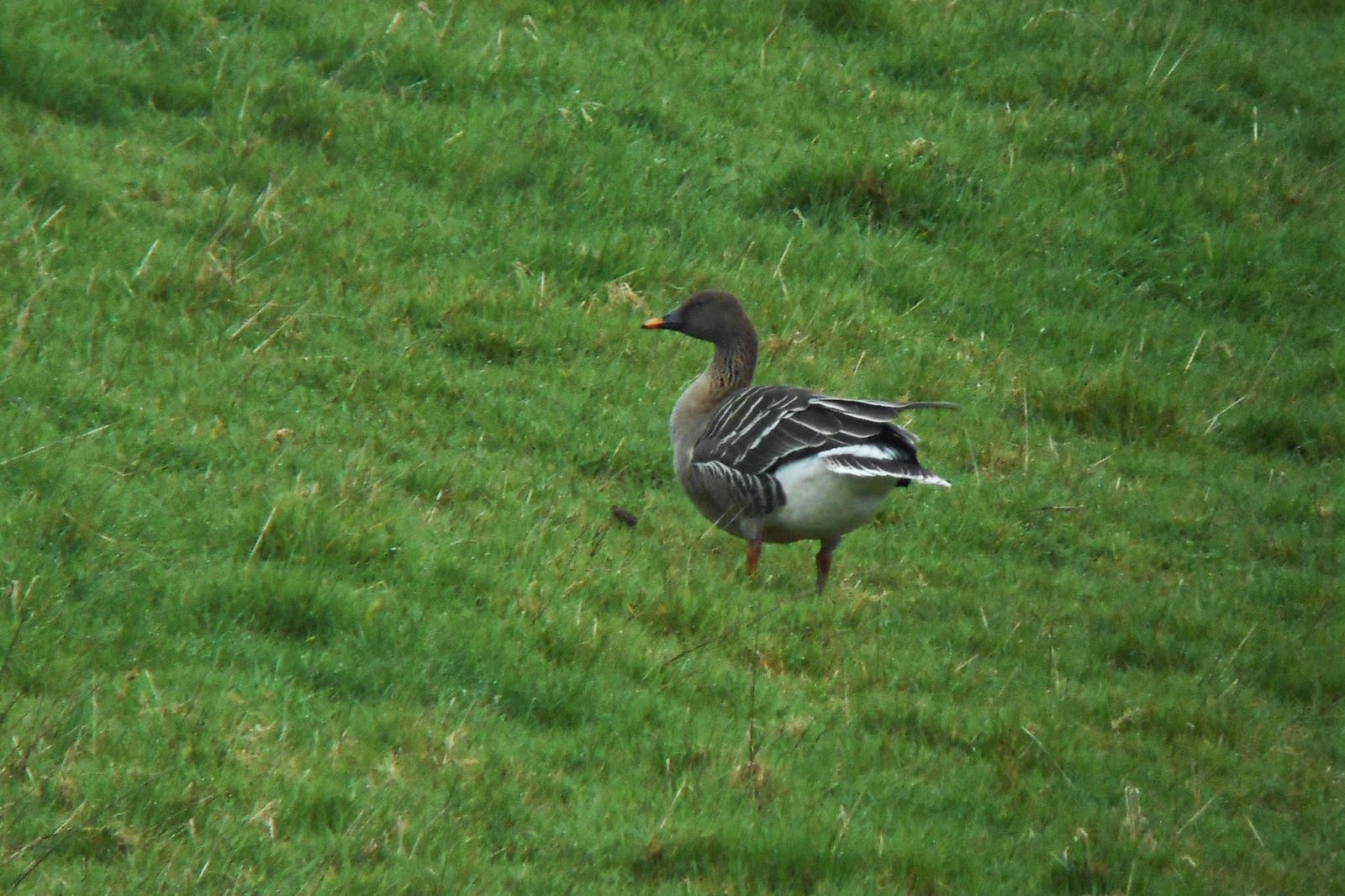
Taiga Bean Goose is a true mega.

Records in the midlands are so rare that even some 'true' national rarities have occurred on more occasions in our humble 4 counties, so therefore it was quite gutting to hear that the two 'Bean Goose at Kemerton' were late on in the day confirmed as both of the Taiga race!

I had not gone to see them as a Bean Goose is an irregular, but not unexpected discovery, that is in its usual 'Tundra' form, as birds can get latched onto Greylag flocks and hang around the region (such as the long staying Chelmarsh bird) or with the wintering White-fronts at Slimbridge.

With it now being to late to 'respond' to the news, it would just have to wait, and they left.

Luckily however, they didn't move far, and soon relocated to Slimbridge, where, while away in Cambridge with the Worcester crew, me and Neil made arrangements to drop in the next morning, with the added bonus of a rather smart looking adult Hooded Crow.

The great thing about being a WWT member is the ability for early access, and we chose to exploit that today, so, following a brief foray onto the patch to see the Mandarins (5) and Goosanders (2), we set off south.

It was great to see the car park and Holden Tower as empty as it was, as I'm sure many of you who bird Slimbridge can tell you, it gets rather scrum like up there later in the day.

Luckily, 4 birders had the hide to ourselves, and the small flock of Greylag the TAIGA BEAN GEESE had chosen to associate with were feeding remarkably close to the hide, giving rather stunning views of this rare race.
For an hour, we were treated to great views as they grazed close to the hide, before dozing off to sleep. While watching these, a flock of 14 Golden Plover dropped onto the Dumbles in heavy rain.

With the first people starting to arrive, we chose to head off to search for our other target.


Following some time in the rather aptly named hide, and still remaining Hooded Crow-less, we moved back around to the Zeiss hide for a wider view, and and soon after, Neil was shouting out that he had it!

It was showing in the field right next to the hide we were just in!
Following distant views, and getting the two birders we had been watching the Bean Geese earlier with onto the bird, we made the quick exit to hopefully reach the hide to get a good view. We got to the hide and it had gone!

A very showy Cetti's warbler kept me interested however in the Crows absence, which contrary to the rule, chose to sing from an exposed perch right outside the hide! To further emphasise the coming spring shown by out trip out east the day before , my first Swallow of the year hawked around outside the hide, always adding that glimmer of excitement as you remember late nights and Hirundines hawking above your head!

While watching that subtle brown warbler bird yell out its ear shatteringly loud song, the call went up the Crow was back, and soon after I was watching a rather snazzy looking HOODED CROW, the northern and western subspecies/Full species/ race or whatever you want to think it as.

No matter what its genetics tell us, this is a really smart bird! Infact I had forgotten just how good looking since I last saw them in Turkey!


All too briefly, and the bird flew back up into the Rookery, and with limited time, we ran away, happy at our outstanding success.

Not bad for a few hours birding on a Sunday morning!

MB

Thursday, 3 April 2014

Waders, Geese and a Bluetail!


19/02/14
Slimbridge has been hosting huge numbers of waterbirds throughout the winter, particularly waders, and it was due to this that i decided a trip down was in order!

Immediately obvious, even from the car park was the huge flock of around 2000 Golden Plover which were feeding and flying around the Tack piece. With the early morning sun behind us, it was a pleasure to sit and watch the numerous waders, ducks and Swans scattered across the flooded meadow.


Moving onto the Holden tower, everything started to happen at once. The White-Fronted Goose flock was unfortunately not playing ball, and had decided to feed along the seawall to the north, and was unviewable.

So, i concentrated on scanning the hundreds of Dunlin looking for a scarce wintering bird. At least 800 were scattered across the flooded Dumbles, no doubt still exploiting the food rich soils that had been deposited by the very high tides on many occasions throughout the year. With some scanning, i picked up one of the LITTLE STINTS feeding way out on the Dumbles, but it soon flushed with every other bird, and once they resettled, it (or another) was re-located! Feeding on the pool in front of the hide!

I always enjoy this stunning tiny wading bird, their restless activity and subtle beauty in winter, and indeed every plumage is just irresistible. I am always amazed when these stunners stay to winter in the UK, as they really should be in southern Europe/ Africa at this time of year!
Against this Lapwing, you can clearly see just how small these birds are, tiny little gems, and one which always brightens up a day!


But it was soon back to scanning Geese, and while scanning the Barnacle goose flock which had been pushed up onto the Dumbles by the tide the Dark-Belled Brent Goose appeared. Sadly however, my first 'decent' view of it over the winter revealed that its wing was really not in good shape, and the bird was constantly dragging it behind and along the floor. A sad fate for any migratory bird, but luckily for it, there aren't too many places too much better for Geese to reside than at Slimbridge.
Somehow i can't see this bird leaving, so you would presume that this bird will become a permanent fixture of the feral Barnacle Goose flock.


Meanwhile, the White-Fronts flew up, and flew slightly further out onto the Dumbles to allow some viewing. A short while later, and i picked up the TUNDRA BEAN GOOSE as it happily fed alongside its Russian friends.
Now, i understand i may have caused some controversy by agreeing with the Slimbridge wardens about this bird being a Bean Goose, but out in the field, it really did look convincing as one, despite its smaller than average size (but which still fits within variation of the species). The 'worrying' features mentioned by some were not obvious like they were in some photos that seemed to suggest characteristics of a hybrid origin.


Scoping from the Holden revealed a singe Avocet roosting on the Top new piece, and also rather surprisingly a flock of 37 Grey Heron perched out on the estuary edge where the Little Egrets usually perch, which, upon enquiring, i was informed was a new record for the site!


With the superb Siberian gem still present in the beautiful Shire valley not much further to the south, it would have been rude not to have visited for seconds!

And a short while after, we were again watching the stunning 1st winter male RED-FLANKED BLUETAIL, and luckily, in much more enjoyable circumstances. A small gathering of around 10 birders/ Photographers, and a Bluetail playing hide and seek in a Hawthorn in the sun!
What is not to love!

With the obviously more relaxed surroundings, the bird often would perch up regularly for long periods of time, a massive contrast to it being constantly harassed and pushed around the first time i saw it. It really gave me the chance to admire its beauty as it commuted from 'its' Hawthorn and the ground where mealworms had being placed.

Do i need say any more?


MB

Thursday, 6 February 2014

Birding and Guitars

3/01/14
Finding myself in Edgbaston  to pick up my new guitar, it would have been rude not to drive the couple of miles up the road to admire the Great-Northern Diver that had (Somewhat ridiculously) taken up temporary residence on the Swan Pool in Sandwell valley!
So, with my Les Paul Studio sitting on the back seat, it was a short drive through the back streets of Edgbaston and Smethwick to our destination. A quick walk out to the lake edge and the GREAT-NORTHERN DIVER was showing on the far side of the pool.

Having seen around 40 the previous day, i chose not to walk around to the other side to get a closer look, and after a short time, decided to cross the road to Forge Mill Lake. Sadly, the amazingly close views of the previous day, and with them seeming almost 'common' i was left somewhat with a glazed look in my eyes. Around 20 Goosander were feeding there, as were very good numbers of Pochard. Moving around the the partially rebuilt RSPB center, i looked over the feeders, and soon found my main target. WILLOW TIT.

Sadly, this is a species that has all but disappeared from my home county, and it is hard to believe that i once had both Willow Tit and Tree Sparrow visiting my garden! Within a few seconds through, the bird had flicked onto the feeder, collected its seed and flew off to eat/stash it away somewhere, and i didn't see it again.

Somewhere nearby, i found myself watching a party of RING-NECKED PARAKEETS, as they flew around calling, and eventually settling on tree's in someones back garden, where i was able to scope them through a hedgeline, 2 metal fences and across a school playing field! Thankfully, being the school holidays, there were no issues with doing so!


4/01/14
Having such a great start to the year was made even better when Neil Duggan offered me a day out, collecting a local rarity and then heading down to Slimbridge for their spectacular wintering flocks!

The TWO-BARRED CROSSBILLS were being as elusive as ever, but were tracked down in a stand of pines as they called incessantly for a while before flying out and disappearing altogether! As i had hoped,the Two-Bars became my 100th species for the year. A good number of Common Crossbill were also showing, some landing in trees adjacent to the path!

With short winter days, time was limited, so we then started towards Slimbridge, but a spur of the moment trip had us dropping into Lineholt, were other than a distant flock of 10c Redpoll sp (Associating with Goldfinch on the Golf course) nothing was seen. Interestingly, one or two looked fairly pale, but with the light and distance they were hard to ID with certainty.

Our arrival at the car-park at Slimbridge was greeted by masses of circling Lapwing and Golden Plover over the tack piece, and it was here where we first headed. Bewick's Swan were dotted along the flooded fields, surrounded by thousands of Lapwing, Golden Plover, and hundreds of Black-Tailed Godwit!

It was clear though, that the most activity was from the Holden tower, as following a very high tide, a large layer of silt created ideal feeding opportunities for thousands of birds. And i mean THOUSANDS! Around 3000 each of Lapwing and Golden Plover, nearing 2000 Dunlin (The most i have ever personally seen here in winter) and similar numbers of both Wigeon and Teal, it was immense!

This is surely the meaning of birding in a British wintertime!


Despite these massive numbers of birds, numbers of White-Fronted Goose and Bewick Swan were seemingly well down, with only 170 White fronts and only 30 Bewicks! The reasons for this are clear though just by walking outside and looking at the sky. A very mild winter (and hence the almost no-stop rain) means our northern and eastern visitors have no need to venture so far west to find sufficient food, so they are currently feeding somewhere in Germany or the like. Certainly not in the UK!

While scanning Teal and the very far edge of the Dumbles however i was surprised to find a female GOOSANDER sitting in with them just off an area of floodwater, well back from the estuary edge! Certainly not a bird i exactly associate with flood water!The resident BRENT GOOSE was showing fairly well on the Dumbles edge.

The Zeiss hide was very quiet in comparison. But 4 Avocet made up for the lack of birds as they roosted on the somewhat flooded flash. A Cetti's warbler was showing stunningly well on the edge of the reeds, which was a real privilege!

With the light fading, and after a quick check of the 'south finger' we decided to look for Egrets at Court lake at Frampton. A Kingfisher, 6 Little Grebe, 10 Pochard and very good numbers of Tufted Duck were noted, but we failed to see any Egrets.


MB

Tuesday, 7 January 2014

Twitching with the Next Gen Birder's + Some days in between.

8/12/13
Having being part of the Next Generation Birders since its foundation last year has come with many bonuses, meeting like minded folk of a similar interest from around the country, nearby and also good dose's of banter, humor and information!
In fact, i have been part of it since before its foundation having also been part of the group since it's precursor 'Young Birders' which remained an outside public view group of young birders for its duration.

Back in early December, i received a message from two of the members of the group who were going up for the drake Baikal Teal near Southport and wondered if i wanted to join them. After a little planning i agreed, as the bird looked a good candidate for a wild bird.

So at an early hour in the morning, the 3 of us, Sean from Portland (our driver) and Espen from Hereford set the sat-nav for Marshside!

A few hours later, we found ourselves scanning thousands of Wigeon and Teal moving up the 'coast road' adjacent to the estuary looking over towards Blackpool tower. Pink-Footed Goose were flying around and calling everywhere, but our main focus was admittedly on the ducks. We located a since drake Pintail on the saltmarsh side of the road but our main target eluded us and negative news was emerging.

Oh no!

We walked a fair distance along the road until we saw the twitch on the seawall. From here there was lots of activity, hundreds of Golden Plover, Lapwing, Wigeon and Teal, with smaller numbers of Black-tailed Godwit, Dunlin and a single male Ruff.
In the distance i picked up a GREAT-WHITE EGRET, but when i say distant, i mean distant, but its yellow bill made it stand out quite well.

The crowd on the sea wall was becoming restless. Only 1 person had claimed the bird and that was a lot earlier. At this point it was somewhat surprising to see my two recent stalkers, Martyn (Now back into the Blogging scene) and Kay who had apparently 'missed' their turning for Cannock Chase and  turned up at Southport! Bit of an overshoot there!

Having been battered by rather heavy winds for only around 10 minutes, Martyn came up to me and proclaimed it had just been pagered as being seen on Marshside, where we had just walked from!
A mass exodus occurred as the scrum walked, jogged and ran back to Marshside.

A seemingly long walk had us arriving at as relatively small gathering of Twitchers scanning a flock of Wigeon (One of the flocks that were too distant from our earlier point of view) and were quickly guided onto the bird, which proved a little difficult to pick up at first glance, but soon, everyone settled down to enjoy this stunning Siberian duck.

No doubt absolutely shattered from its long flight, the bird spent all but around 20 seconds of the time we were watching it asleep. Drake BAIKAL TEAL must surely be one of the best looking of the worlds wildfowl, with that stunning black, green and yellow  head pattern and those stunning drooping orange back feathers.


After our fill, we bode farewell, but it would have been a shame to have not gotten a crowd shot, so we did.


15/12/13
A true failure of a twitch down to Severn Beach, the Desert Wheatear had left overnight, and a distant, flying silhouetted, no calling view of 3 Finches flying from the Saltmarsh were about as close as we got to the Twites, but there is no way i would claim them on that sort of view. A pair of Stonechats were about the only things about.


21/12/13
News of a GREAT-GREY SHRIKE emerged from Hopwood, and we duly headed over there, to get distant views of it perched in the field behind the first field from the road. Not at all good views, but my first in county Shrike so worth the effort for one of these wintertime specialties.
From here we did the roost at Bartley, which was very quiet, with no rare gulls despite a fairly large roost. The 2 long staying SCAUP (1W Drk + Fem) were compensation though for the freezing fingers and the dog crap on my Converse.


22/12/13
The next day we, (that being a selection of the Next Gen Birders) had planned to head up to the Mynd, but having returned from my birding foray the previous day the day plan changed somewhat! 
Yorkshire was the destination. Why? One of the very elite of Gulls. One of that band of 'ultra' Gulls which stand head and shoulders above the rest. Most of which live in the far north.

A band of Gull's so sexy that only the likes of Scarlett Johansson and Mila Kunis rival them. Yes folks! Really. That good!

So, having being picked up by James and Espen we headed over to the home of Matt, the voted chairman of  the NGB's and then set on our way to Patrington!

A big set back on the way up followed, when news came though that the bird WAS NOT present....

Errm, really not good!

However we failed to let our driver know in fear of turning back so we plowed on Patrington bound!

Just before Humber came into view a quick check of RBA revealed the bird to have been found somewhere near Spurn Point, no doubt feeding on one of the many Seal carcasses that would have been washed ashore following the Tidal Surge that destroyed the Eastern coastline.

Soon after it flew off westwards and arrived for the waiting crowds at Patrington.
We were soon parked and the walking began.


 Walking out to the water building and then overlooking the Humber we were led onto a bright white IVORY GULL sitting on the rocks! Awesome! Sadly, with the freezing and strong winds we struggled to see much more than just a completely white Gull as it sat preening on the rocks.

I must say though, i became distracted by the many thousands of waders that were present out on the mudflats! Being bad at estimating numbers i generally underestimate, so 100 Oystercatcher, 50 Grey Plover, 1000 Golden Plover, 1000 Knot, 1000 Dunlin, 300 Redshank, 40 Bar-Tailed Godwit and single figure numbers of Ringed Plover, Turnstone and Black-Tailed Godwit represent absolute minimums among a decent number of Lapwings!

Despite the IVORY GULL being stubborn, the crowd refused to  leave, and once everyone had passed the threshold of freezing (like the point when you would be seriously be considering a trip to the hospital for treatment of Hypothermia or missing body parts!) most took shelter behind the buildings.

It took a long time, but when it did everything came clear, and the IVORY GULL flew towards us, and the crowd fell silent. The bird just seemed to hang in the air above us for an age, seemingly in no rush to do anything. It teased us to a few low flypasts, but refused to land until the 4th circuit.


But when it did, it was straight onto a nice piece of rotting Mackerel.


Yummy!


After around 10 minutes feeding, and not doubt stinking of rotting fish, the Ivory Gull decided to reinstate its sexy status, and after a good drink, Off it flew back out to preen and wash on the Estuary. 


(Nearly done now folks, stick with it a little longer)

27/12/13
I dropped into Eyemore in an attempt to find a rare Worcestershire Crossbill, which failed quite miserably, with not even a Common Crossbill seen. So it was down onto Trimpley, where 12 Mandarin, 8 Goosander, 8 Tufted Duck and a Peregrine flew over.

28/12/13
Despite my failure the previous day, i quickly found the 3 TWO-BARRED CROSSBILL'S around Postemplain, which were calling occasionally and were seen in flight, but proving very elusive!

The Common Crossbills in the area though were showing well!

31/12/13
The last day of the year was taken up with a twitch for the Hornemann's Arctic Redpoll on the other side of Stourport. Sadly, i arrived about 30 Minutes to late, and following a 6 hour search i didn't see it. 5 MEALY REDPOLL were nice compensation, particularly a strikingly pale bird! Around 50 Lesser Redpoll were around, and a Yellowhammer and a Brambling were also seen.

And that was it folks! The end of 2013!

Next post will be my summary of 2013, so it will be a few days before it will be completed!

MB

Monday, 28 October 2013

Catching up (AGAIN!)

As i'm sure you have all come to expect of the blog over the last few months, it has become fairly inactive. Much of my time has been fairly full recently and a recent change in personal circumstance has left me with very little motivation to do anything, particularly blog orientated work. I appologise for the complete lack of posting, and i will try to create a regular routine again.

21/08/13
A day out around Cannock chase was rewarded with 5 Spotted Flycatcher around the car park.


We then moved onto Blithfield Reservior, where i luckily stumbled across a juvenile BLACK TERN as it hawked over the water to the north of the causeway. A further exploration of the area produced, Little Egret, 5 Ringed Plover, a juvenile Ruff, 5 Yellow Wagtail and a single Tree Sparrow. Aside from the Black Tern, my other personal highlight was seeing my first Clouded Yellow butterfly.

23/08/13
6 Willow warbler (4 juv) were nice to find on the patch.

Later that morning, i headed to Grimley Camp lane pits, where 3 Little Egret, 6 Ringed Plover and 4 Yellow Wagtail were showing.

Following a period of work, i then headed to Upton Warren for the Roost, where a single LRP was 'hanging on', Ringed Plover (Ad and Juv), Dunlin,7 Green Sand and 2 Ruff.


The only passerine of note was a Lesser Whitethroat.

24/08/13
The following night, i again dropped into Upton Warren for the roost, the LRP and the 2 Ringed PLover remained, as did the Dunlin but Green Sandpiper numbers had increased to 8. A GOLDEN PLOVER flew north over calling which was a nice addition to the list. 2 1st winter Common Gulls roosted with 1000c BHG. The Lesser Whitethroat also remained.


25/08/13
A early morning vismig session was very quiet, a single Common Gull was seen briefly and a Lesser Whitethroat was found.

For the last time of the weekend, we dropped into Upton Warren as they were having somewhat of a wader fest. The highlight goes to a flock of 6 RUFF, but vismig in action was shown by 2 juvenile Dunlin which dropped in.

MB

Monday, 2 September 2013

After the Bogey Bird!

4/08/13
For many years, Spoonbill has being somewhat of a glaring omission from my British list, having missed 4 county birds in the last few years, including one by a painful 5 minutes, (meaning i would have been on site and walking to the hide when it flew through), and a further 5 in my journeys around the wider country.

However, a brief flypast of an adult Spoonbill back in May at Titchwell RSPB proved to me that these mythical creatures did actually exist, so, with slightly more optimism i headed down to Slimbridge WWT for the long staying bird with my curse now broken.

And it was straight to the South lake, and as soon as entering the hide, the stunner of an adult SPOONBILL greeted me towards the back of the lake perching on a stump. Initially asleep, it occasionally woke up, revealing the spatula of a bill that the bird possesses.


Still in partial summer plumage, the bird was obviously heavily moulting into its winter plumage. As you would expect for a species more accustomed to southern climates, the bird was irritated by the somewhat crap weather of the day, with heavy rain and cloud.
2 Ruff and a partial summer plumaged Golden Plover joined the 130c Black-tailed Godwit.

Hearing that the juvenile WOOD SANDPIPER was showing on the Rushy, we headed over there, where we hid in the hide from the worsening rain, but the Wood Sandpiper was indeed present with 5 Green Sandpiper.


 After a check of the Zeiss Hide, where we saw the 8 Avocet, a Pintail, and the Wood Sandpiper flew in and joined us.

A scan from the Holden Tower revealed a adult DARK-BELLIED BRENT GOOSE, with 6 Ringed Plover, 10 Dunlin and 6 Common Tern, so then we moved to the Middle Point, with the rain having now ceased.

From here, following the heavy rain, we witnessed a period of vis-mig, and in 2 hours, a total of 42 WHIMBREL flew past the 'hide', all of them calling as they went, a few of the birds dropped down onto the mud briefly before continuing off south. Similarly, a juvenile MEDITERRANEAN GULL flew past us as it headed downriver, but this bird seemed to drop down onto the Saltmarsh. A party of Blackwit (40 birds) were on the estuary, before being flushed and flying off back towards the Center. 4 Little Egret were located out on the mud also, and with the growing number of Gulls, a juvenile YELLOW-LEGGED GULL was picked out on the edge of a sand bank.

MB