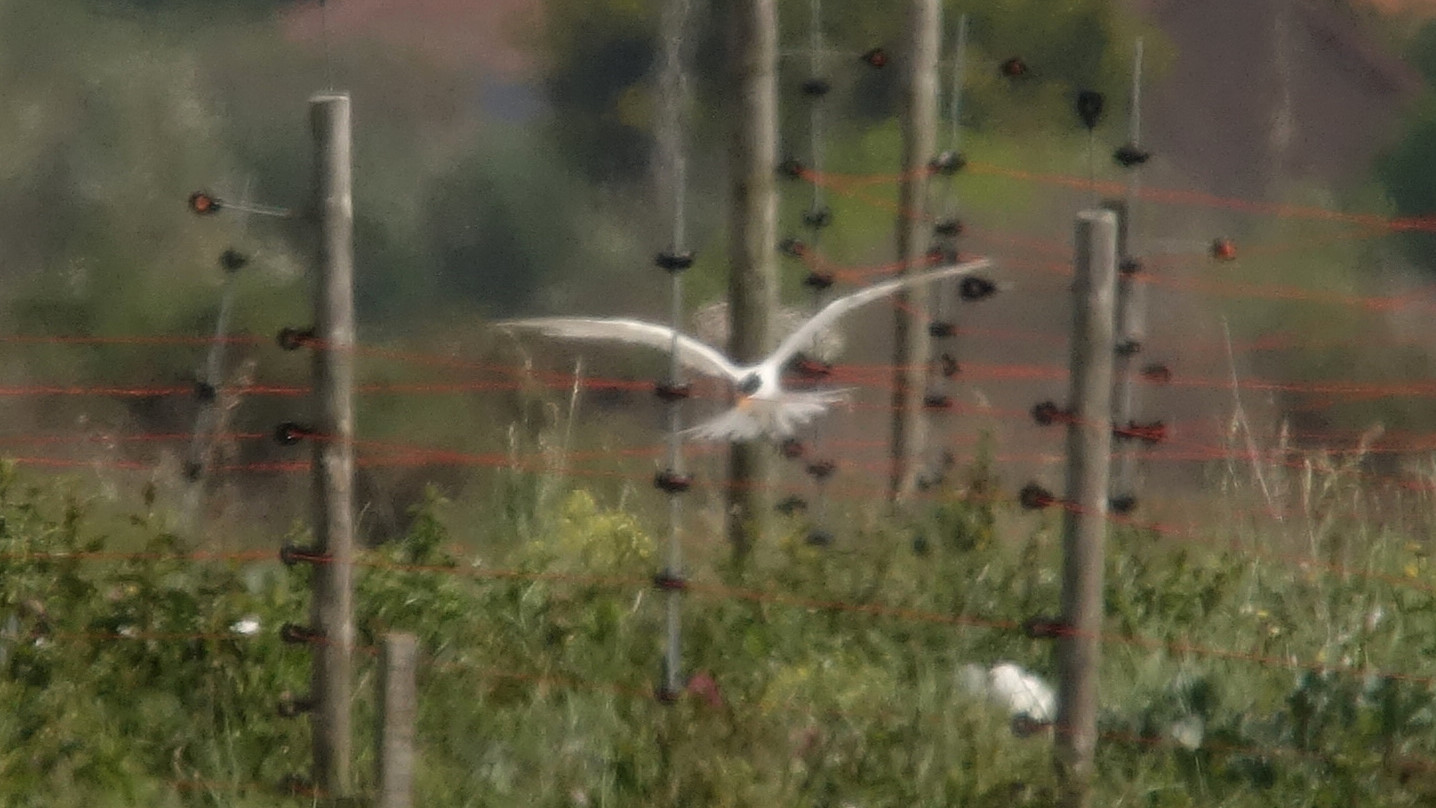
With news of a putative Elegant Tern being found in Hampshire in early June, it was sure to attract a fair few admirers. The species has been reported on a number of occasions in the UK, (5 accepted and 3 pending), but most of the previous records have been tarred by the messy prominence of hybridization within the species in Europe. A number of birds have been semi-resident in Sandwich Tern colonies on the Atlantic coast for many years, and have allowed for close study while they hybridized with Sandwich Terns.
It is particularly the results from this study that interest many listers in a UK sense. This bird, along with 3 others, all of which show Elegant Tern like plumage have been caught, colour ringed and DNA analysed. Cut short, the results showed that the hybrid offspring do not resemble Elegant Terns in any way, and the original adults that were tested using DNA, matched specimens of pure Elegant Terns from the pacific coasts of the USA.
And the Hayling Island bird? It was soon confirmed to be a colour ringed male, and with DNA confirmation, it proved without doubt that this was an Elegant Tern. In terms of listing within the UK, the first unequivocally confirmed Elegant Tern was sure to attract a big crowd... Had the bird stuck around...
A couple of brief appearances followed, each lasting around an hour, before eventually the bird was tracked down in the Tern colony within Pagham Harbour, on the other side of the Selsey peninsula.
11/06/17
Plans for a day birding at Ham Wall was postponed so we could join in the excitement of a UK 'orange-billed' Tern. As we approached Hayling Island en route to Pagham, news circulated that the bird had flown out to sea. Having seen the birds routine the previous day, of going out to feed every 3-4 hours, for around 2 hours each time. So a quick stop, breakfast, coffee and we drove the remaining 15 minutes around an hour later.
20 minutes later, after leaving a crammed RSPB carpark and we saw the crowd. And a rather large one it was!
The bird still hadn't returned, but we were entertained by frolicking flocks of Med Gulls, hovering Little Terns and flocking Sandwich Terns.
Around an hour later, a shout came that the bird was flying back in, but before anyone could react, it had dropped down onto 'its' spot in the colony, out of sight, and leaving a good few hundred birders without a view!
A tense 10 minute wait, after patiently having the scope fixated on the area were it dropped in, and up flew a carrot billed large Tern. It hovered around for about 5 seconds, before dropping down again. This process was repeated a few times across the next hour, as we pieced together views of this world lifer for both of us.
Eventually, after a couple of brief flights around the Tern island, the bird took a more distant circular route around the harbour, giving its closest view so far, before it flew across the seawall and out to sea.
And on that, we chose the walk home, together with a quick drop into the New Forest.
It was a somewhat depressing return to the UK on the 12th, the lack of birds of prey and general birdlife drained a fair bit of my usual 'spring optimism'. However, I soon tried to get back into the swing of inland UK birding.
Daily visits of Sedgley Beacon occurred, with optimism raised slightly by a couple of passage Wheatear on the 14th, followed by a decent day (in Beacon terms), with a Wheatear, 4 Tree Pipits and best of all a singing Grasshopper Warbler on 15th. Infact, the Gropper gave fairly good views, popping up on top of its temporary bramble home briefly on a couple of occasions!
A visit out to the University survey site on 16th revealed a pair of Little Egret was still present within the Heronry present there, however there was unfortunately no further breeding evidence over the summer.
This year a new joint BTO/ Natural England/ Forestry Commission survey has been set up within the Wyre forest to monitor effects on breeding birds within the Wyre over the coming years in which management work is being carried out to restore the original broadleaved deciduous forest. My Survey area is deep within the center of the forest and my first visit was very promising, despite the Douglas fir plantation (which is my survey area), the surrounding land is promising, and featured good numbers of Tree Pipits and Willow Warbler. A Lesser Spotted Woodpecker and a nice early Wood Warbler singing away next to 'my' woodland were very gratefully received.
Later the same day, the second summer Mediterranean Gull was still present at Upton Warren, together with the usual cast of breeding waders.
The patch has been fairly exiting this summer, and things kicked off early, with LRPs and Peregrines both being seen. A late Goosander still present on the river is usually a good sign that breeding could have been on the cards but unfortunately no chicks were found. A couple of Red-legged Partirdge scurried away along one of the dirt tracks while a Wheatear and a Yellow Wagtail were both the first on patch this year.
A day trip to near Reading with a University Society on 21st led to me seeing lots of Red Kites however it was on the 22nd that a real panic moment hit. While midway through writing up one of my essays (about flightlessness in the Galapagos Cormorant no less) I received news from a fellow Upton Warren warden. "Red necked Grebe at the Moors!!
Many rushed phone calls until a friend agreed to drive up from my hometown in Worcester up to my house on the other side of West Midlands country to pick me up! (massive shoutout to Rob, Legend!) And we were on our way.
A couple of hours running up and down the west shore until superb views were had just before the sun started to set with the bird swimming about just in front of the hide, a crippling bird for Upton Warren, a reserve first no less and in stunning summer plumage!
Huge thanks to both Rob and Hughie for their help!
My first Swifts of the year, a party of 3 moved over the university site again the follow day.
A fair quiet visit to the patch followed other than breeding birds but the Upton Warren all dayer was on the Saturday (25th). I arrived fairly early, before I heard news of an absolute 'mega' in Somerset. Despite the offer being given and many others abandoning the birdrace to go see the rare yank wader I refused as I was meeting a friend on site. As always, by the end of the day, my only contribution to the day list (with others already having found everything else by the time I arrived) was a single Ringed Plover, a species that I often seen to find on these All dayers, and infact it was probably the my best bird of the day, so I wasn't going to complain!
A lot of uninspiring 'patchworking' of multiple sites was very similar to the latter of last month. A Little Grebe and Water Rail remained on Patch on 1st.
It was brightened up with a very unexpected site first at Parkes Hall Reservoir on 4th though, when a drake Shelduck was present. Something I didn't expect at all while heading out for an evening walk!
The first highlight of the month came on 6th, when news emerged late evening of a Yellow-Browed Warbler at a sewage treatment works just outside Sedgeberrow, near Pershore. It was in county, so it wasn't too hard a decision to head over there the next morning. It didn't take long to get out first views. A really smart winter gem!
It seems as if these things are now yearly in Worcestershire, which is an anomaly compared to the track record of other midlands countys.
Cracking views were had as it initially used the barbed wire fence adjacent to the sewage beds as a launching post before dropping down to feed on the pans. As it warmed up, insects became more active, and the bird followed them out into the trees, and it spent the latter half of the visit feeding up higher in the trees.
It wasn't exactly far to Ashleworth Ham from here, and with the sporadic appearances of a drake Green winged Teal we gave it a go. Sadly no yank Teal, but a top class list of winter birds. A very good variety of dabbling ducks, and a very good flock of Common Gulls. It didn't take long for my curiosity of the Gull flock to materialize, and it took a matter of seconds to locate one of my targets, a Mediterranean Gull, a rather pretty 2w bird, but soon more Common Gulls flew in, and with them, an adult Mediterranean Gull, Nice!
A Red Kite flew low over, which added another unexpected bonus to the day.
On the 8th,a Barnacle Goose joined a few Canada Geese on the patch. Interestingly, a bird also appeared around this time 2 years ago. Similarly, the both stuck around for some time, and this bird became a permanent fixture of the patch for a number of weeks.
Sometimes in birding you have surreal moments that you simply can't begin to comprehend what just happened, and the 9th March was one of those days. A fairly typical day, a number of lectures, and just a bit dull weather wise. Nothing in the slightest to get exited about right?
With lectures over, I was out into the courtyard and out of reflex the first thing I did was look to the skies, a couple of Feral Pigeon, typical... But as I glanced up, the unmistakable shape of a Swift rose up from behind the building opposite me!!
A Swift in March is always going to hit the 'PANIC' button, more so for the fact I didn't have my bins in hand and I couldn't see any sort of plumage details on it due to the white sky. It was merely a silhouette, but instantly it was obvious it was big and bulky. A few seconds, a couple of flaps, and it was across the top of the building and towards the Church/town centre.
Other than the certainty it was a Swift, which one?!?
Wanting to get people looking to the skies, a panicked tweet went out on my twitter and texts sent to all locals who may be in the area (including a number who were working in the office buildings around me!) in the hope it would be picked up/ people would run out of work.
Minutes of anxiety followed, I now had bins in hand and was scanning the skies, please tell me that wasn't it! As a gut feeling I knew it was an Alpine, but I just couldn't say it with that view.
A minute turned to 5 minutes, 5 turned into 30.
I was now standing around the opposite side of the church, facing towards the town, skies darkening by the minute. And then there it was, 35 minutes after I first saw it, a large Swift came cruising down the road below the height of the buildings, initially with its wings tilted showing its upperwing, then banking to show me its underside, with its huge white belly patch. ALPINE SWIFT! Absolute frigging MEGA! I watched it until it disappeared behind a building and I ran to get a better viewpoint, tweeting about its reappearance as I ran (hence the barely comprehensible message). The first birder arrived only 5-10 minutes after this, and as they arrived so did the rain. And that was that. It disappeared. Did it roost before the rain? Did it push off ahead of the weather system? Who knows. I stuck around until after dark, and spent most of the next day looking, but nothing, the skies above Wolverhampton returning to the Feral Pigeons and F-15s.
With my enthusiasm levels up high, it didn't take much effort to wake up early on the 14th and get out on patch, and I was in for yet another treat. The Barnacle Goose was still around, but I was anxious to check the quarry, and it was a good job I was, because as I arrived I picked up two waders on the mud at the far end of the flood. RINGED PLOVERS!! Getting the scope on them, I then realised that there were infact 3 waders, a pair of Ringed Plover and a Dunlin! Absolutely mega patch birds! They fed on the mud for around 30 minutes, before taking flight, climbing high and flying off north. Exactly what I had been waiting for when the quarry flooded last autumn!
A late evening visit to Upton Warren that evening gave me a showy Redshank and a Green Sandpiper, the former being a species I don't see regularly at the site anymore.
The next morning (15th) I was out on patch again, and I again found a good number of decent patch birds, with the highlight being a drake Teal, which came off the 'Wigeon lake' at Blackstone. A Snipe also flew out from the edge of the pool and the Water Rail scurried along the edge of the willows. 2 Yellowhammer gave me a flyover and it was a 3 goose day, with Canada, Barnacle and a flyover flock of 3 Greylags.
On 17th, I journeyed over to Sandwell Valey RSPB to meet with a couple of Uni friends. A few hours of walking around Forge Mill and the RSPB area gave us a few nice birds. My First Little Ringed Plover of the year, a flock of 20 Barnacle Geese, 3 Parakeets and a Jack Snipe in the marsh.
Perhaps the most unusual addition being a Harris Hawk, which repeatedly flew over the RSPB area.
I have been watching Parkes Hall regularly, to not much reward, however on the 18th, a Red Kite flew south over Tenacre Fields. The first in the area for me!
After a fairly standard patch walk on 21st, and working in the afternoon, I was able to drop into Upton Warren flashes for the roost. All pretty standard stuff until late on when a superb adult summer Mediterranean Gull dropped into roost. What a looker!
With news having emerged that a drake Ring-Necked Duck had turned up at Priorslee Lake, Shropshire the previous day, we journeyed up there the next morning. News hadn't been released so we were going in blind but it was great to see on arrival that the bird was still present, and showing increasingly well as the morning progressed. Much better views compared to my previous (and only other) RND in the UK, a very distant bird on the Ouse Washes.
On our success we took a punt to go looking for a specific species, and a while later we were out searching. Not really hoping for much due to it getting towards mid morning it was somewhat shocking to find our targets within a few minutes of leaving the car, and we were soon getting crippling views of 3 Woodlarks, with a 4th singing off in the distance! You really couldn't have asked for much better, feeding in short grass right next to (and often on) a public footpath. Easily the best views I had managed of this species to date!
It then went quiet for a few days, visiting my usual local sites for not a huge reward. So instead I used the lull to practise some digiscoping skills, and this Chiffchaff obliged.
With the month coming to an end, and with migrants arriving, I journeyed over to Ryders Mere with a friend on 26th. Originally we had planned to drop into Stubbers Green but the Brent Geese had flown off, and following an uneventful stop, we carried on to the Mere. A good selection of birds were present but we knew out main target was on the marsh so we walked over there. It didn't take long before the female Garganey flew past us, and over the next hour we had a number of brief views. We walked to check elsewhere, but while doing so I saw a duck in the distance briefly which circled the Marsh. "Looked like a Mandarin" I thought to myself, but given the view it wasn't even worth calling.
We however walked back past the Marsh, and instantly there on the water was a drake Mandarin! Apparently only the 3rd site record and a couple of local patchworkers were soon on their way to twitch it! As we waited for them to arrive, the Garganey flew in, and swam about with the Mandarin for a while, before swimming off into the rushes. We stuck around until the first birder arrived, but as he approached, the Mandarin had flown. It seemed to drop down again in the distance, so following a brief search, the bird was refound on a 'puddle' at the north end of the site. Job done. Everyone was happy.
I was back in the home county on the 28th and again it was time for a roost session at Upton Warren. Again quiet until another Mediterranean Gull, this time a 2s dropped in to roost. Equally as stunning as the adult the previous weekend. Those primarys are just... Wow!
The last birding day of the month was spent on patch, and my effort was rewarded with a very good view of a female Merlin, which barrelled through the Quarry as I was unsuccessfully trying to find a few waders. I wonder why with this bundle of anger and feathers bombing around. Needless, a very good patch bird, and I left the patch very happy that day.
Slipping further and further behind as ever, but I still do intend to catch up with myself
The month started with the usual work party and Upton Warren on the 1st, where the standout highlight was 13 Jack Snipe and 18 Commons. A fairly low total for Common Snipe but a half decent count for the Jacks.
A mess of local birding followed, without seeing very much, including regular failed attempts at gulling around the Stubbers area, which returned no reward. So it was gratefully received on 7th when a day out was offered in south Wales, with a whole host of scarcities to keep up occupied. First of was the stunning Little Bunting at Forest farm country park, which showed superbly throughout the visit. Perhaps too well!
Due to the awkward position for digiscoping I often had to go to the furthest point away in the hide, which meant I was looking through a fence for most of the time, but the bird performed admirably!
After our fill, and wanting to avoid the increasing crowds, we moved out from the country right into the center of Cardiff for the regularly returning drake Lesser Scaup, which was located without too much fuss swimming about with a large group of Tufted Duck. Having chosen to reside at the furthest point away from the viewpoint, and with strong and cold winds, we didnt stay around long, moving onto Newport RSPB.
The RSPB site itself was very quiet, a good number of waders on the estuary being the saving grace, featuring Grey Plover, Bar and Black tailed Godwit. A quick tea break led us to see Peregrine and Kestrel from the Cafe, which signalled the start of a bit of a raptorfest!.
Moving around to the Goldcliff Pools, we quickly located the wintering Spotted Redshank, a few Pintail etc. All was quiet untill from over the top of the hide can a raptor. Dropping low over the water in front of us a white rump gleamed. Ringtail Hen Harrier!!
She gave a good show for a couple of minutes, hunting around the pools, before drifting off over the seawall back towards the RSPB center.
While following it in the scope it dropped down, and while trying to pick it up again, another raptor appeared, another Harrier! But this was 4th raptor species in only 15 minutes, a juvenile Marsh Harrier! But no, it wasn't to end there, a male Sparrowhawk bombed past the hide only seconds after. With 5 species of Raptor on show in a matter of 30 seconds (Marsh, Hen, Buzzard, Sprawk and Kestrel) it was pretty good going. With most of the birds having gone into hiding, we left the hide, and while talking to a local birder about the enduring raptorfest, our 7th raptor species in 30 minutes appeared, as a female Merlin zoomed past us!! What a way to spend half an hour!
To finish the raptor extravaganza, we decided to take in some Owls, and an hour or so later, we were watching 4 Short-Eared Owls hunting over a weedy field, often at point blank range! But it didn't end there, a quick scope job of 3 distant raptors proved them to be Red Kites, Raptor species number of for the day, a superb days winter birding!
The very next morning, and I was out again, this time heading north into Cheshire, looking for my 2nd yank in 2 days. Heavy fog shrouded us as we arrived at New Brighton, and visibility was very restricted. We perserveered however, and after an hour or so, decided to try our luck with the Snow Buntings down the road, to return back to the marina later.
The Snow Buntings didn't prove too hard to find, as a pair shuffled about on the Wallsey end of the beach. Not wanting them to bother them too much in the cold weather we moved off, and then we heard that the Laughing Gull had just been refound. Perfect.
A minute drive back down the road, a trudge across the beach out to the lighthouse, and there in the still thick fog was the 1st winter Laughing Gull, standing out like a sore thumb. Good views were had as it ran about on the beach with the Redshanks and Turnstones, but the fog did prove very annoying.
However it was great to watch it flying around etc, showing off extremely well just how dark its plumage was!
A bonus 6 Purple Sandpiper out on the breakwater was a nice addition, but with limited time, and as the previous day, the freezing wind, it was hard to stay out too long.
We retreated to Burton Mere RSPB, almost entirely to see the roosting Long-Eared Owl, which was showing superbly on the track to the IMF hide.
A Spotted Redshank overflew the site when we checked the scrape, but it was otherwhys fairly quiet, particularly when compared to my last visit here!
Checking West Park revealed that Med Gull PNU9 was still present, with its hood becoming increasinfgly prominent on the 9th, with it last been seen on the 17th.
With the Water Pipits having returned to Doxey Marshes, it would have been rude not to visit, hence on a dreary 11th, i was stood scanning Pipits and Wagtails. Once reaching the right location, it didn't take too long to locate a Water Pipit, and by the time I left a few hours later, I was confident that there were at least 2 on show, with probably more.
The 'resident' 2 Barnacle Goose were often flying around and a good variety of wetland birds was present, including 10 Goosanders, 4 Little Egret and at least 6 Water Rail. A number of Stonechats were flicking around near the Water Pipit site, and some great views of Cetti's Warbler were had.
A patch visit on 15th revealed 2 hard to find patch birds, with both Little Grebe and Water Rail being present, both of which went on to stay around for a few weeks. A good flock of 119 Lapwing were also in the quarry.
The 21st saw my annual trip over to Draycote Water. Despite having a good number of good birds, we managed to dip the drake Smew, but a couple of hours getting wet, cold, and hailed upon proved worthwhile with a Black-Necked Grebe, a flock of 25 Tree Sparrows and the Greylag Goose flock containing a pair of White-Fronted Goose and a Pink-Footed Goose.
The last birding trip of the year took me to North Wales, where an early morning drive around the mountains saw us seeing a lekking flock of 22 Black Grouse! Very good, but distant views were hard in the breezy conditions, but it was great to watch them strutting their stuff on the grassy slopes.
2 Red Grouse, and a flyover flock of 3 Crossbill were the only other notable birds present in this very hostile, cold place!
A seawatch from Old Colwyn included the expected masses of Common Scoter, including a partially leucistic bird, but we failed to find any Surfs. We did however find 3 Velvet Scoter, with a nice cast of 7 Red-Throated Diver and 10 Red-Breasted Merganser. A flock of 5 Whooper Swan flew west far our at sea, which proved for a rather awesome, if random sight!
With a showy Iceland Gull being up the road it wasn't a hard decision to go take a look, and from the car as we pulled in you could see the bird, down on the sand, being thrown copious amounts of bread by a couple of photographers. I wasn't going to complain, as within a minute I was getting views like this. Absolutely stunning!
A drake Red-Breasted Merganser was showing well on the same tidal pool, until it and the Iceland Gull was flushed by a rampant Dog, much to everyones annoyance.
A check of the Scoter flock proved difficult, with distance and increasingly strong wind proving a problem. Needless to say, no luck here either.
With a few hours still remaining of daylight, and on the way home, we dropped into Venus Pool, where a Ringtail Hen Harrier had been hanging around. We had seen it briefly just north of the site on the drive down, but it proved elusive once we reached the site, and having given it a really good time, we only saw it once briefly for a matter of 20 seconds. We were however entertained by a large flock of winter Finches/ Buntings, which included around 100 Yellowhammers, 15 Reed Buntings and a flock of 17 Corn Bunting. The latter a very good record for the site!
Yes yes, I know. Here we go again, 5 weeks without a post.
The usual excuses are again exercised, Uni work, and to busy with actual fieldwork to update here. So here we are, another catch up post!
It's better than nothing!
1/01/15
After a night partying into the new year, I found myself stumbling through the city centre early the next afternoon after waking at a friends flat. It was straight down to West Park, where I managed to grab a few 'new year' ticks. Nothing special, but highlighted by the wintering Pochard and Shoveler.
Throughout January I was visiting West Park with regularity, so I wont be commenting on every visit, as the details from which are very monotonous and 'samey'.
3/01/15
The next birding adventure was pursuing one of my winter pastimes.
GULLS!
Bartley had an Iceland Gull visiting, so it didn't take much coercing to get my ass over there. With most of the Gulls at the west end, I moved around to view through the fence and here I met all the usual assemblage of Gullers. Nothing interesting had come in yet.
With the sailing boats having retreated back to dry land for the night, the gulls started drifting out, and so did most of the birders to the usual viewpoint off Scotland Lane.
A matter of minutes after, and I picked up the regular 2w Caspian Gull nice and close in. Needless to say, a few decent views (gull roost standards) were had, and soon after the guys up on Scotland lane picked it up also.
Again not much longer after, a return call came, the Iceland just dropped in!
We rushed around the corner, but the bird had flown. Having already set my tripod up, I chose to run the 100 or so metres to the high ground, and a little bit of scanning and BINGO!
3rd winter Iceland Gull!
Very distant, but shining like a beacon among the throng of white, grey and black.
I even managed a couple of record shots (literally!) showing the bird.
Iceland Gull (Red) and Mediterranean Gull (Black)
A Med Gull was called from near the bird, but no-one other than the finder managed to see it. That was until I reviewed my photos 2 months later and found the bird in question in a matter of 10 seconds. Ah, how easy is this Gulling lark when you don't have to contend with field conditions and freezing shanking hands! Needless to say. I'm not counting it, but a great reminder about how birds can so easily go 'under the radar'.
4/01/15
Patch birding followed, which boosted the year list significantly, gathering a couple of decent patch birds in the process in the form of a Snipe and a flyover Yellowhammer. The Lapwing flock in the quarry had levelled out to 54.
6/01/15
With the Great-Northern Diver still being in residence at Ryders Mere, it would have been wrong to not visit right?
So I found myself on a muddy shoreline getting cracking views of the juvenile bird as I made my way to Chasewater for the roost. A really nice supporting cast of birds here also, which shows just how top quality this site is, particularly so being within an urban area!
Moving onto Chasewater, it actually turned into a very productive visit. Highlighted by a 2nd winter GLAUCOUS GULL which arrived quite late in the roost. White wingers have been particularly scarce in this area this winter in comparison to the last few years, so to get both within the first week of the year was good going! Add to this, 2 Caspian Gulls and 2 Yellow-Legged Gulls. A very good if very cold visit!
8/01/15
Following a session in West Park, I moved around to Parkes Hall, where a flock of 15 Goosanders (4 drk) greeted m. The Mute Swan remained (the first site record!) and a good flock of 28 Moorhen remained.
10/01/15
A little bit of dirty twitching, or actually, lets rephrase that... I dropped into Worcester Cathedral to pay homage to the long staying, and often elusive Black Redstart. It was actually the first time I have visited the Cathedral to look for a 'Black Red', which are present most winters. I have heard tales of peope dipping this birds regularly, but within 15 minutes, up popped the bird, quivering tail and all, out in the sun above the Stonemasons Garden. Cracking scope views were had as it flicked, flycatched and shimmied along the ledges. Always a real treat!
Having just brought a digiscoping adaptor from the Birders Store down the road, this bird was my first 'subject', and it chose to be very obliging.
(Literally the first photo I took with the new adaptor in 'field conditions;)
I spent all the time I possibly could with the bird before the time ran out on the parking meter, during which she preformed admirably!
Wanting to try out the apaptor further, we moved around the Upton Warren, where, as luck would have it, a 1st winter drake Pintail had dropped in for the day! Not a bird I see at Upton regularly, so very chuffed with that stroke of luck! A Little Egret was also still around.
I tried my luck with birds on the feeders, and this stunning mossy male Greenfinch probably turned out the best.
11/01/15
Another day, another visit to the mecca (Upton Warren that is). The first work party of the year, and with the allure of Jack Snipe, who could resist. Prior to work, we undertook the usual Snipe count/flush, which proved very productive, with 15 Jack Snipe, and 40+ Commons!
Now before I get rolling eyes and 'that look', it must be said that these counts are an intrinsic part of our management regime, and without them, we would never know if the habitat management is working. And as anyone can see from these results, it really is!
Birding was limited throughout the work party, but a Great-Black backed Gull flew over, a very scarce yearly visitor to the Warren, so a great tick to get under the belt so early.
The usual after work birding party moved to the Moors to finish the day, where our luck was in! At very last light, a BITTERN clambered its way to the tops of the reeds. Having had a Bittern found dead only a few days before we were very relieved to still have a bird on site. Infact, it was my first at the Warren in almost 2 years! A great way to end what is always an enjoyable, if hard day!
12/01/15
Another visit to West Park called, and I finally connected with the 2 Ring-necked Parakeets that had been hanging around for a while. Somehow they had managed to elude me for two weeks, but eventually nice views were had of them sqwarking on the island.
Moving onto Stubbers Green, it was very uneventful bird wise, so the less I talk the better. Hitching a ride with a friend and his companion, we then moved around to Ryders Mere, where I took a 3rd helping of Great-northern Diver. Still present and accounted for...
Having just arrived, we walked to the nearest birder, who informed us that he thought he had a Caspian Gull. Guiding me onto the bird and I was faced by an absolute cracker of an adult bird! A real classic. 'Daz white' head, small beady eye, long parallel edged bill and best of all, a huge dollop of white of p10, with that classic white tip. Stunner!
Our main target though had been eluding us, so with only 5 or so minutes of usable light remaining, we rushed around for another viewpoint on the western shoreline.
Plonking the scope down, 3 seconds worth of scanning....
"GLAUC"
Everyone was on the bird, but the reason I had came up again was to get some video. (It had been showing well for a number of days). Unfortunately it wasn't too close, and annoyingly, wherever it had been foraging it had picked up some dirt on one of its right primarys, and given how dark it was, this was only exaggerated. Not the footage I had hoped, but it gives me something to improve on!
16/01/15
Visited Chasewater again in the hope of finding the two headlining Gulls for Mike. Unfortunatly the Glauc was a no show, but Mike picked up the adult Caspian from a couple of nights before. After a winter of trying, I also managed to see the 'White winged' Herring Gull, which was pottering about near the powerboat club.
17/01/15
A rather uninspiring afternoon wardening at the Warren. The usual array of birds were present, but this Blue Tit beside the hide was looking stunning.
18/01/15
What January would be complete without a visit to Slimbridge WWT. With the weather not being particularly cold (despite my hands still telling me it was!) the numbers of birds around the reserve had not reached their usual peaks, with many having short stopped on the continent.
Even though not of the usual size, many of the flocks were still of huge size so certainly gave me something to scan through throughout the day! A flock of Little Stints had been hanging around with the Dunlin flock for much of the winter, and I managed to locate one fairly quickly, rather obligingly pottering about in the long grass pretty close to the hide.
The Goose and Swan flocks have been particularly low. Only around 100 White-fronted Geese were on site, add to this only 80 Bewick's Swans and you can see what I meant with my earlier statement. A single Pink-footed Goose was found however, lumbering about at the back of one of the pools on site.
3 Avocets were the first to return to the site this year, and while watching 2 GCP Common Cranes from the Sloane Tower, a distant Barn Owl started hunting the reedbeds around the Zeiss Hide, rather confusingly, at around 12:30 in the middle of the day!
A Kestrel was showing very well from one of the hides, but unfortunately the crowds in the hide meant the floor was shaking like crazy!
22/01/15
A walk down to West Park was livened up when this stunning Gull decided to drop onto the pool! A stunning Mediterranean Gull. A great bird for such a site, and luckily it hung around well into the winter so all could come and admire it. Funnily enough, just before I scanned the Black-headed Gulls I remember saying "Wouldn't it be funny if there was a Med Gull in that lot".... A matter of 15 seconds later and I was calling out there actually was a Med Gull in there! Amazing!
23/01/15
Having noticed the Med Gull was ringed as it flew off, I returned the following day in the hope it would visit again, and luckily, on my very first scan, there it was, perched out on ice revealing its leg-ring code to be PNU9.The midlands seen to have a track records with these 'PNU' birds. I have previously seen PNU4, and PNU5 has been seen a number of times, so this bird made the 3rd PNU bird to be seen in the midlands within only a few years. These Polish Med Gulls certainly do like the midlands!
The bird was seen throughout January, and continued to visit until at least the 17/02.
While trying to find the Med Gull for a friend, we were caught in a heavy snowstorm. This Shoveler looked about as happy as I was to be in such weather. (Grim)
31/01/15
The last afternoon of the month was spent at Upton Warren, looking at the Gular pouch angle on Cormorants. Such a glamorous life.
This Cormorant however, was looking absolutely fabulous!