Showing posts with label Spotted Flycatcher. Show all posts

Monday, 22 December 2014

Virjinxity! Wryneck, YBW and Spoonbills! (21/09/14)

I have never been on one of the RSPB Stourbridge field trips, however, following some encouragement, in late September I joined them as they went to Portland Bill and Lodmoor RSPB.

Following some banter on the coach, we arrived in the bill car park, and as we had picked up some news from twitter we headed straight up the hill to the area where a Wryneck had been found!

Masses upon masses of Hirundines were everywhere, Yellow Wagtails, Meadow Pipits and a single Grey Wagtail flew over south, so there was certainly plenty of vismig! But, having dipped on Wryneck many times in the past, I was keen to get there as soon as possible. I was in so much of a rush that even a Whinchat perched on a fenceline was almost ignored as the crowd appeared on the track opposite us!

It felt like an age to cover the fields to them, but as soon as we did I saw what looked like a Wryneck as it flicked past me and behind a hedge, yet no-one was looking. Surely that wasn't it! 

A quick question later, and having learnt that they hadn't seen it for a while I went to check out the bird I saw. A short walk later, and there, perched atop a hedge, with a backdrop of the English channel was a stunning WRYNECK! I had lost my "Virjinxity"!

Over the next 30 minutes, the views slowly got better and better, and as people left, the bird became more confiding, and eventually, with only a small group of people, the bird landed on the fenceline adjacent to us and started feeding from the track! Although invisible when on the deck, the bird often flew up onto the adjacent fenceline and hedge, giving absolutely amazing views to all present!

Wryneck

Wryneck

Wryneck


I have dipped so many Wryneck in the past, and so to finally catch up with one put a huge smile on my face, and it was with regret I left the bird to look for another scarcity.

It was clear that overnight there had been a 'significant' (at least by my standards) fall of Chiffchaffs around Portland, and in the Observatory garden alone there were at least 80. Counts from the Ob's staff suggested the actual total was closer to 200! In this fall of 'Phyloscs' a Yellow-Browed Warbler had been located, but it was being very elusive in the dense vegetation, which was literally dripping in birds! Chiffchaffs were flycatching everywhere, and these were joined by two birds that are more akin to the behaviour, as two Spotted Flycatcher perched sentinel over the 'alive' garden.

Most people had given up with the YBW when it hadn't shown for a good hour and a half. However I soldiered on, and just as a group of birder rounded the corner from the Ob's car park, an absolutely stunning bright Yellow-Browed Warbler flitted up above the fenceline!

Calling over the crowd, only 1 got onto the bird, before it disappeared back into the bushes, but despite only being on view for around 15 seconds, as always with these delightful leaf warblers, it was well worth the wait!

With the time now running out, I decided on a quick look out to sea, where 3 Mediterranean Gulls were flying about and a Kittiwake flew past. A Yellow-legged Gull landed on a post outside the cafe, but had flew off by the time I had gotten my camera out.

In the old quarry, the Little Owl was showing nicely to the assembled crowd!

Little Owl

Moving onto Lodmoor RSPB, our first notable sighting was when this stunning little thing flicked up next to us:

Clouded Yellow

A Clouded Yellow!
Again, this had become another of my bogeys, and despite having seen them before, they had steadfastly refused to land. But this one was different, and gave us stunningly intimate views as it perched on roadside vegetation! 

Moving onto the pool, 2 Spoonbills were very quickly located (how could you miss them?!) and gave a great performance as they fed constantly in the shallow water! Not something you expect a Spoonbill to be doing.

Spoonbill

Spoonbill


A small selection of Waders were present, with Lapwing, Green Sandpiper, Common Sandpiper, Black-tailed Godwit, Snipe and Ruff all being present. Walking to the opposite end of the flashes (so I could view the gull flock of course!) I found an early Pintail roosting on the edge of the water. But my mind soon wondered and my reason for walking here was obvious, and I was soon seeing countless Mediterranean Gulls flying into the increasing Gull flock!

All ages were present, and great views were had of all!

Mediterranean Gull

Mediterranean Gull


Bliss!
MB

Wednesday, 26 November 2014

Birding the Beacon- Autumn 2014

As I'm sure many local birders would now be aware, I have attained somewhat of a bug for birding Sedgley Beacon.

There are many reasons for it, but the main one being that it has became clearly obvious that the Beacon is a regular stopover for migrating thrushes, and during the correct winds, can result in some rather spectacular vismig.

Perhaps the most significant 'discovery' has been the string of Ring Ouzels I managed to find. Through the autumn, I managed to connect with 4 of these scarce migrant Thrushes,  3 adults and a juvenile as they paused (however briefly) on the hill. The first day of October brought the first two, combined with a fair bit of vismig, as both a male and a female stopped briefly within the Hawthorn valley on the NW side of the hill. Both of the birds were picked up in flight as they dropped down calling, their harsh chacking call being very distinctive. It was by call that both the birds on the 15/10 were also picked out, but the SW winds on this day revealed a significant movement of Thrushes, with about 2500 (of various species) noted by me flying over in the morning. Further watching by another observer later in the day added another 1500 birds, so the passage was certainty sustained throughout the day (and the night by the sounds of hundreds of migrating Redwings flying over my house). The first bird dropped into the NW valley to feed, as did many of the Thrushes it was migrating with, but the juvenile flew very low along the entire length of the hill (just above head height!) before dropping into bushes below the masts.

I'm sure more regular watching over the coming years could lead to more records as I'm pretty sure it must be a regular stop over site for the species!

Female Ring Ouzel- Despite being a poor photo, note the very pale wings and if zoomed in, the pale edging to the belly feathers.

As already mentioned, I also logged all the regular thrush species, and often in good numbers, with the 15th proving to be by far the best day!

Vismig was regular, and included my first Golden Plover for the site (15/10) and regular movements of Meadow Pipit and Wagtails. This included 2 Tree Pipit (3/09),11 Grey Wagtail (1/10) and the first real 'finch push' of the year, with 70c Chaffinch, 2 Brambling, 40 Linnet, 2 Redpoll sp and 5 Siskin going over on a 9 'finch species day' (15/10). A single Hobby gave stunning views on 1/10 as it migrated at eye height over the plateau of the hill at about 30ft range. As you can imagine, leading to some rather stunning views as it glanced at me as it barreled past.

Tree Pipit (Trust me!)

Away from vismig, there was also a good number of Passerines, with Redstarts present on 3/09 (x2) and 15/09 (1) with a Spotted Flycatcher also present on the latter date (And another nearby but off the Hill) 


Redstarts

A pair of Stonechat appeared on the 15/10, giving great views from my vismig point.


Male Stonechat

Combined with decent movements of regular species, it often led to some very enjoyable birding, so rest assured, I will continue birding the site!
MB

Tuesday, 28 October 2014

Ash Brownies! Butterfly watching

24/08/14
Usually when I go looking for Butterflies I like the solitary aspect, and I spent many hours this year walking around and stalking these dainty beauties.

However, I was approached by a friend from Hereford saying there was an open day at Grafton Wood and wondered if I wanted to go.
As a site I have never previously visited, a guided walk seemed the more sensible option.

Grafton is considered to be one of the the main strongholds for one of the UK's slightly more scarce butterflies, the Brown Hairstreak. It wasn't a very hard decision, and plans were made to join the group in the Church carpark at Grafton Flyford in the morning.

A large crowd had developed, and lots of familiar faces started to emerge from the crowd!

Following a walk around the entire south end of this rather appealing woodland, but having seen very little, 2 Purple Hairstreak being the obvious standout highlight, we heard news that the group at the north end had found a couple of Brown Hairstreaks!

A walk to the opposite end of the wood followed, and soon after a rather stunning female BROWN HAIRSTREAK was showing rather beautifully on trackside vegetation, moving between bouts of sunning and egg laying!


A 2nd 'Ash Brownie' was flying about but they were part of only a few Hairstreaks seen by the entire group during the open day. It had been a poor year!
 
We managed to find a few birds on our jaunter too, and a male Redstart was flitting about in the hedgerows outside the main woodland, as was a male Yellowhammer. A Yellow Wagtail flew over calling.
However, a short walk away, 2 Spotted Flycatchers were feeding on a fenceline, and were showing superbly as the adult would fly in to feed its speckled juvenile.


A nice mixed flock were also moving through the adjacent willows, a Lesser Whitethroat and 2 rather stunning juvenile Willow Warblers showed well as they moved past among the usual Blue and Great Tits.
 
Having completed the task for the day, I dropped into Grimley CLP on the way home, which was rather quiet, however there were some very nice birds around, 8 Little Egrets were still on show, and a large Wagtail flock included 5 Yellow Wagtails.
 
 
A adult Hobby was showing nicely but the highlight of the visit was my first Whinchat which was perched very distantly on fencelines far to the south.
 
A check of Waggon Wheel pits was needed but again it was rather quiet.. 
 
However, a Whinchat showing superbly on the eastern side of the pools certainly made a good highlight. I always enjoy seeing (and moreso finding!) these rather smart birds, and it is always a pleasure to do so!

 
MB

Tuesday, 2 September 2014

June and July- The Wyre Forest

My last June and July roundup mostly covered some of the avian delights I had seen at Upton Warren, but away from that I spent a long time down in the Wyre forest, looking for and photographing butterflies, but also keeping an eye and an ear out for any passing birds.

By far the rarest thing that I found was a stunning Dark-Green Fritilary, which despite originally identifying it as a female Silver washed, that later changed that evening, and it turned out that this species had gone practically extinct in the Wyre  a number of years ago, and my sighting was followed by a few more, which is great news.

Luckily, I had my Canon DSLR with me, and I was able to get up close and personal to a number of Fritilaries, including this stunningly fresh specimen which repeatedly returned and fed off a  thistle in one of the many flower meadows in the forest.


I also managed to find a Marbled White, which perched really nicely on ferns adjacent to one of the tracks. Although a fairly common butterfly, these still remain up there on my 'favorites' list.


The number of Silver-washed Fritilaries was superb, and they could literally be found throughout the forest. As is in their nature though, they were more content gliding around up in the treetops and tantalisingly dropping down low over the ground to flit around you before flying back up to the canopy.

Needless to say, this proved fairly aggravating, but eventually, a rather dapper female dropped down and perched really well and proceeded to show very nicely, sadly lacking the males gorgeous markings, but rather nice in itself.


Also showing off its silvery green underwing.


A few males chose to perch up distantly though, and I managed a few Digi-binned shots as they perched on nettles, which I'm sure got a  few 'phwarr' notes from me, Look at that!


Red admirals were common throughout the forest, and I eventually managed to track down a very photogenic black and red gem as it perched and warmed up in the sun.


The White Admirals were less than showy unfortunately, and tended to only perch up briefly once I had found them. One did perch up on trackside vegetation, but it was rather tatty, with large chunks taken out of the wings and bright sunshine glowing off its upperwing.


A few very stunning freshly emerged Comma's were also showing, with one choosing to warm up on my bad which proved a nice radiator for it!


I also managed much that I saw but didn't managed to photograph, such as Small Pearl-boardered Fritilaries and most Common butterflies. Dragonflys were represented by Four spotted Chasers, a single Golden-ringed Dragonfly as the highlights, with most of the common 'Dragons' of the forest also seen.

MB


HANG ON!

You didn't think i was going to do a post without mentioning birds right!!

Despite most birds been fairly quiet at this time of year, i still managed to 'connect' with all the forest specialities, such a Pied Flycatcher, and a large family party of Spotted Flycatchers. Tree Pipits also made an appearance, and i finally managed to connect with a Redstart, with a male showing in the vicinity of Lodge Hill Orchard. A number of Dippers were located, including a few juveniles, which were great to watch. A Lesser Spotted Woodpecker was a nice surprise as it called loudly while I was watching White Admirals!
All in all a very enjoyable way to spend a number of days!
MB

Tuesday, 22 July 2014

Summer in the Wyre Forest! Woodland birds and butterflies

18/05/14
The Wyre forest in spring is one of my favourite birding destinations. Despite the hoards of ramblers, 'extreme' cyclists and marauding dogs, I always find that a walk in the Wyre is a great way to 'get away' from everything, just looking for birds and butterflies.

Today was no exception, and I went in hopeful to snag the entire plethora of our regular summer migrants.
First on the list, although I had seen two already was a singing male SPOTTED FLYCATCHER, already a good start, as a few years ago I truthfully struggled to find any throughout the summer. Luckily, the last couple of years has been more productive for them, and they seem to have also had much better breeding success! I found another singing male in another area of the Wyre also.

 
As always, WOOD WARBLERS were easy to pick up, with their very distinctive, and rather appealing 'spinning coin' song, and this could be heard almost constantly throughout the walk! Although many remained as 'heard only' I did eventually track down a few birds, including a pair which gave stunning views, showing off the rather beautiful mix of moss greens, bright yellows and dazzling whites on their plumage!
A total of 4 Tree Pipits were singing at various points in our circular walk, including a few which were showing nicely and parachuting from the tops of tree. Weirdly, one of the located singing birds was well away from one of the usual areas, and rather than being in a clearing as usual, had instead chosen to hold territory in the middle of a deep woodland, below the forest canopy, obviously resulting in an inability to 'parachute' display flight, rather choosing to sing from a perch.


As the more acutely trained of you may hear in the previous video, there was also a stunning male PIED FLYCATCER singing close to where the Pipit was, which was actively defending a nest box adjacent to the track. 
 
 
In previous years I have seen male Pied Flycatchers with small amounts of grey on the back and upperwings, however this bird really was a very extreme 'grey' bird, which at times resembled a Shrike from behind! I can't say that I have ever seen a Pied Fly like this before!

 
(Sorry about the Dog panting all over the camera in this video, as previously stated, the number of marauding dogs was extremely high on this fine summers day!)
 
 
I managed to find 3 male Pied Flys, and reports from others seem to suggest they have had a much greater presence in the forest this year, which is great news, as for the last few years, numbers have been dwindling!
 
A single juvenile DIPPER, in fact my first of the year, was located along the brook, and a pair of Mandarin did their best to try to avoid being detected!
 
As well as its birdlife, the Wyre is famed for it's Butterflies, but being fairly early in the season, other than decent numbers of Pearl-Bordered Fritilary it was rather quiet!
 
 
All in all a very successful visit, and one that would be repeated throughout the summer!
MB

Tuesday, 15 July 2014

NORFOLK! Monty's, Dott's and summer migrants

10/05/14
With many of our summer migrants arriving en mass now, and a few scarcer birds appearing, we, that is Mike, Jarad, Neil and me, made plans to head east in the hope of some great birding, and Norfolk, as always, lived up to its usual standards!
 
Our first port of call was right on the county boundary, as it is renowned for a strange and somewhat range restricted wading bird which finds the short grass of the Norfolk and Suffolk Brecklands to its liking!
 
We walked through one of the many Pine woodlands in the area to the hide, where we added a few birds to our day list that we may struggle with elsewhere, and a high pitched song from high up a Pine revealed itself to be a male Spotted Flycatcher.
 
 
The hide was not much further so I carried on, and it was only a short time scanning before a STONE CURLEW was in the scope. Also since the last time I was at this location, the birds were being far more co-operative, they were very mobile, running around, chasing, displaying to each other and calling. Much more enjoyable than watching a snoozy brown blob in a ditch.

For a few minutes, 3 of the birds, a pair and a single intruder started displaying and posing to each other, which was amusing to watch, but it was all talk (or should that be posturing) and no action, and after a while, the single bird crept off after being kicked off by the other birds.
 

One of the birds however was doing its usual sitting in a ditch, but it was still giving decent views.


 Having completed a single lap of the Wolferton Triangle, to the usual failure of seeing nothing, we carried on, with our next location being Choelsley Barns as we wanted to catch up with some farmland birds. We stopped next to a likely looking field, and it didn't take long to pick up a Grey Partridge working its way along the set aside margin. Also present were larger numbers of Red-legged Partridge.
A long staying party of DOTTEREL were still also in residence, and we made a stop at the crowd, and we had nice views of the birds as they fed in fields adjacent to the road. Varying numbers have been present during their time of residence, but we managed to count 8, including a few smart looking females. Having life ticked them earlier in the spring, it felt somewhat surreal to be watching my 2nd flock in just over as many weeks, totalling 20 birds.

 
We failed to find our Dove targets, but a distant singing Corn Bunting perched on overhead wires briefly, and a Yellowhammer was also singing its heart out.
 
It was next onto the Mecca, and a very short car journey led us to Titchwell RSPB, where we quickly made our way out onto the marshes. We had barely left the woodland before we were treated to views of 3 RED-CRESTED POCHARD as they flew past us across the track. They picked down on the pool to the west of the track where in total 6 of these stunning flame headed ducks were feeding, 4 of which were actually 'flame headed' males.
 
It was just before making a move to head to the beach, two small ducks flew up off of the reeds, and pitched down on the small reeded pool adjacent to the track, a pair of GARGANEY! They gave excellent views but were almost always obscured, but I managed by far the best views of Garganey I have ever managed, and the drake in particular was a rather stunning example of these delectable chocolate coloured and cream striped migrant dabblers. 


A Little Tern was feeding over the brackish marsh, and a few more were out over the sea, but otherwhys our attempt at a seawatch was quite an uncomfortable affair. Strong winds from the southwest were whipping up the sand making focusing on flying seabirds almost impossible. However, we did pick up a Fulmar and a Gannet among a variety of Tern species. 2 female Common Scoter were showing on the water. We quickly gave up, knowing our luck would be better tried elsewhere. Although I managed to avoid any scratches on the lenses of both my bins and scope, my phone screen is now in quite a state due to the 'sandstorm'.

We moved back to the Parrinder hide, where we picked up a number of decent birds. A sleepy Spoonbill was showing distantly in the SE corner of the marsh and a number of waders and ducks were dotted around. A Greenshank was feeding in the shallows, and a number of Yellow Wagtails were on the move!

We moved off from Titchwell, and parked in an area of extensive arable farmland. A Grey Partridge was calling, 3 Marsh Harriers quartering and 2 Yellow Wagtails were flying.
However, what we were looking for couldn't be found, and we spent some time scanning, but with a seemingly vicious looking thunderstorm heading our way, we were contemplating leaving, and infact, were putting our scopes in the car when we were shouted over, and on the adjacent hillside, an absolutely ridiculously stunning male MONTAGU'S HARRIER was quartering! A friggin MONTYS!!
 
 
As many people will know, I have a fondness to Birds of Prey, and for many years I have wanted to catch up with one of these gorgeous elegant Harriers, so to have finally got one in the scope was such an immense buzz!
As the UK's rarest breeding raptor, we really had a stroke of luck to see it, and for the next 10 minutes, we were treated to great views as it hunted low over an area of set aside, showing off its pale grey upperwing, black primarys and secondary bar.


It was really a moment to savour! But, with the arrival of the thunderstorm, which as we had guessed really was fairly violent, the Harrier flew off low over the hedgeline, and with that we decided to head off to hopefully dodge the rain. We had driven only a few hundred meters before our escape was realised and it poured it down!

From the massive high of the harrier, we moved onwards to Cley NWT, where it had again reverted back to bright sunshine!
Our main targets here sadly had been flushed by a Hobby not long before, and were not seen for the remainder of the day, which was unfortunate, and many of the birds were 'repeats' from Titchwell. The main highlight probably goes to decent flight views of 3 Bearded Tits along the boardwalk, which often flew up and 'pinged' across the top of the reed's before dropping back down!

A colour ringed Spoonbill dropped in, but ran off into long grass before I could judge the ring colours.
 
 
Other than 2 Greenshank, the pools were quiet so we moved up onto the shingle bank, where large numbers of Sandwich Tern were moving, including a single Little Tern. Further out at sea 5 Gannet we diving and around 30 Common Scoter were moving around, but any further interest was limited.
A Whimbrel flew past calling, which added to the day list, and a Wheatear in the Eye field was also new for the day!
 
With our day now at an end, and on the homeward journey, we totted up our daylist, and between the 4 of us, we managed 112 species, and I personally managed 107, a couple of birds behind my own personal day list record, but honestly I can say it was an awesome day!
 
As I opened the post with! Norfolk came up with the goods again!
MB

Thursday, 3 July 2014

The first 'official' NGB meetup- Spurn 2014

3/04/13
The first weekend in May was the proposed data for the first meetup on the Next Generation Birders, a 350 strong member group (and growing) of young birders, each of which have a common interest. birds and wildlife.
Luckily, I hooked up with local birder James from Shropshire, Justin from Carmarthenshire and Sam from Nottinghamshire, and these became my companions for most of the weekend.
As I'm sure many can guess, Spurn was chosen because of it very enviable track record when it comes to migrants, and despite being a little 'early' in the spring for passage at Spurn I remained hopeful, I was going to see birds I don't usually see in my Worcester homeland anyhow.

After a fairly uncomfortable and cold night camping, I was awoken very early on before the first few sheds of light started to appear to the sound of a Cuckoo'ing Cuckoo, my first of the year, and with the sound of 'Klupping' Avocets and piping Oystercatchers, I took that as my alarm to wake up! A couple of other NGB's, Dan and Sam, had took that as their wake up call also, so we decided to walk to the Beacon Pools via Kilnsea wetlands in the early morning gloom. We had barely got past the last house on the road before ahead of us we spotted a silhouetted SHORT-EARED OWL quartering the long grass and rape fields around us. It flew off fairly quickly though, and flew off towards Beacon lane.

Nearing the Wetlands hide, a stunning male Whinchat perched up on the adjacent rape field, giving stunning views, even despite their still being almost no light.
The pools were quiet, but we kept finding decent birds, a Marsh Harrier flew over, Lesser Whitethroats were singing everywhere and both 'Flava' and 'Alba' Wagtails were piling over in numbers.

One of the outstanding highlights of the trip on the first day however, the great numbers of both Bar-tailed Godwit and Whimbrel on the move, with decent numbers of both moving through the wetlands throughout the day, among these migrating wader flocks were smaller numbers of Curlew and a partially summer plumaged SPOTTED REDSHANK dropped onto the Kilnsea wetlands over high tide with a decent flock of Barwit and Whimbrel.


Throughout the day more birds dropped in, a Common Scoter and 4 Red-breasted Merganser dropped onto the Beacon pools in the afternoon, and the male Whinchat from the morning found a 2nd bird.


 A female Redstart was found, and that was duly located and seen, as was good numbers of Wheatear along the road between Kilnsea and the Warren.
 
 
High tide here was full of activity, with a large wader and Brent Goose flock showing on the adjacent Humber mudflats. Among the numerous Dunlin and Grey Plover were smaller numbers of Ringed Plover, Sanderling, Turnstone and a single Knot, most of which were in stunning summer plumage!
Terns were constantly moving around along the sea, and throughout the day 30+ Little Tern and 4 Arctic Tern were seen.

The rarest bird of the weekend was found in the afternoon, but was sadly not at Spurn, but a few miles up the road. However, despite the short time they saw it we decided to drive over there, we couldn't find it, but a lucky piece of mis-direction led us to find a stunningly plumaged male Pied Flycatcher.
We refound the location where the Wryneck had been, and instead head another Cuckoo and found a singing male Tree Sparrow, a fairly rare bird in my home county so I was very happy!
 
We returned to Spurn and saw the Spotted Flycatcher that had been found, which had drew quite a crowd!


For the sake of completeness, I walked out onto the point in the hope of relocating the Black Redstart seen earlier in the day. This drew a blank and food started to take over our minds, so we hotfooted it back to the Joly Sailers for food and drinks with the other 20 NGB's, via a very showy male Kestrel.


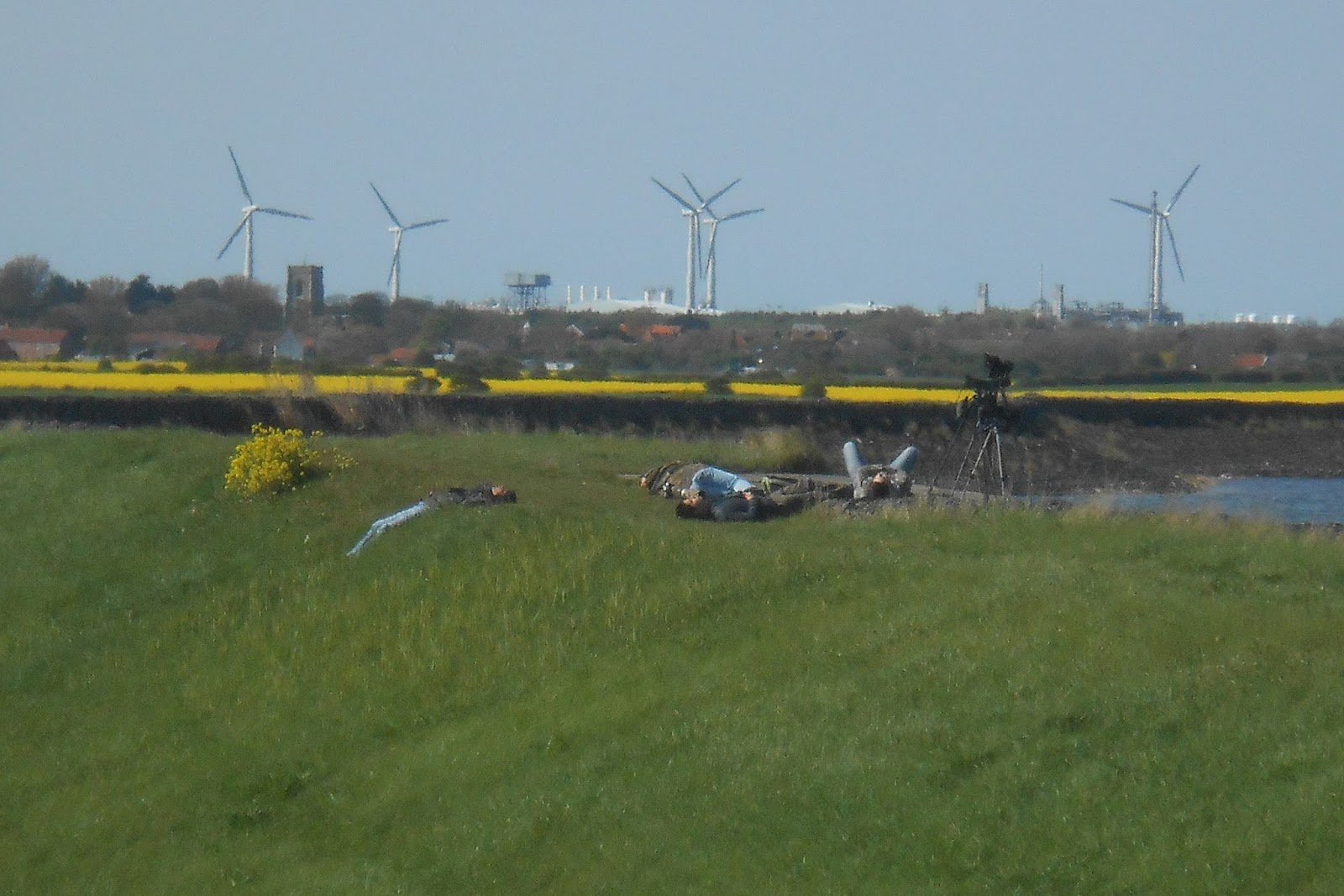
 As you can see, a full days birding left some very tired NGB'S strewn about on the raised track between Kilnsea Wetlands and the Beacon Pools.


4/05/14
As you can imagine, having had a good reward from getting up early the previous day, I chose to repeat that. A much better nights sleep left me feeling in a better mood, and I head out to find some birds! The wetlands held a flock of 4 Pintail, and the Pools had 2 Shoveler, a Common Sandpiper, and the female Common Scoter from the previous day remained. A number of Little Tern were feeding in the pools, giving stunning views from the raised track. A single Snipe was showing in fields adjacent to the road


Yellow Wagtails were moving en mass throughout the day, even from very early in the morning, and it is possibly the first time I have ever said "Just another Yellow Wagtail". 2 Marsh Harrier passed through during the day, one even hunting in the field, as view from our tent! A Greenshank flew in off the sea mid-afternoon. Migration in action!
 
 
While walking up the beach side of the Beacon Pools, I met up with Sam again, and we walked up Beacon Lane, and soon after, we were treated to great views of a male Lesser Whitethroat, and then a male RING OUZEL started 'chacking' in the hawthorns next to us, showing briefly in the grounds of the caravan site and in flight!
 
There really did seem to be Lesser Whitethroat everywhere, and while watching ANOTHER 2 near the Bluebell, a Tree Pipit flew low over our heads calling.
Just up the road, a late BRAMBLING was showing around the grounds of Kew gardens.
 
Down at the Warren, a repeat of yesterdays wader flocks was again a great sight, and it was spent scanning with Martin Garner of Birding Frontiers fame. The large Dark-belled Brent Goose flock had been joined by two Pale Bellied Brents (One shown in photo).
 
 
Wader numbers were higher than the previous day, and we enjoyed larger numbers of almost the full range of Arctic breeding waders in summer plumage. With news having emerged of a couple of migrant passerines out on the point, we dragged ourselves on the long walk across the sand out to the concrete track. The recent storm tides of winter 2013/14 had washed a significant part of the road out, making access difficult.
 
We managed to locate a male Redstart, and after texting Justin (who was already on the point) he came to have a look. While waiting for the bird to re-appear, we heard a 'Crest' calling from an area behind us, and immediately knew this was the FIRECREST we had been wanting to re-locate. Eventually, we all had great views as it came to the edge of its favoured bushes a few times.
 
With time now coming to a close on the NGB trip, we made our way back to the Warren, where we were told we had just missed a flypast Spoonbill, but a hunting Short-eared Owl gave us some compensation as we rested before starting our journey.
 
 
Despite no real rarities, (being from a midland county) I had a great time seeing decent numbers of passage migrants, and certainly saw more than I would in my home counties.
 
Thanks to James G for driving, and for providing the tent, I would have been a little stuck if it wasn't for you! Also, thanks to all NGB's that turned up, for the banter, and for sharing news on birds that were being found, it certainly made a great break to endless revision!
 
MB