Showing posts with label Firecrest. Show all posts

Thursday, 28 January 2016

May 2015- Hudwit!

May 2015
One good  aspect of writing something in hindsight is the fact that it takes somewhat of a greater context. And within the context of the entire year, one of the most stressful birds for me turned out to be the Hudsonian Godwit.  Having turned down a lift on the birds first day (at the end of April), it looked like I had missed my chance when it then disappeared.
I don't usually get annoyed about missing birds, and stress isn't something I usually feel when thinking about them, but with something as striking (and incredibly rare as a Hudsonian Godwit!) something was different about this one.
Fast forward a couple of days.... It was back!!
However with impending university deadlines it would have been stupid for me to 'Just go for it', and another lift was turned down.
It disappears again... Then reappears.. Another lift offer... Again, circumstances stopped the journey south..
But then, with the weekend approaching, and me having pulled metaphorical chunks out of my hair, it was finally time to head down. As we sped south on the early morning of the 2nd, news emerged it was still there! Joy!
However, one of the better things about this bird was the fact of where it was. Present within the Avalon Marshes at the superb Shapwick Heath, you know you are in for some good birding, and that proved incredibly true, with just stepping from the car revealing flypasts of both Great Egret and Bittern. Standard fare here nowadays!

The 'Hudwit' hadn't shown since the original sighting, but a stirring among the Godwit flock below the near bank (out of view) sent the flock into the air, to shouts of 'there it is'.

A second or two later, the flock alighted at the very back of the flash, and among it, the yank Godwit that had caused me so much pain, anguish and stress over the course of the last 7 days. It stayed on view for the remainder of the visit, allowing for close study of this superb looking bird.
However, it was clear that it was all about those underwings, and after tantalising for what seemed like an age, it finally raised its wings, to an audible gasp for the large crowd of onlookers.


A great supporting cast was noted, Great Egrets, Bitterns, Garganey, Hobbys, Marsh Harriers and a singing Grasshopper Warbler. Superb

A rather ambitious plan to twitch a trip of Dotterel fell through while driving back north, so we decided to drop into Slimbridge, where a Little Gull was flitting around the pools and a couple of GCP Cranes were giving stonking views.

Mid month (15th) a plan was hatched to spend the day in Norfolk, always a superb way to spend any time in May, and our usual route was followed. Making our way up from the Brecks up onto the North coast. Our first stop proved good with the expected Stone Curlew and Spotted Flycatcher, but also 3 Firecrests, which gave great views. Not a bird I had seen at this site before so rather unexpected!


The previous year, we stumbled upon a small quarry which held a pair of Turtle Doves, and while driving past again we decided to drop in. And to my amazement, within a few minutes a Turtle Dove started purring! Great, but brief views followed as the birds moved in and out of the gorse. And to think we only stopped to look for Grey Partridge!

Choesley Barns is a regular site for Dotterel in spring, and a large flock had developed and refused to carry on with their migration. With the heat building it made for hard scanning, but with a bit of perseverance, at least 19 were counted in the distance. Certainly not the best views I have had of the species, but a welcomed bird to see at any time.
We had planned to meet up with Gary P, the Biking Birder to have a catch up and we spent the rest of the day birding the site.
Finding the 2 Temminck's Stints were the main priority, and these were located fairly quickly once in the Parrinder hide. Distant, heat haze, not good. 
Luckily, they were showing significantly better later in the day!


Some great birding was had working our way through the masses of expected birds, and it was particularly satisfying to find this ringed Sanderling on the Beach. Apparently ringed in Ghana, Africa!!


A wide array of wader species were present, and a magical encounter with a pair of cooperatively hunting Peregrines culminated in a Redshank using us as a screen to prevent it being caught. The Peregrines weren't too happy and spent a while circling around us at very close range. It was great to watch a variety of Tern species over the sea and the pools, with a number of Littles looking stunning in the sun. Joining them were 4 Little Gulls. The flock of Red-crested Pochard were also giving good views.


Essay hand in date on the 18th and news emerges of a Great Reed Warbler present in Sandwell Valley. A huge shock and another 'I need to get there moment'. Arrived later in the afternoon to hear the bird loudly signing away on the island. I spent a good while trying to get decent views of the bird, with it mostly being fleeting glimpses, however a few rather nice views were had in the end. A 1st for West Midlands county.


The last week of the month 23rd-30th was spent on a family holiday in Pembrokeshire. Little bits of birding here and there revealed a variety of Coastal species, however the highlight of the trip was making it over to Skomer Island again, and admiring the large number of seabirds present, as well as some amazingly confiding Chough!


Back on the mainland, visits were made to Marloes Mere (which was fairly quiet) and the Gann. The tide was at the right stage and a good wader flock was present, with an array of Ringed Plover, Sanderling, Turnstone and Dunlin all giving great views as they fed only a matter of 20ft away.

The last day of month saw me again chasing a Black Tern. Another bird had been found at Upton Warren that morning so, having dipped the last couple, a rush was made to get over there, and very glad we did. A stonking summer plumaged bird giving superb views as it lapped the sailing pool!


MB

Thursday, 3 July 2014

The first 'official' NGB meetup- Spurn 2014

3/04/13
The first weekend in May was the proposed data for the first meetup on the Next Generation Birders, a 350 strong member group (and growing) of young birders, each of which have a common interest. birds and wildlife.
Luckily, I hooked up with local birder James from Shropshire, Justin from Carmarthenshire and Sam from Nottinghamshire, and these became my companions for most of the weekend.
As I'm sure many can guess, Spurn was chosen because of it very enviable track record when it comes to migrants, and despite being a little 'early' in the spring for passage at Spurn I remained hopeful, I was going to see birds I don't usually see in my Worcester homeland anyhow.

After a fairly uncomfortable and cold night camping, I was awoken very early on before the first few sheds of light started to appear to the sound of a Cuckoo'ing Cuckoo, my first of the year, and with the sound of 'Klupping' Avocets and piping Oystercatchers, I took that as my alarm to wake up! A couple of other NGB's, Dan and Sam, had took that as their wake up call also, so we decided to walk to the Beacon Pools via Kilnsea wetlands in the early morning gloom. We had barely got past the last house on the road before ahead of us we spotted a silhouetted SHORT-EARED OWL quartering the long grass and rape fields around us. It flew off fairly quickly though, and flew off towards Beacon lane.

Nearing the Wetlands hide, a stunning male Whinchat perched up on the adjacent rape field, giving stunning views, even despite their still being almost no light.
The pools were quiet, but we kept finding decent birds, a Marsh Harrier flew over, Lesser Whitethroats were singing everywhere and both 'Flava' and 'Alba' Wagtails were piling over in numbers.

One of the outstanding highlights of the trip on the first day however, the great numbers of both Bar-tailed Godwit and Whimbrel on the move, with decent numbers of both moving through the wetlands throughout the day, among these migrating wader flocks were smaller numbers of Curlew and a partially summer plumaged SPOTTED REDSHANK dropped onto the Kilnsea wetlands over high tide with a decent flock of Barwit and Whimbrel.


Throughout the day more birds dropped in, a Common Scoter and 4 Red-breasted Merganser dropped onto the Beacon pools in the afternoon, and the male Whinchat from the morning found a 2nd bird.


 A female Redstart was found, and that was duly located and seen, as was good numbers of Wheatear along the road between Kilnsea and the Warren.
 
 
High tide here was full of activity, with a large wader and Brent Goose flock showing on the adjacent Humber mudflats. Among the numerous Dunlin and Grey Plover were smaller numbers of Ringed Plover, Sanderling, Turnstone and a single Knot, most of which were in stunning summer plumage!
Terns were constantly moving around along the sea, and throughout the day 30+ Little Tern and 4 Arctic Tern were seen.

The rarest bird of the weekend was found in the afternoon, but was sadly not at Spurn, but a few miles up the road. However, despite the short time they saw it we decided to drive over there, we couldn't find it, but a lucky piece of mis-direction led us to find a stunningly plumaged male Pied Flycatcher.
We refound the location where the Wryneck had been, and instead head another Cuckoo and found a singing male Tree Sparrow, a fairly rare bird in my home county so I was very happy!
 
We returned to Spurn and saw the Spotted Flycatcher that had been found, which had drew quite a crowd!


For the sake of completeness, I walked out onto the point in the hope of relocating the Black Redstart seen earlier in the day. This drew a blank and food started to take over our minds, so we hotfooted it back to the Joly Sailers for food and drinks with the other 20 NGB's, via a very showy male Kestrel.


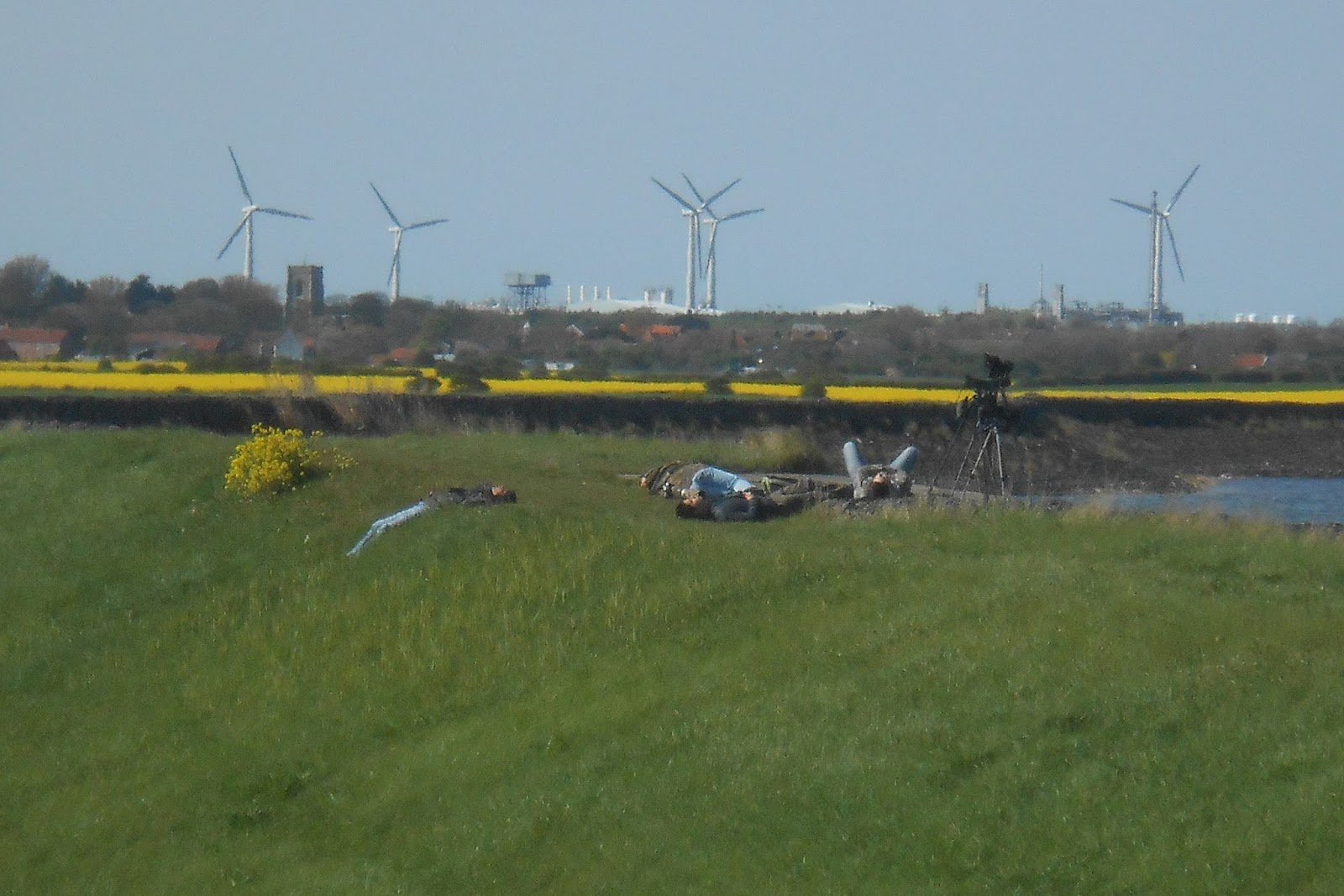
 As you can see, a full days birding left some very tired NGB'S strewn about on the raised track between Kilnsea Wetlands and the Beacon Pools.


4/05/14
As you can imagine, having had a good reward from getting up early the previous day, I chose to repeat that. A much better nights sleep left me feeling in a better mood, and I head out to find some birds! The wetlands held a flock of 4 Pintail, and the Pools had 2 Shoveler, a Common Sandpiper, and the female Common Scoter from the previous day remained. A number of Little Tern were feeding in the pools, giving stunning views from the raised track. A single Snipe was showing in fields adjacent to the road


Yellow Wagtails were moving en mass throughout the day, even from very early in the morning, and it is possibly the first time I have ever said "Just another Yellow Wagtail". 2 Marsh Harrier passed through during the day, one even hunting in the field, as view from our tent! A Greenshank flew in off the sea mid-afternoon. Migration in action!
 
 
While walking up the beach side of the Beacon Pools, I met up with Sam again, and we walked up Beacon Lane, and soon after, we were treated to great views of a male Lesser Whitethroat, and then a male RING OUZEL started 'chacking' in the hawthorns next to us, showing briefly in the grounds of the caravan site and in flight!
 
There really did seem to be Lesser Whitethroat everywhere, and while watching ANOTHER 2 near the Bluebell, a Tree Pipit flew low over our heads calling.
Just up the road, a late BRAMBLING was showing around the grounds of Kew gardens.
 
Down at the Warren, a repeat of yesterdays wader flocks was again a great sight, and it was spent scanning with Martin Garner of Birding Frontiers fame. The large Dark-belled Brent Goose flock had been joined by two Pale Bellied Brents (One shown in photo).
 
 
Wader numbers were higher than the previous day, and we enjoyed larger numbers of almost the full range of Arctic breeding waders in summer plumage. With news having emerged of a couple of migrant passerines out on the point, we dragged ourselves on the long walk across the sand out to the concrete track. The recent storm tides of winter 2013/14 had washed a significant part of the road out, making access difficult.
 
We managed to locate a male Redstart, and after texting Justin (who was already on the point) he came to have a look. While waiting for the bird to re-appear, we heard a 'Crest' calling from an area behind us, and immediately knew this was the FIRECREST we had been wanting to re-locate. Eventually, we all had great views as it came to the edge of its favoured bushes a few times.
 
With time now coming to a close on the NGB trip, we made our way back to the Warren, where we were told we had just missed a flypast Spoonbill, but a hunting Short-eared Owl gave us some compensation as we rested before starting our journey.
 
 
Despite no real rarities, (being from a midland county) I had a great time seeing decent numbers of passage migrants, and certainly saw more than I would in my home counties.
 
Thanks to James G for driving, and for providing the tent, I would have been a little stuck if it wasn't for you! Also, thanks to all NGB's that turned up, for the banter, and for sharing news on birds that were being found, it certainly made a great break to endless revision!
 
MB

Tuesday, 13 March 2012

Am i a photographer? Or do i just like Firecrests?

24/02/12

With my last couple of visit producing dire pictures of the Firecrest, i wanted a record shot for my Note book, so therefore, on a Friday, i walked home from 6th form (1 1/2) miles, and then walked the remaining 5 miles over to Penn Common, where the FIRECREST was still residing.
After getting abit lost on Penn golfcorse, i eventually found myself back on track, and was soon at the area the bird was in, Light Wood.
I was quite proud of myself, as Google maps predicted my journey would take 1 hour 1 minuite, however, i got to the site in just over 40 mins walking, so i was quite happy!
And as i arrived, i scanned over towards its favored hedge, and within 30 Seconds, i was watching the stunning male FIRECREST, flashing its orange crown as it went about its buisness.

It soon flew into a tall tree and started climbing, zipping between branches. Here i got a few photo's which show its orange crown.


Even in this relaxed posture, the orange is easilly visiable on the bird, i watched for about 20 mins before it moved off into the wood, and i informed a couple of birders who appeared from no-where that it was just showing while they were looking in the wrong place!

As time went by, there was still no sign, and both birders left, leaving me along again, soon, as is the luck with birding, the FIRECREST popped out on the edge of the holly not far away. i took a couple of snaps and looked down at the screen,

YES!
A photo of a FIRECREST!


As i had been watching the male bird earlier, i didnt look at its crown stripe, presuming it was the same bird, and just kept the above photo because it was the 'sharpest'. Despite having suspitions as to there being a pair of then on site, having seen a seemingly yellow crown striped bird on my first visit! With the light dropping, and the Firecrest having again dissapeared, i went looking for a bird i had heard calling all day, a flock of 15 YELLOWHAMMER, including 6 males which perched on the hedgeline further south of the wood, also mixed in was 4 Bullfinch and 10 Linnet.

However, over a week after seeing the bird, i finally uploaded the 'full set' of photos that i took and i went through them, and i was shocked when i came to this one. In the same 'set' as the picture above, pic 1 was blury, very blury, pic 2, again blury, pic 3, the photo below, pic 4 the 'good' photo, Pic 6, the bird dissapearing into the hedge.

On reviewing picture 3 i finally came to checking the colour of the crown stripe, and saw this!


A completly yellow crown stripe!

Could this mean that i was right, and there are 2 FIRECRESTS at Penn Common? please leave a comment on your thoughts.

I remain fairly certain there are 2 birds,
I know the stripe can 'change colour' when the bird is adjitated, or exited, however, i have seen the male bird in both 'relaxed' and 'exited' state, and both times you could see significant Orange tones (As seen in the relaxed first picture). Having said that, i also (not wanting to sound to far up my own arse) have quite good 'experiance of Goldcrests and their changing crown strpe after many years of close study on the patch (were lucky enought to see over 30 birds regularly!).

Having said the 'pluamge' side. the birds habits also stuck out, the male Firecrest often fed high in tree's, and often showed for long periods of time, however, this possible second bird was ALWAYS low down in the Holly bushes, and was alot less showy, only apperaing briefly each time.

Having summed up the pro's and con's, i cant see how there can only be (or WAS only) one Firecrest at Penn.
Your thoughts would be much appreciated,from people more 'in the know' than me?

MB

Tuesday, 6 March 2012

FIRECREST- Round 2

18/02/12


Well, as i said in the last post, i love Crests, and i couldnt resisit another peek at the Firecrest.
To cut it short, after 30 mins, we spotted the bird flitting within a trackside hawthorn at about 10 ft range!, giving stunning views, it fed around us at very close range for about 15 minuites even showing outside of the holly giving even better views!
In this amazing moment though, i forgot to pick up the camera, and then when i did, i failed to get anythig decent, as the bird was constantly moving, and with slow focousing camera, it didnt work very well.
However, i manadged this shot!


However, after these views, we didnt see this bird again, so, with the light dropping, we left for home.
MB

Monday, 5 March 2012

Bi-county Twitching

15/02/12

AS readers may know, i like seeing 'rare' birds, so, although primarily being a patch birder, i do like to visit odd locations for out of range birds.
And there happened to be one quite close by, a Firecrest had been found near Penn in south Staffs, so with a day free, we decided for a look!
The 2 'crest' species being particular favorites of mine, so i was enthusisatic, as i had heard both were showing side by side in the small woodland.

And here we were.


After about an hour looking, we finally clocked onto a stunning FIRECREST darting about between Holly, and adjacent Tree's, we were treated to great views of this stunning crest at about 30ft range.
I must say, it was great to catch up with this species again!
After about 20 Minuites watching the bird, we left for another site, Sandwell Valley RSPB

As i didnt get any photos, here is a drawing of the FIRECREST (Life sized)


So onwards and upwards, Sandwell Valley RSPB had been holding a redhead Smew for the last few days so we decided to head off there.
On arrival at the lakeside hide, we were treated to views of a stunning drake PINTAIL feeding within the reeds, a great bird to see anywhere, never mind at an urban reserve!


However, the lack of Smew got me edgy, i was informed it flew out 5 minuites before, so decided to stick around, and forfit the visit to Stubbers Green after.
I was kept entertained by a female GOLDENEYE and a decent flock of Goosander. I picked out a adult Common Gull in the gull flock.


However, a good time later, i finally heard the sound was hoping for as someone spotted the SMEW!


Although there was debate as to the age/sex of this bird, i am quite confident that this bird is an adult female despite the small amout of white feathers on the brown 'hood'. The lores were black, and the belly was white (would be grey in 1st win drk).

As the hide closed soon after the bird returned, we headed to the feeders, where i soon got onto a WILLOW TIT. i even manadged a crap photo!


We then headed into a nearby wood, where we saw a single female RING-NECKED PARAKEET


With 5 year ticks, i can say that it was a good day!
MB