Showing posts with label Lesser Whitethroat. Show all posts

Tuesday, 28 October 2014

Ash Brownies! Butterfly watching

24/08/14
Usually when I go looking for Butterflies I like the solitary aspect, and I spent many hours this year walking around and stalking these dainty beauties.

However, I was approached by a friend from Hereford saying there was an open day at Grafton Wood and wondered if I wanted to go.
As a site I have never previously visited, a guided walk seemed the more sensible option.

Grafton is considered to be one of the the main strongholds for one of the UK's slightly more scarce butterflies, the Brown Hairstreak. It wasn't a very hard decision, and plans were made to join the group in the Church carpark at Grafton Flyford in the morning.

A large crowd had developed, and lots of familiar faces started to emerge from the crowd!

Following a walk around the entire south end of this rather appealing woodland, but having seen very little, 2 Purple Hairstreak being the obvious standout highlight, we heard news that the group at the north end had found a couple of Brown Hairstreaks!

A walk to the opposite end of the wood followed, and soon after a rather stunning female BROWN HAIRSTREAK was showing rather beautifully on trackside vegetation, moving between bouts of sunning and egg laying!


A 2nd 'Ash Brownie' was flying about but they were part of only a few Hairstreaks seen by the entire group during the open day. It had been a poor year!
 
We managed to find a few birds on our jaunter too, and a male Redstart was flitting about in the hedgerows outside the main woodland, as was a male Yellowhammer. A Yellow Wagtail flew over calling.
However, a short walk away, 2 Spotted Flycatchers were feeding on a fenceline, and were showing superbly as the adult would fly in to feed its speckled juvenile.


A nice mixed flock were also moving through the adjacent willows, a Lesser Whitethroat and 2 rather stunning juvenile Willow Warblers showed well as they moved past among the usual Blue and Great Tits.
 
Having completed the task for the day, I dropped into Grimley CLP on the way home, which was rather quiet, however there were some very nice birds around, 8 Little Egrets were still on show, and a large Wagtail flock included 5 Yellow Wagtails.
 
 
A adult Hobby was showing nicely but the highlight of the visit was my first Whinchat which was perched very distantly on fencelines far to the south.
 
A check of Waggon Wheel pits was needed but again it was rather quiet.. 
 
However, a Whinchat showing superbly on the eastern side of the pools certainly made a good highlight. I always enjoy seeing (and moreso finding!) these rather smart birds, and it is always a pleasure to do so!

 
MB

Friday, 17 October 2014

Amazing patch birding. Non stop migrants!

 August 2014 must surely go down as one of the best birding months I have ever had on patch. Despite there being no rare birds, I left each visit feeling happy with a superb variety of species, both migrants and residents, and a fair number of surprises.
 
Foremost what must be mentioned was the superb showing of REDSTARTS throughout the month. As regulars will know, they in previous years have been hard to come by, so I was overjoyed with a single female on the 9th, but the next couple of weeks proved to be extremely productive, and on 16th I found 2 more Redstarts, including a stonking male but then it went crazy!
 
17th saw a mass arrival of these stunning blue and red jewels as I found an unprecedented 5 Redstarts in various points around the Lickhill meadows section of the patch (3m, 2 fem/juv). This included 2 birds which were feeding on fence posts adjacent to one of the permissive roads that runs through the fields. Luckily I have access, and was treated to stonking views!


As well as the pair of Redstart, the same section of fenceline was often also the perch of a migrant Lesser Whitethroat, enjoying the suns rays.


The arrival of these birds coincidentally coincided with a planned week thrashing the patch and I spent nearly all of the daylight hours out thrashing the bushes and vismigging. The 18th had 4 Redstarts and the 19th 3. Both the 20th and 21st then had one each and then they were gone!
 
No doubt this week will end up being known as Redstart week for me in future years!
 
It seems crazy to think I mentioned Redstarts before a patch first, but their sustained presence was wholly unexpected, but the arrival of my first patch WHEATEAR (A female) which was present in some horse paddocks early on 21st was gratefully received non the less. However it could not be relocated later in the day. A Wheatear has been long coming, so I wasn't hugely surprised to pan onto this bird!
This was followed by a male bird on the 25th and 3 present on the last day of the month (31st). So much for a patch mega!
 
 
But wait!! I have another patch mega!
 
And another first for patch infact, as a LITTLE EGRET flew over south during drizzle on the 25th! No doubt the bird I had seen earlier in the month feeding on the river at Bewdley, but it was certainly very welcomed to have seen it within the patch boundaries!
 
Semi- regular Yellow Wagtails were also found, with birds being found on 6 dates, with a maximum of 3, but most of the records related to multiple birds. A female and a juvenile perched on a fenceline in the Meadows, and despite having a broken camera (broken screen) and not being able to see what I was photographing, I got lucky and got this one pic which showed one of the Yellow Wagtails.


2 Tree Pipits flew over, one on both the 16th and the 24th, and numbers of general vismig species, such as Pied and Grey Wagtails, and the first few Meadow Pipits of the autumn increased as the month passed.
This increase was also juxtaposed with an increase in Hirundine numbers, and triple figure counts of all 3 common species were regular! And with the large concentrations of these brought very regular interest from at least 3 HOBBY, which were present most days!

All the 'regular' warbler species were present, with the only real disappointment being a real lack of Willow Warblers, but a few sulphur yellow juveniles added a massive dose of colour! Particularly impressive though was a sustained presence of Lesser Whitethroats, with 4 present for most of the month, and often showing very nicely! Certainly one of my favourite warblers, and they never fail to give me a thrill as one flicks onto the edge of their favoured hedgerows!

 
Not to shabby for an area of meadows, paddocks and hedgerows tucked up in NW Worcestershire!
 
MB
 

Wednesday, 1 October 2014

Great patch birding and some more Gulling!

9/08/14
It's early August, for me the official start of 'vismig' season, and it really didn't take much effort to drag myself from the warm confines of my bed to the cold, breezy paddocks on the patch.

Large numbers of Hirundines had started to gather in the insect rich aerospace above  the open fields and paddocks, totaling around 300 birds. These were slowly dispersing south, and a single Swift barreled through.
My first Meadow Pipit of the autumn flew over calling as I picked up a 'hawk' powering low south over the paddocks along the river valley. My bins went up, and that hawk transformed into a juvenile Cuckoo as it continued to fly very quickly across the fields. Following on from a singing male back in the spring, I couldn't help but wonder if it may have been locally bred?

The bird however had no inclination to land, and was watched flying a considerable distance to the south before flying across a line of trees and out of sight!

Hey!

I did say it was the 'start' of vismig season didn't I, so no doubt it wouldn't reap huge numbers and variety of birds!
However, what the air lacked was certainly made up for on the ground, and a decent number of migrant passerines were dotted around the hedgerows. 2 Garden Warbler, 9 Blackcap, 6 Whitethroat, a Lesser Whitethroat, 2 Willow Warbler and 10 Chiffchaff were not at all a bad haul.

A lone elderberry bush stands in the middle of the paddocks, and it was nice to see a male Blackcap and a female Whitethroat feeding from it, and it was while watching this nice duo a flash of red caught my eye as a mouse brown female REDSTART flicked out onto the edge of the bush!

Redstart for a good number of years has been a very rare/ overlooked bird on the patch so it was great to finally see another. Needless to say, to see 3 migrant passerines feeding together in a small lone bush only reminds me why I do love Bird migration, and truly anything can turn up anywhere!

The evening was spent at my usual Saturday evening location of Upton Warren, and again, the best bird took until the last shreds of light to show up, but when it did a stunning adult Mediterranean Gull dropped in among the roosting BHG, of which numbers had built up to around 1200.

Adult Med Gulls aren't the most common of ages at Upton Warren and therefore I was quite happy to have pick out this stunning Gull. Just check out those white primarys!


The bird walked around with an obvious limp, but it was more preoccupied with roosting than anything else. It's very delicate proportions, and rather 'thin' primarys indicated that the bird was probably a female.

The flashes also held a total of 16 Green Sandpiper, 3 Common Sandpiper and 7 migrant Snipe.

MB

Friday, 26 September 2014

Egrets, Gulls and Old friends

2/08/14
With it being the first few days of August, and with Migration now underway, I was out on patch nice and early to scout the riverbank.

Sadly, despite thrashing the patch for the next 3 hours, other than a few Warblers, such as 2 Garden Warbler, Lesser Whitethroat and a few Willow Warbler it was much the same as always.

Next, I headed into Bewdley town centre, and being obsessed with Birdtrack, I decided to walk along the river, to count the Mute Swans!

What I was not expecting however was to find a Little Egret pottering about below the bridge with a roosting flock of Swans!


As well as this surprise, 4 Mandarin joined the waterbird flock, as did a female Goosander. Not bad for a quick journey to the shops!

Later that day, it was time for a roost shift, and following a look around the Moors pool, which held 3 Little Egrets among the expected species, but otherwhys quiet, so I headed down to the flashes.

It didn't take long for the Gulls to start piling in, but numbers remained fairly low (only about 600). A familiar friend dropped in, as ringed Black-headed Gull '2K44' dropped in. I first saw this Gull back in 2010 as a 1st year, and it was therefore good to see it having reached adulthood!


It wasn't much longer after before the main target of the evening dropped in, as another stunning juvenile Mediterranean Gull dropped in for the evening, giving nice views as it preened on the islands right up until dark, rather than the snoozy bird of the previous weekend.


It switched islands and sat on the read edge of the main island for the remainder of the evening.


A good variety of waders were also present on the pools with 9 species being present, with a decent count of 16 Green Sandpipers being noteworthy. 3 Common Sandpiper, a Dunlin, 10 Snipe and 3 Little-Ringed Plovers made up the list of migrant waders present among the regulars.

MB

Friday, 8 August 2014

Savi's in the bag!

8/06/14
With the continued presence of the Savi's Warbler at Newport Wetlands, and with it being only an hour and a half down the road it was worth the effort (It takes that amount of time to reach some midlands sites, never mind south Wales!)
 
Sadly however, with it having been around for a number of weeks, it had become much more elusive, and that proved so true!
 
Hours were spent standing adjacent to the area the bird had been seen in, and there was very little activity. Bearded Tits could be heard 'pinging' from many stands of reed around us, and brief flight views proved a welcomed distraction to what was rather a tedious wait.
 
As I said though, hours passed, and there was still nothing, the only hope resting on the fact the bird had been heard very early that morning! Time dragged on, a few Little Egrets flew past but it was hard to keep staring at a seemingly empty patch of reeds.
 
Eventually I cracked, and walked off, and I continued on, and still, saw very little. But eventually a couple of long tailed birds could be seen flicking across the tops of the reeds, and as I was standing behind one of the screens, a Bearded Tit flew in  and dropped down on the edge of the reeds, showing very well!
I had left my scope back at the crowd which was just down the track, so I only had my bins to take photos. But still, I managed a few photos which are my first of the species!


Feeling quite happy with that, I trudged back to the crowd.
 
A bird started moving in the reeds below us, and then it happened!
It reeled!
 
The dry wooden rattle rang out for a short time, and then it went silent, as it slowly moved through the reedbed, where it could be seen as it slinked its way back into the depths of the reedbed! And that was it, 3 hours for less than 10 seconds, not particularly satisfying considering views other people had been getting, but non the less, it was the SAVI'S WARBLER! Finally!
 
Another significant time followed, but still it steadfastly refused to show, so it was time to head back to the car. However, one last decent find was a singing Lesser Whitethroat along the track back to the visitor centre.
 
MB

Monday, 28 July 2014

The annual pilgrimage! Pembrokeshire 2014

25/07/14
Perhaps didn't get as much birding time in as I was hoping on this holiday, but some good days non the less!
 
I headed out early to be on the clifftops behind our accommodation, and although it was late May, the brisk and cool morning winds was still harbouring a slight whiff of migration, and a few Lesser Whitethroats, Whitethroats and 'Phyloscs' certainly added to that feeling.
 
My main intention though was to get out to a nice high point and have a couple of hours seawatching.
With Oystercatchers calling from the rocks below, and Gannets and Fulmar fishing and gliding close in to the cliff, it was a rather relaxing affair, as actually rather little was moving on the sea!
However, a party of 7 waders flying in from the west quickly attracted my full attention, with long necks and bill shining a vivid orange as they moved further east, with their huge white wing bars and black and white tail it was obvious I was watching my first Pembrokeshire BLACK-TAILED GODWITS of the year, they continued east, fast across the horizon, before dropping out of sight behind the headland.
A further 2 hours passed and 3 Mallard was all I had to show for it (Mallards!!), but quickly two large seabirds came in from the east, hugging the coast so they were maybe only 100ft out. Immediately obvious was the fact that two divers were flying towards me! They got closer and closer, and it was about when level with me it stuck that both of these birds were huge! They're huge pale grey bills could be seen as could a dark half collar and large, projecting feet, they were winter plumaged GREAT-NORTHERN DIVERS! Being so close I thought they would drop onto the sea off Freshwater east, but rather than doing this they jutted out into the sea, heading for St Govans head in the distance, but this allowed for prolonged viewing as they flew away from me. A small party of 10 Razorbill flew past from the direction of a nearby breeding colony.
 
With no Tern movement, despite an onshore breeze, I took a few snaps of a few of the resident seabirds of the shores around Pembrokeshire and went off searching for landbirds!


Soon, in one of the steep 'gullys' that had been eroded by the sea a juvenile Raven was found, hopping from rock to rock and showing that juvenile interest in anything that only a chick recently out of the nest could have!
 
 
It's parents were in close attendance, searching for food on the cliff edges, and giving absolutely stunning views, showing off their glossy plumage to full effect in the sun, shimmering blue, green and purple in the light!
 
 
Rock and Meadow Pipit's were ubiquitous, as were Stonechats, with 16 counted including many 'first broods'. As always though, these active firecrackers of a bird always made me stop for a little while I had a quick watch. It was quite interesting to watch their feeding methods as they worked the gorse and heather in pairs, with the male keeping vigil as the female gathered food for the chicks.
 
 
As you would expect, I managed to locate a number of a west coast of wales speciality, and once the walk had been completed, a total of 8 CHOUGH had been seen tumbling through the air, filling the air with their distinctive crys. Sadly, non were co-operative enough to perch up for a photo, but a number of nice flypasts were enough to keep me happy!
MB

Thursday, 3 July 2014

The first 'official' NGB meetup- Spurn 2014

3/04/13
The first weekend in May was the proposed data for the first meetup on the Next Generation Birders, a 350 strong member group (and growing) of young birders, each of which have a common interest. birds and wildlife.
Luckily, I hooked up with local birder James from Shropshire, Justin from Carmarthenshire and Sam from Nottinghamshire, and these became my companions for most of the weekend.
As I'm sure many can guess, Spurn was chosen because of it very enviable track record when it comes to migrants, and despite being a little 'early' in the spring for passage at Spurn I remained hopeful, I was going to see birds I don't usually see in my Worcester homeland anyhow.

After a fairly uncomfortable and cold night camping, I was awoken very early on before the first few sheds of light started to appear to the sound of a Cuckoo'ing Cuckoo, my first of the year, and with the sound of 'Klupping' Avocets and piping Oystercatchers, I took that as my alarm to wake up! A couple of other NGB's, Dan and Sam, had took that as their wake up call also, so we decided to walk to the Beacon Pools via Kilnsea wetlands in the early morning gloom. We had barely got past the last house on the road before ahead of us we spotted a silhouetted SHORT-EARED OWL quartering the long grass and rape fields around us. It flew off fairly quickly though, and flew off towards Beacon lane.

Nearing the Wetlands hide, a stunning male Whinchat perched up on the adjacent rape field, giving stunning views, even despite their still being almost no light.
The pools were quiet, but we kept finding decent birds, a Marsh Harrier flew over, Lesser Whitethroats were singing everywhere and both 'Flava' and 'Alba' Wagtails were piling over in numbers.

One of the outstanding highlights of the trip on the first day however, the great numbers of both Bar-tailed Godwit and Whimbrel on the move, with decent numbers of both moving through the wetlands throughout the day, among these migrating wader flocks were smaller numbers of Curlew and a partially summer plumaged SPOTTED REDSHANK dropped onto the Kilnsea wetlands over high tide with a decent flock of Barwit and Whimbrel.


Throughout the day more birds dropped in, a Common Scoter and 4 Red-breasted Merganser dropped onto the Beacon pools in the afternoon, and the male Whinchat from the morning found a 2nd bird.


 A female Redstart was found, and that was duly located and seen, as was good numbers of Wheatear along the road between Kilnsea and the Warren.
 
 
High tide here was full of activity, with a large wader and Brent Goose flock showing on the adjacent Humber mudflats. Among the numerous Dunlin and Grey Plover were smaller numbers of Ringed Plover, Sanderling, Turnstone and a single Knot, most of which were in stunning summer plumage!
Terns were constantly moving around along the sea, and throughout the day 30+ Little Tern and 4 Arctic Tern were seen.

The rarest bird of the weekend was found in the afternoon, but was sadly not at Spurn, but a few miles up the road. However, despite the short time they saw it we decided to drive over there, we couldn't find it, but a lucky piece of mis-direction led us to find a stunningly plumaged male Pied Flycatcher.
We refound the location where the Wryneck had been, and instead head another Cuckoo and found a singing male Tree Sparrow, a fairly rare bird in my home county so I was very happy!
 
We returned to Spurn and saw the Spotted Flycatcher that had been found, which had drew quite a crowd!


For the sake of completeness, I walked out onto the point in the hope of relocating the Black Redstart seen earlier in the day. This drew a blank and food started to take over our minds, so we hotfooted it back to the Joly Sailers for food and drinks with the other 20 NGB's, via a very showy male Kestrel.


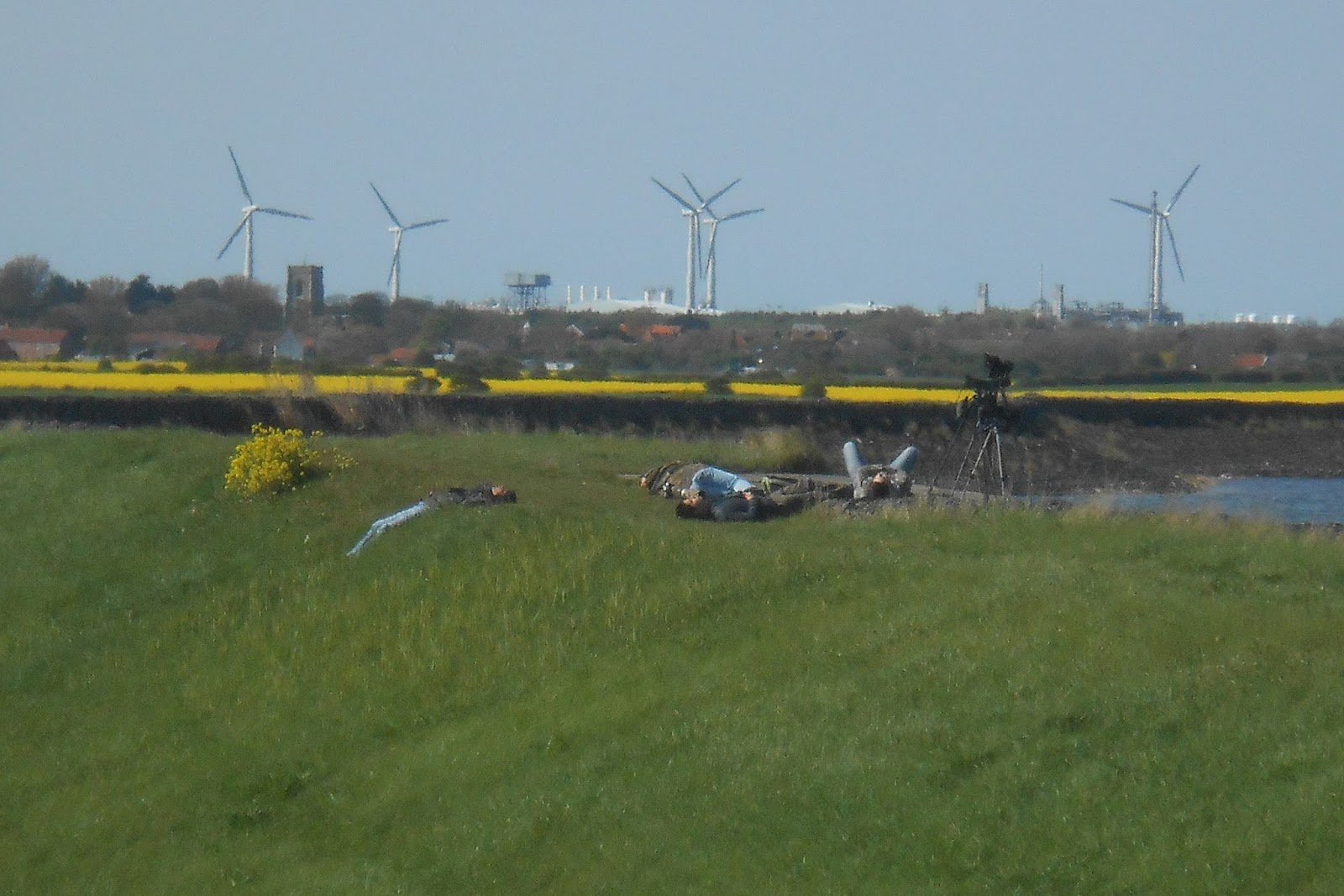
 As you can see, a full days birding left some very tired NGB'S strewn about on the raised track between Kilnsea Wetlands and the Beacon Pools.


4/05/14
As you can imagine, having had a good reward from getting up early the previous day, I chose to repeat that. A much better nights sleep left me feeling in a better mood, and I head out to find some birds! The wetlands held a flock of 4 Pintail, and the Pools had 2 Shoveler, a Common Sandpiper, and the female Common Scoter from the previous day remained. A number of Little Tern were feeding in the pools, giving stunning views from the raised track. A single Snipe was showing in fields adjacent to the road


Yellow Wagtails were moving en mass throughout the day, even from very early in the morning, and it is possibly the first time I have ever said "Just another Yellow Wagtail". 2 Marsh Harrier passed through during the day, one even hunting in the field, as view from our tent! A Greenshank flew in off the sea mid-afternoon. Migration in action!
 
 
While walking up the beach side of the Beacon Pools, I met up with Sam again, and we walked up Beacon Lane, and soon after, we were treated to great views of a male Lesser Whitethroat, and then a male RING OUZEL started 'chacking' in the hawthorns next to us, showing briefly in the grounds of the caravan site and in flight!
 
There really did seem to be Lesser Whitethroat everywhere, and while watching ANOTHER 2 near the Bluebell, a Tree Pipit flew low over our heads calling.
Just up the road, a late BRAMBLING was showing around the grounds of Kew gardens.
 
Down at the Warren, a repeat of yesterdays wader flocks was again a great sight, and it was spent scanning with Martin Garner of Birding Frontiers fame. The large Dark-belled Brent Goose flock had been joined by two Pale Bellied Brents (One shown in photo).
 
 
Wader numbers were higher than the previous day, and we enjoyed larger numbers of almost the full range of Arctic breeding waders in summer plumage. With news having emerged of a couple of migrant passerines out on the point, we dragged ourselves on the long walk across the sand out to the concrete track. The recent storm tides of winter 2013/14 had washed a significant part of the road out, making access difficult.
 
We managed to locate a male Redstart, and after texting Justin (who was already on the point) he came to have a look. While waiting for the bird to re-appear, we heard a 'Crest' calling from an area behind us, and immediately knew this was the FIRECREST we had been wanting to re-locate. Eventually, we all had great views as it came to the edge of its favoured bushes a few times.
 
With time now coming to a close on the NGB trip, we made our way back to the Warren, where we were told we had just missed a flypast Spoonbill, but a hunting Short-eared Owl gave us some compensation as we rested before starting our journey.
 
 
Despite no real rarities, (being from a midland county) I had a great time seeing decent numbers of passage migrants, and certainly saw more than I would in my home counties.
 
Thanks to James G for driving, and for providing the tent, I would have been a little stuck if it wasn't for you! Also, thanks to all NGB's that turned up, for the banter, and for sharing news on birds that were being found, it certainly made a great break to endless revision!
 
MB

Wednesday, 25 June 2014

Dotterel, Partridges, Grouse, Flycatcatchers and a bit of Med.

18/04/14
It was late on the evening of 13th that news emerged that a large flock of some stunning passage waders had dropped onto a regular stop-off on the Long Mynd, and sensing my angst to get up there, Liz, Rob and Luke came to my rescue, and within an hour, plans were arranged for a dawn journey up onto the stunning Shropshire hills.
 
Unfortunately, I usually miss Dotterel passage, but this year the birds arrived on a day I was able to drop everything.
 
Following a bit of driving around, we soon located a suitable looking field up on one of the peaks of the Mynd, just down the road from Pole cottage, and even from a distance, a couple of birders could be seen.
 
We were soon informed that the entire flock of DOTTEREL were still present! All 12 of them!
 
Even though the light was poor, we had amazing views of the birds as they trotted around the sheep grazing field. Of the flock, 8 were males/ winter plumaged birds, but the remaining 4 were all stunning summer plumaged females, truly stunning birds,
 the mixture of slate grey contrasting strongly to that vivid orange belly and bright white face and breast markings!


Soon however, the sun started to come out, and the light improved, showing just how stunningly beautiful these high plateau breeding waders are!


Even from early on, it was clear the birds had migration on the mind, being very flighty, taking off and circling, sometimes up to a great height, calling , but always eventually dropping down, often giving binocular filling views as they flew past the ever growing crowd.


While watching the Dotterel flock, a few raspy clucking calls from behind us in the heather gave us prior warning to a short fly past of a pair of RED GROUSE before they dropped back down into the undergrowth, and no doubt then going off scuttling away along the ridge.

 With the crowd now growing  rapidly, we moved on to another site in the hills, where we managed to find a nice and early male PIED FLYCATCHER, singing his heart out from adjacent to his chosen patch of trees.


In the distance, a spiral of soaring Raptors guided us onto a loose 'flock' of 4 Red Kite, 2 Raven and 8 Buzzard, not at all a bad combination!
 
Our last check of the Shropshire hills led us onto the Stiperstones, where we managed to 'connect' with even more summer migrants, with both Tree Pipit and Redstart singing. The heather held a few Stonechats, and 2 Red Grouse gave stunning views as they flew past us and over the ridge and the adjacent valley proved superb hunting grounds for another 2 Red Kites.
 
Moving onwards again, we moved to Venus Pool, where a long staying Mediterrenean Gull was showing on the water, a rather poorly marked 1st winter bird, but it gave good views in both flight and on the water. A single Little ringed Plover was scuttling around one of the islands and a late male Pochard was on the water.
 
 
With the pool being generally quiet however, we decided to walk around, down to the river and back. In doing so, a male Yellow Wagtail flew over our head calling.
 
On our walk around some nearby fields, a pair of GREY PARTRIDGE flushed out of the set aside ahead of us, before flying off and landing on the set aside on the opposite side of the field. It was great to see this species in particular, as it is one I do not regularly see at all!
 
As it was on the way back, it would have been rude to not drop into Chelmarsh, and we were rewarded with a singing Lesser Whitethroat, which was showing in the hedge adjacent to the parked car. 2 Whitethroat were also showing here which added to the passerine interest of the day. The reservoir had low water levels, and 4 Common Sandpipers were wading the edges. A surprise female Goosander was also roosting on the water.
 
 
Following on from a great days birding, we split our ways, but we were all reunited as soon as a few hours later, when we turned up to Upton Warren to try to see the reported Savi's warbler.
 
A couple of hours later, a few singing Sedge, Reed and a single reeling Grasshopper Warbler was all we had to show, but the banter was brilliant and ended a great day perfectly.
 
MB


Thursday, 14 November 2013

Pembrokeshire- Autumn 2013

I have never been to Pembrokeshire in the Autumn before! So as you could expect, a week away was highly anticipated! We were staying in the freshwater east area and i spent much of the week searching the surrounding area.

Soon after arrival out our beach-side temporary home i was already picking up birds, with 4 Sanderling scurrying along the shoreline close to some fishermen. All of them being juvenile's and these were the first of many over the week. 5 GBBG were also on the sand with a Shag out in the bay.

The next morning i was itching to get out, so i was out at 6:30am, and was soon ammassing a healthy list of species, a 1st winter MEDITERRANEAN GULL spent some time on the Beach before flying off, as did a winter plumaged BAR-TAILED GODWIT and a single juvenile Sanderling.

As time progressed, and having had little luck on the cliffs (No seabirds moving other than Gannets) i moved back down onto the Beach, where a juvenile Sanderling was showing, which as the tide increased became more and more confiding. After a patient wait, this superb arctic wader approached within 15ft of where i was sat, giving superb and intimate views!


Nice view isnt it.


The Sanderling remained all day on the Beach, moving out on the tide then moving back in again. Another wader highlight was soon given when a WHIMBREL fly over calling, as did an Oystercatcher and eventually 2 CHOUGH were seen over the hillside.

The next morning i awoke with optimism again, and i was out searching the area from early on in the morning and i was rewarded with a superb range of species. By far the standout species was that of a superb SABINE'S GULL which hung around offshore for around 15 minuites with a large flock of Gannets, Kittiwakes and Gulls, with 11 SANDWICH TERN'S, 20 Fulmar, 5 MANX SHEARWATER and the same 1st winter MED GULL as yesterday! Hows about that for a bit of seawatching! There was a massive movement of Hirudines and easily 2000 Swallow, House and Sand Martin flew over, all going south and straight out to sea! Watching them skimming only a flew feet over the top of the headland before dropping down to sea level was breathtaking! A TREE PIPIT put on a similar preformance heading straight south calling. Actually on the headland it was quieter, with a single Stonechat, 2 Whitethroat and i flushed a GREY PARTRIDGE while walking through waist high foliage.

Here was the view from my self designated 'Seawatching spot'.


A brief watch later in the day around 12:30 revealed a dark morph ARCTIC SKUA was followed the coast heading SE.
A small flock of Gannets entered the bay, and i tried to take some digi-scoped flight shots,


Again, a nice early start had me out scouring the clifftops. The Hirudine passage was still going incredibly strong with 1000+ Swallows and about even numbers of House and Sand Martin at around 100 birds. 'Alba' Wagtails were also on the move, and 50 flew over, as did a measly 20 Meadow Pipit. In contrast to yesterday, there was very little seabird activity and an after an hour I gave up and scoured the gorse. I had closer views of the CHOUGH pair, but could not locate their feeding area. It was while doing this I heard the 'raspy' call of a Dunlin as one wizzed past over my head. Passerines were still a little hard to come by, but 2 Whitethroat and 2 Stonechat were found. Late in the day, 3 Sanderling came up on the tide, but didn't hang around for long!
 
11/09/13
A visit into Tenby town always produces Rock Pipits and I wasn't disappointed when I found 3 birds on the south beach.
 
12/09/13
Do you know those days where you really couldn't ask for much better? That one day where the slightest bit of dampness in the air and a little fog and every bush seems to have some sort of life in it. These next two days certainly lived up to that expectation, not because of the rarity of what was seen, but just for that feeling of interaction you get when you come face to face with a variety of migrants, that you know in just a few weeks would be flying across oceans, plains, deserts and countries to reach their wintering ground. That brief moment when you can almost feel that slight feeling of anxiety, that desperation to move onto pastures new.
Quickly I found 3 SPOTTED FLYCATCHER doing exactly as their name implies, flycatching off a wire fence along a hawthorn hedge only 50ft from the sea, obviously waiting for that moment to launch themselves off towards Cornwall of beyond. In the fields adjacent to this hedge, 5 WHEATEAR and at least 40 WHITE WAGTAIL were scurrying around, relentlessly searching for sustenance for its upcoming journey. Multiple Chiffchaffs, Blackcaps and Goldcrests, Constant streams of Linnet, Goldfinch, 'Alba' Wagtails and Meadow Pipits overhead.


A late evening jaunter on the beach was rewarded by a flythrough flock of 15 Dunlin.
 
13/09/13
If the previous day had been good, today was brilliant! 'Our' SPOTTED FLYCATCHERS were still hanging on, but had been joined by a 4th bird overnight, and the hedge was absolutely teeming. 5 Willow Warblers, 5 Chiffchaff, a Whitethroat and multiple Goldcrests were also flitting from the hedge to the wire fence, obviously a prime feeding spot. The adjacent horse paddock was similarly teeming, but with Wagtails, Pipits and Goldfinch. 30 White Wagtail remained, with small flocks of Meadow Pipits in the weeds (Although 150+ flew over) and 50 Goldfinch were feeding on Thistles.


A very good start and I quickly had itchy feet to search the rest of the coastline. A LESSER WHITETHROAT was feeding on Trewent Point, and I was briefly exited as I saw a black 'mask',blue head and a peach breast perched on the top of a hawthorn. Shrike flashed through my mind but a change of viewpoint revealed the head on bird to be a male WHEATEAR, 3 others (totalling 4) were present in more typical habitat.


6 Stonechats were found, but my personal highlight was when a bright orange autumn male REDSTART perched on a wire fence, only feet from the cliff face. Within a minute, the bird had flicked of and down the cliff face not to be seen again. Migration in Action!
 
And finally, after nearly 5 days, I finally located the CHOUGH feeding area, and I was treated to stunning views of the pair as they fed in a paddock!


On returning back to Freshwater East, 9 SANDWICH TERN were feeding in the bay and spent about 30 minutes doing so before flying off again. Small numbers of Gannets were also following a similar routine. Just to add to the total of 'Sarnies', much later in the day 2 more flew in and perched distantly on a Boyd.


The final day of the holiday was a brief stop at Saundersfoot, where another 3 SANDWICH TERNS were feeding, with 40 Gannet, 2 Rock Pipit and a Grey Wagtail!
MB