Showing posts with label LRP. Show all posts

Wednesday, 24 June 2015

March 2015- Alpine Swift, YBW & RND

A lot of uninspiring 'patchworking' of multiple sites was very similar to the latter of last month. A Little Grebe and Water Rail remained on Patch on 1st. 
It was brightened up with a very unexpected site first at Parkes Hall Reservoir on 4th though, when a drake Shelduck was present. Something I didn't expect at all while heading out for an evening walk!


The first highlight of the month came on 6th, when news emerged late evening of a Yellow-Browed Warbler at a sewage treatment works just outside Sedgeberrow, near Pershore. It was in county, so it wasn't too hard a decision to head over there the next morning. It didn't take long to get out first views. A really smart winter gem!
It seems as if these things are now yearly in Worcestershire, which is an anomaly compared to the track record of other midlands countys.

Cracking views were had as it initially used the barbed wire fence adjacent to the sewage beds as a launching post before dropping down to feed on the pans. As it warmed up, insects became more active, and the bird followed them out into the trees, and it spent the latter half of the visit feeding up higher in the trees.


It wasn't exactly far to Ashleworth Ham from here, and with the sporadic appearances of a drake Green winged Teal we gave it a go. Sadly no yank Teal, but a top class list of winter birds. A very good variety of dabbling ducks, and a very good flock of Common Gulls. It didn't take long for my curiosity of the Gull flock to materialize, and it took a matter of seconds to locate one of my targets, a Mediterranean Gull, a rather pretty 2w bird, but soon more Common Gulls flew in, and with them, an adult Mediterranean Gull, Nice!


A Red Kite flew low over, which added another unexpected bonus to the day.

On the 8th,a Barnacle Goose joined a few Canada Geese on the patch. Interestingly, a bird also appeared around this time 2 years ago. Similarly, the both stuck around for some time, and this bird became a permanent fixture of the patch for a number of weeks.

Sometimes in birding you have surreal moments that you simply can't begin to comprehend what just happened, and the 9th March was one of those days. A fairly typical day, a number of lectures, and just a bit dull weather wise. Nothing in the slightest to get exited about right?

With lectures over, I was out into the courtyard and out of reflex the first thing I did was look to the skies, a couple of Feral Pigeon, typical... But as I glanced up, the unmistakable shape of a Swift rose up from behind the building opposite me!!
A Swift in March is always going to hit the 'PANIC' button, more so for the fact I didn't have my bins in hand and I couldn't see any sort of plumage details on it due to the white sky. It was merely a silhouette, but instantly it was obvious it was big and bulky. A few seconds, a couple of flaps, and it was across the top of the building and towards the Church/town centre.

Other than the certainty it was a Swift, which one?!?

Wanting to get people looking to the skies, a panicked tweet went out on my twitter and texts sent to all locals who may be in the area (including a number who were working in the office buildings around me!) in the hope it would be picked up/ people would run out of work.

Minutes of anxiety followed, I now had bins in hand and was scanning the skies, please tell me that wasn't it! As a gut feeling I knew it was an Alpine, but I just couldn't say it with that view.
A minute turned to 5 minutes, 5 turned into 30.

I was now standing around the opposite side of the church, facing towards the town, skies darkening by the minute. And then there it was, 35 minutes after I first saw it, a large Swift came cruising down the road below the height of the buildings, initially with its wings tilted showing its upperwing, then banking to show me its underside, with its huge white belly patch. ALPINE SWIFT! Absolute frigging MEGA! I watched it until it disappeared behind a building and I ran to get a better viewpoint, tweeting about its reappearance as I ran (hence the barely comprehensible message). The first birder arrived only 5-10 minutes after this, and as they arrived so did the rain. And  that was that. It disappeared. Did it roost before the rain? Did it push off ahead of the weather system? Who knows. I stuck around until after dark, and spent most of the next day looking, but nothing, the skies above Wolverhampton returning to the Feral Pigeons and F-15s.


With my enthusiasm levels up high, it didn't take much effort to wake up early on the 14th and get out on patch, and I was in for yet another treat. The Barnacle Goose was still around, but I was anxious to check the quarry, and it was a good job I was, because as I arrived I picked up two waders on the mud at the far end of the flood. RINGED PLOVERS!! Getting the scope on them, I then realised that there were infact 3 waders, a pair of Ringed Plover and a Dunlin! Absolutely mega patch birds! They fed on the mud for around 30 minutes, before taking flight, climbing high and flying off north. Exactly what I had been waiting for when the quarry flooded last autumn!


A late evening visit to Upton Warren that evening gave me a showy Redshank and a Green Sandpiper, the former being a species I don't see regularly at the site anymore.


The next morning (15th) I was out on patch again, and I again found a good number of decent patch birds, with the highlight being a drake Teal, which came off the 'Wigeon lake' at Blackstone. A Snipe also flew out from the edge of the pool and the Water Rail scurried along the edge of the willows. 2 Yellowhammer gave me a flyover and it was a 3 goose day, with Canada, Barnacle and a flyover flock of 3 Greylags.

On 17th, I journeyed over to Sandwell Valey RSPB to meet with a couple of Uni friends. A few hours of walking around Forge Mill and the RSPB area gave us a few nice birds. My First Little Ringed Plover of the year, a flock of 20 Barnacle Geese, 3 Parakeets and a Jack Snipe in the marsh.
Perhaps the most unusual addition being a Harris Hawk, which repeatedly flew over the RSPB area.

I have been watching Parkes Hall regularly, to not much reward, however on the 18th, a Red Kite flew south over Tenacre Fields. The first in the area for me!


After a fairly standard patch walk on 21st, and working in the afternoon, I was able to drop into Upton Warren flashes for the roost. All pretty standard stuff until late on when a superb adult summer Mediterranean Gull dropped into roost. What a looker!


With news having emerged that a drake Ring-Necked Duck had turned up at Priorslee Lake, Shropshire the previous day, we journeyed up there the next morning. News hadn't been released so we were going in blind but it was great to see on arrival that the bird was still present, and showing increasingly well as the morning progressed. Much better views compared to my previous (and only other) RND in the UK, a very distant bird on the Ouse Washes.


On our success we took a punt to go looking for a specific species, and a while later we were out searching. Not really hoping for much due to it getting towards mid morning it was somewhat shocking to find our targets within a few minutes of leaving the car, and we were soon getting crippling views of 3 Woodlarks, with a 4th singing off in the distance! You really couldn't have asked for much better, feeding in short grass right next to (and often on) a public footpath. Easily the best views I had managed of this species to date!


It then went quiet for a few days, visiting my usual local sites for not a huge reward. So instead I used the lull to practise some digiscoping skills, and this Chiffchaff obliged.


With the month coming to an end, and with migrants arriving, I journeyed over to Ryders Mere with a friend on 26th. Originally we had planned to drop into Stubbers Green but the Brent Geese had flown off, and following an uneventful stop, we carried on to the Mere. A good selection of birds were present but we knew out main target was on the marsh so we walked over there. It didn't take long before the female Garganey flew past us, and over the next hour we had a number of brief views. We walked to check elsewhere, but while doing so I saw a duck in the distance briefly which circled the Marsh. "Looked like a Mandarin" I thought to myself, but given the view it wasn't even worth calling.

We however walked back past the Marsh, and instantly there on the water was a drake Mandarin! Apparently only the 3rd site record and a couple of local patchworkers were soon on their way to twitch it! As we waited for them to arrive, the Garganey flew in, and swam about with the Mandarin for a while, before swimming off into the rushes. We stuck around until the first birder arrived, but as he approached, the Mandarin had flown. It seemed to drop down again in the distance, so following a brief search, the bird was refound on a 'puddle' at the north end of the site. Job done. Everyone was happy.

I was back in the home county on the 28th and again it was time for a roost session at Upton Warren. Again quiet until another Mediterranean Gull, this time a 2s dropped in to roost. Equally as stunning as the adult the previous weekend. Those primarys are just... Wow!


The last birding day of the month was spent on patch, and my effort was rewarded with a very good view of a female Merlin, which barrelled through the Quarry as I was unsuccessfully trying to find a few waders. I wonder why with this bundle of anger and feathers bombing around. Needless, a very good patch bird, and I left the patch very happy that day.

MB

Saturday, 30 August 2014

June & July - The Upton Warren roundup

June & July 2014
With the grip of the summer doldrums in place, birding took a far more relaxing approach, and with that came a fair bit of local general wildlife watching, navigating across from our avian delights, to our inverts, and to our plantlife, and I rather enjoyed it.

Upton Warren I look as one of the most productive, and educational sites in Worcester, and what better to do during the quiet summer months than keep track of the breeding birds, and enthuse about them to locals and semi-interested day visitors!

The major news from this summer at Upton Warren has been the successful hatching, and subsequent raising of a massive 10 Shoveler chicks, the first time the species has bred at Upton Warren since 1947. A truly remarkable occurrence, and hopefully this years bumper success will promote breeding in future years.

It is still even possible to see these local superstars (which made local newspapers, radio shows and possibly even the local TV news) as I write this in the dying days of August. They may even stay around for the rest of the winter now?

As always, the first returning waders of the year are making an appearance, and Green Sandpipers were typically on time, with some spanking adults dropping in for extended stays on the flashes, often showing superbly from the hide. In the two 'J' months, I had a peak count of 10, but this increased further in August which will be covered in an upcoming post.


For the 3rd year running a ringed Common Sandpiper made an appearance for a few days, showing how site faithful some species can be, particularly waders!


And the first few Common Snipe started to appear in the channels adjacent to the hide at the flashes, typically showing well out in the open as migrant birds often do.

 A juvenile Ringed Plover dropped into the flashes in front of me one evening, which proved incredibly productive!

It could often be see within the same scope view as a number of Little Ringed Plover, but sadly all of these were raised elsewhere, with all the earlier chicks having been predated.


Wader wise my personal counts peaked at, Avocets- 45, Little Ringed Plovers-8 and Common Sands- 5 and up to 21 Curlew. Oystercatcher raised 4 chicks and Lapwing were also present, but Lapwing being quite scarce and hard to come by, but occasional counts of up to 30 were seen as the autumn flock built up.

Gulls have been high on the agenda, and there has been an almost continual presence of Mediterranean Gulls throughout the summer as a few 1st summer birds have been loitering around with the Black-headed Gulls. The Little Gull remained for some time also, but had disappeared by mid July.

Towards the end of July, I was lucky enough to locate the first juvenile 'Med' Gull of the year in the flashes roost, on the same evening as the Ringed Plover. The roost also held 2 2nd summer Common Gulls that night, so I certainly was kept entertained. 


Away from birds, it was a very poor year for Orchids around the site, with only 2/3 Bee Orchids flowering, and around 30c Common Spotted. Pyramidal was unfortunately not see this year, but it is quite normal for Orchids to flower in some years and not the next.
My undoubted butterfly highlight were 2 White-letter Hairstreaks that were present when I looked adjacent a small colony of them. A recent colonist to the reserve and a pleasure to see.
MB

Wednesday, 6 August 2014

Gull watching and wader chicks!

7/06/14

With both of the Gulls from the previous Gull watching session having lingered, I again took the opportunity to drop in and have a look. It didn't take long to stop the 1st winter LITTLE GULL feeding over the open water.  It steadfastly refused to land however, but that meant that the gorgeous black 'w' pattern was showing, which is always a treat!
It dip-fed constantly, but not wanting to hang around for too long, a scan across the islands, and a check on the Orchids and I moved to the flashes as news have came out of a couple of chicks that had hatched.


News had emerged that an LRP chick had hatched a single chick, and it was showing very nicely on the flooded grassland in front of the hide. These little bundle's of fluff always put a smile on my face, and it was great to watch it scurrying about in the short grass with parents in close attendance!


The parents were as vigilant as possibly can be, but it came as no surprise to hear that a few days later the chick was sadly predated by a large gull, a common fate to many of the LRP chicks in the county. Needless to say, productivity is generally low.

On the south shore of the flash, the 1st summer Mediterranean Gull was sleeping among the young and non-breeding flock of Black-headed Gulls, but it did eventually wake up, have a brief wing stretch, showing off its brilliant white underwing, and then fly off south.


5 Shelduck were dotted around the Flashes, and a male was escorting a single chick around, which is a very unusual occurrence on site, as they rarely breed. Despite protecting the chick in close attendance, he seemed to have sadly 'lost' the other chick which was swimming around on the 3rd flash being attacked by Black-headed Gulls. Both of the chicks were still alive and kicking by dark however and the Black-heads had calmed down. Interestingly, or sadly given your point of view, it was only the 1st summer Black-headed Gulls that were attacking the chicks, the adults being pre-occupied in 'other' activities. It suggests that the young bird's (which usually disperse through the summer) which have stayed on and around the reserve are more mischievous, and hence have been causing a fair amount of disturbance, which is quite sad.


It was good however to see the first returning flock of Teal to the site, with 6 being present. A singing male Garden Warbler was singing nearby, which is an unusual bird to have on site, and it looked very fond of an area of blackthorn.
MB

Wednesday, 25 June 2014

Dotterel, Partridges, Grouse, Flycatcatchers and a bit of Med.

18/04/14
It was late on the evening of 13th that news emerged that a large flock of some stunning passage waders had dropped onto a regular stop-off on the Long Mynd, and sensing my angst to get up there, Liz, Rob and Luke came to my rescue, and within an hour, plans were arranged for a dawn journey up onto the stunning Shropshire hills.
 
Unfortunately, I usually miss Dotterel passage, but this year the birds arrived on a day I was able to drop everything.
 
Following a bit of driving around, we soon located a suitable looking field up on one of the peaks of the Mynd, just down the road from Pole cottage, and even from a distance, a couple of birders could be seen.
 
We were soon informed that the entire flock of DOTTEREL were still present! All 12 of them!
 
Even though the light was poor, we had amazing views of the birds as they trotted around the sheep grazing field. Of the flock, 8 were males/ winter plumaged birds, but the remaining 4 were all stunning summer plumaged females, truly stunning birds,
 the mixture of slate grey contrasting strongly to that vivid orange belly and bright white face and breast markings!


Soon however, the sun started to come out, and the light improved, showing just how stunningly beautiful these high plateau breeding waders are!


Even from early on, it was clear the birds had migration on the mind, being very flighty, taking off and circling, sometimes up to a great height, calling , but always eventually dropping down, often giving binocular filling views as they flew past the ever growing crowd.


While watching the Dotterel flock, a few raspy clucking calls from behind us in the heather gave us prior warning to a short fly past of a pair of RED GROUSE before they dropped back down into the undergrowth, and no doubt then going off scuttling away along the ridge.

 With the crowd now growing  rapidly, we moved on to another site in the hills, where we managed to find a nice and early male PIED FLYCATCHER, singing his heart out from adjacent to his chosen patch of trees.


In the distance, a spiral of soaring Raptors guided us onto a loose 'flock' of 4 Red Kite, 2 Raven and 8 Buzzard, not at all a bad combination!
 
Our last check of the Shropshire hills led us onto the Stiperstones, where we managed to 'connect' with even more summer migrants, with both Tree Pipit and Redstart singing. The heather held a few Stonechats, and 2 Red Grouse gave stunning views as they flew past us and over the ridge and the adjacent valley proved superb hunting grounds for another 2 Red Kites.
 
Moving onwards again, we moved to Venus Pool, where a long staying Mediterrenean Gull was showing on the water, a rather poorly marked 1st winter bird, but it gave good views in both flight and on the water. A single Little ringed Plover was scuttling around one of the islands and a late male Pochard was on the water.
 
 
With the pool being generally quiet however, we decided to walk around, down to the river and back. In doing so, a male Yellow Wagtail flew over our head calling.
 
On our walk around some nearby fields, a pair of GREY PARTRIDGE flushed out of the set aside ahead of us, before flying off and landing on the set aside on the opposite side of the field. It was great to see this species in particular, as it is one I do not regularly see at all!
 
As it was on the way back, it would have been rude to not drop into Chelmarsh, and we were rewarded with a singing Lesser Whitethroat, which was showing in the hedge adjacent to the parked car. 2 Whitethroat were also showing here which added to the passerine interest of the day. The reservoir had low water levels, and 4 Common Sandpipers were wading the edges. A surprise female Goosander was also roosting on the water.
 
 
Following on from a great days birding, we split our ways, but we were all reunited as soon as a few hours later, when we turned up to Upton Warren to try to see the reported Savi's warbler.
 
A couple of hours later, a few singing Sedge, Reed and a single reeling Grasshopper Warbler was all we had to show, but the banter was brilliant and ended a great day perfectly.
 
MB


Friday, 25 April 2014

The Wyre, The Patch, A Green-Winged Teal and a Yellow Browed Warbler!

16/03/14
Having spent over 8 hours in a car the previous day, I decided to stretch my legs, so I decided on a very long walk from within the county of Shropshire back to Stourport, a route which would take me through a variety of woodlands, farmland and along the river. A good mix of habitats and hopefully I would check some areas that I may not have previously visited!
I didn't particularly plan very well though, so no map, or compass, just me, a sense of direction and some common sense.

The first standout bird of the walk came when I found one of the TWO-BARRED CROSSBILL at Postemplain, calling its head off from deep within the pines. Sadly however, apart from this though the surrounding pine plantations were rather devoid of life.

Moving across the road I then worked my way through the main bulk of the forest, along a variety of rather confusing path! Although very little wildlife was seen, it was great to be able to be somewhere, and not see, or hear a single person! I really was in the middle of no-where! I managed to find my way onto the Dowles Brook valley, and followed this all the way until it outflows into the River Severn. Sadly, again this was rather devoid of life, sadly still a little too early in the year for the forest to be back in the full swing of things!

At the outflow of the brook, a pair of Mandarin and a single drake Goosander were perched together on a log.
Continuing south, I finally made it back onto patch, where 2 Mandarin and 3 Goosanders were quickly located. Again though, from here, it all went quiet, and I finally plodded back home many hours after I first started out! A very tiring, but enjoyable walk!

17/03/14
A drake Tufted Duck was present on the reservoir behind my Dudley house! My 2nd of the spring!

20/03/13
A journey out to Sheepwash was rewarded with a flock of 11 Goosander, but other than that, it was rather hard to be enthused by the visit. Sadly, it has been very quiet at this location for most of the winter!

21/03/14

It was with luck, that the Green-winged Teal that had been found the week before had stayed around all week, and late on the Friday, some spare time had me heading over to Warwickshire for a couple of birds. Eventually, we made our way down to the flashes at Morton Baggot. Initially, there was no sign of the Teal as we scanned the closest flash (e.g. where it had been seen), but when walking further still, I could scan the distant flash, and among a small flock of Eurasian Teal was a 'yank' interloper with some white on it going the wrong way!

Drake GREEN-WINGED TEAL!

With the light fading, it was near impossible to digi-scope, but in my typical enthusiasm, I still tried!


A single Wigeon joined the Teal flock on the distant flash, but the most interest was on the near flash, where my first 2 LITTLE RINGED PLOVER of the year were feeding! I always have a moment of joy when picking up my first migrants of the year, and with LRP they are one of my favorites, so it was great to have seen them fresh in from Africa! 5 Green Sandpiper also probed the muddy edges of the pool, and a single Common Snipe made an appearance in the tussocks!

22/03/14

This morning was all about the Mandarins, and I fairly quickly located 7 along a stretch of the river. As you would expect, they were being very flirty this morning, and the males were rather aggressive towards each other. A fairly even split could be seen, with 4 drakes and 3 females, which is a typical count, with there usually being more drake Mandarins about than females.

One of the pairs were checking out one of the nestboxes, but had some trouble getting back out.  

Two of the 3 females:


And three of the four drakes.


Later the same day, we took the same route as we had the previous night, and after dodging a heavy rainshower, we arrived again to Morton Baggot, where we again found the GREEN-WINGED TEAL, but in much better light.

However, it was again distant of the far flash, but after about 10 minutes, it flew across to the near flash where we had great views of it as it fed adjacent to a small flock of Eurasian Teal again.

It spent much of its time hiding from us in the 'channels' in the field, and often dropped out of view, but it slowly dabbled its way closer to us. It never approached really closely, but scope views were decent. In the times the bird was running across between the channels, you could see just how different it was to Teal. Other than the obvious vertical white bar along the breast side, the extent of the salmon colour was also noticeably stronger. The head pattern also differed, with the yellow border of the green eyestripe being very pale, and almost non-existent.


Soon after though, and unknown reason sent the bird  into the sky with the rest of the Teal flock and dropped back onto the flash, where it fed alongside one of the Little Ringed Plovers from the previous night!


23/03/14
I had been wanting to catch up with the Yellow browed warbler again since i had brief, and somewhat unsatisfying views just before it went back to roost back in February. So, having arrived at Uffmoor wood for yet another visit we made our way along the track.
Within minutes, we had been thoroughly soaked and pelted with hail as we walked, but by the time we arrived at the far end of the wood it had cleared and we were treated to bright sunshine!

It was after just clearing the dreaded mud patch that i heard a call that i had been hoping for! The search had been made a whole lot easier!
The distinctive, loud 'Psweet' call rang out from the small birches adjacent to the track, and soon after, there hopping from branch to branch in a small area of holly was the stunning  yellow and green  of the YELLOW BROWED WARBLER!

Much easier than last time!

Over the course of the next 30 minutes, we were treated to good on/off views and it moved around, occasionally latching onto a passing flock of other small passerines. It quickly came clear it was particularly prone to doing this in the presence of both Goldcrest and Long-tailed Tits, but if it strayed from 'its' area too far it would double back and wait for the next flock to pass through its temporary territory.

In one of these 'passes' the bird gave stunning views down to about 15ft, but being so restless, i couldn't find it while trying to digi-bin it! A shame because at that range i may have actually got a decent photo of it!
I did manage to get one photo though that doesn't completely hide the bird behind twigs, but it was just flying off.

Take a look at those legs however! Bright yellow! Stunning!


The bird did manage to elude us for some time after this though, until it proclaimed its present from right next to the track!

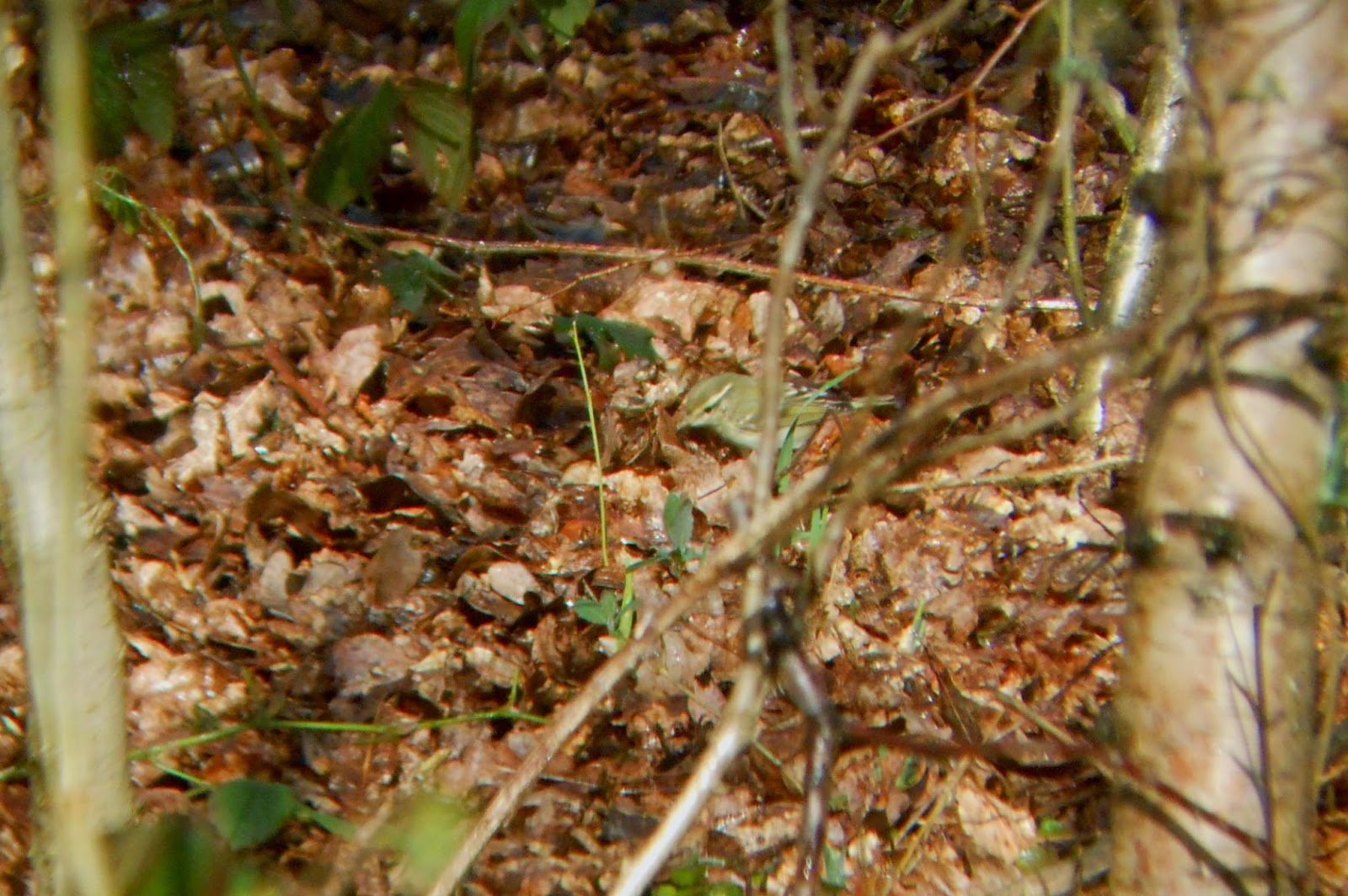
It was feeding in the leaf litter!

Here we had prolonged views as it slowly hopped its way through the leaves, flicking them to find food underneath, in a similar fashion to Thrushes! I couldn't help but feel privileged to see this behavior, as it is something that I was not aware this species did! It just seemed so wrong for a 'Phyllosc' to be hopping around on the floor like that. Presumably this is something the bird had learnt in its presence within Uffmoor, as it would have been one of/the only place where it would have been able to find food during the 'colder' winter months?

If so, that is a great piece of opportunistic learnt behaviour from this eastern migrant!


As many of you many know, I have a bit of a 'thing' with 'Leaf warblers'. Each of them are incredibly smart looking birds, with those mossy greens and lemon yellows contrasting to clean white underparts! Combine that with their tiny size, their epic migrations and their scarcity, and you have a truly incredible bird!

To have one wintering in a rather shoddy Worcestershire woodland has been a pleasure!

MB

Tuesday, 19 November 2013

Yanks and Sibes!

22/09/13
Anyone that knows me as a birder will know i have a fondness towards waders. And the autumn months certainly bring us some excellent wader action here in the UK.
With our geographical location being right on the edge of the continent, and being the first landfall for many Yank and Arctic waders we are often spoiled for choice. An it was exactly that situation when i heard news of the wader flock developing in the Severn Estuary around Slimbridge. This build up invariably brings a higher chance of rarities and it was when James Lee's, Warden of Slimbridge WWT, found a stunning 1st winter Buff-breasted Sandpiper out on the estuary with the Dunlin flock, when my recent partner in crime (That crime being dirty twitching), Neil D was contacted to arrange an impromptu visit on the Sunday, as access has been arranged out onto the foreshore of the Dumbles to search the flock.

First off, a huge hats off to the Wardens of Slimbridge WWT for allowing this type of access, not only on this one occasion, but for the many times that they have done over the last few years. It certainly was a privilege to be out adjacent to the Saltmarsh scanning the waders. 

As you could imagine, being a weekend bird it was very popular, and just prior to the arranged time the Holden Tower became very full, with the queue eventually stretching off down the Holden walkway. Luckily, we had arrived early and were at the front of the queue.

Soon after we were trudging out onto the shore, and soon after the tide was fast approaching.

And so were the waders.

We were soon surrounded by the sound of Ringed Plovers and Dunlin, and once they were pushed closer i soon started picking out waders.
A pale juvenile CURLEW SANDPIPER was soon showing well in the nearest group, but the search for the Yank continued. Not long after, while scanning the mudflats away form the main bulk of birds i scanned onto an obvious orangey coloured wader. A short quick run through some grass led it out into the open, revealing it to the the BUFF-BREASTED SANDPIPER. A quick shout out was followed by the usual pleads for directions, and it was at that moment i realized why i was a crap twitcher, How the fuck do i get 80 people onto a Starling sized bird in the middle of the mud with no other reference point or adjacent bird other than a small area of saltmarsh grass the bird was feeding in? There really was nothing at all, as i backed away from the scope Neil grabbed a quick look as i tried to navigate people onto the area, but as i was doing so was told the bird had just took flight when my directions became redundant.

Tip one- If on a twitch with me looking for waders, make sure your standing next to me so if i do pick something out you can just grab a look through my scope rather than having to suffer my pathetic directions.

Luckily, the bird was seen again a few times, but again, it was only seen briefly by a select few or in flight, not exactly the most accommodating Buff-breast then when you consider some of them plod around by your feet.

With the 'biggie' now successfully 'gotten' (Twitching slang for the uninformed out there) i relaxed and started going through the rest of the ranks of waders.
The pale CURLEW SANDPIPER was picked out in almost the same spot. And 2 LITTLE STINTS (Both juvs) were feeding nearby.


The warden then moved the gathering slightly to where the main flock were gathered and soon many more waders were being picked out, a nice 'peachy' CURLEW SAND was soon picked out, which was showing nicely.


After around 2 hours i didn't manage another views of the Buff-Breast, but the other mix of Arctic Siberian, Arctic and single yank waders made a very good variety. Among the 100c Ringed Plover, 300c Dunlin we found 4 CURLEW SANDS (3 juvs, 1 ad), 4 LITTLE STINTS (Strangely of the same age combination as Curlew Sand, 3 Juvs, 1 ad).
The high tide had also given us 12 LITTLE EGRET and a small flock of Wigeon amongst the expected large numbers of Curlew, Gulls and Geese.
Away from birds, we were surprised by the continued presence of the HARBOR SEAL fishing off the Dumbles throughout high tide.

We then decided to 'work' the rest of the site. A single LITTLE RINGED PLOVER was still showing in the Rushy Pen (we saw it earlier in the morning) with 2 GREEN SANDPIPER and small numbers of Blackwit. 2 Pintail were close to the hide
The remainder of the action was centered around the Zeiss hide, where a wild 2nd summer COMMON CRANE was showing close to the hide, giving stunning views.


 A decent sized flock of Teal, Lapwing and 38 Golden Plover held small numbers of Redshank, but also the hoped for juvenile SPOTTED REDSHANK, showing at the far end of the flash. A large flock of 15 RUFF were also feeding here after flying in as were 2 GREENSHANKS. To finish off the list of waders, 4 Snipe fly in and also started feeding in the shallow water, making that our 16th wader species for the day.

 I dropped into Upton Warren upon our arrival back in the home county, where a nice gathering of 3 juvenile male RUFF were showing close to the hide.
MB

Wednesday, 6 November 2013

Migration!

31/08/13
 
Migration, don't you just love it!
That twinge of excitement as you wake in the morning to see if that clear spell overnight has brought anything with it. You anxiously await the text to confirm the presence of a rarity down the road while thrashing the patch in attempts to find your own 'mega'.
 
Sadly, mega's were lacking. In other words there were non, however, a nice scattering of migrants fresh in is enough to keep this midlands birder satisfied.
 
Following my work at Earlswood, I headed down the road to the lakes where a stunning juvenile BLACK TERN was showing. Within a few minutes I had picked up the bird feeding along the south shore of Engine pool, however repeatedly dropped onto pipes adjacent to the 'island' to perch, which, from the shore, gave stunning views!


I watched the bird for some time, being much closer than the bird I found at Blithfield Reserviour, both in flight and 'on the deck' before moving onwards to the Causeway between Engine and Windmill pool. From here I has stunning views of the Tern, at times down to a mere 10ft as very strong headwinds pushed it closer to the bank, directly passed where I was standing.
A Grey Wagtail was the only other 'Of note' bird, just because it strolled past me at around the same range as the Tern flew.

 
From here it was the roost at Upton Warren, complete with a nice array of Waders. The juvenile Little Ringed Plover and Ringed Plover remained (The adult had departed mid-week). Beside the residents, 4 Green Sand, 4 Common Sand and 2 migrant Snipe were also found probing the soft mud around the edges of the flashes. As we sat, a party of 3 Yellow Wagtails flew over south calling, as did a Common Tern.
 
The next morning (1/09) that feeling arose again, and it was straight to my phone to see a local 'grapevine' text. LITTLE STINT at the flashes.
As you would expect, patch birding was delayed slightly so I could catch up with this scarce inland arctic wader. As with most autumn LITTLE STINTS it was a juvenile bird and initially was feeding exclusively at the back of the flash among the base of the reeds, with the occasional Green Sand of Teal walking past, revealing just how miniscule of a bird it was.
Some time later, after having not very satisfying views the bird started to wade along the shoreline, before flying onto the near side of the 'channel', slowly working its way closer and closer until eventually it creeped out from beside the 'main island'


Completely worth the wait, Juvenile Little Stint is a stunner of a bird, but sadly one that is not guaranteed on a county yearlist this far inland. Needless to say, I left a happy birder.
Overnight, a single Green and Common Sand had left, leaving 3 of both, and the 2 Snipe remained, but new in was a Redshank, the first I had seen at this particular site all year!
 
3/09/13
Another grapevine text, however this time in West midlands county revealed the presence of a juvenile Shelduck at Sheepwash Urban park, which, being the site rarity it is warranted a fairly impromptu visit, within minutes, the Shelduck was located, feeding on the only suitable section of habitat on site, (note the litter also present). Also recently arrived was the first Pochard of the winter, a drake which was asleep in the favoured wintering area.
 
4/09/13
Yes I know, I'm ashamed, I twitched a Shelduck, but the real laughing point was that I dropped in again the next day with the scope to get some photos, with the objective to give a digi-scoping demonstration to another birder. While walking along the raised track, a familiar call had me looking to the sky to see a superb RING-NECKED PARAKEET circling above me, calling constantly, before after a short time flying off north. Another new site bird for me! As luck would have it, my digi-scoping companion was just around the corner at the time, and also heard it calling as it flew around.
Amazingly, the Shelduck remained, as did the Pochard, but a surprise was given when an adult HOBBY flew over the pool and proceeded to hawk dragonflies over johns lane pool. All in all, one of the better days I've had at Sheepwash recently!
MB