1/06/17
I try to visit one of the Pembrokeshire islands every year. It is always great to leave the mainland and visit the seabird colonies out on the cliffs of these remote havens. Being based around an hour away from Martins Haven, an early start is needed to get anywhere near the front of the queue for tickets.
Arriving around 45 minutes before the lodge to buy tickets opens, we arrived to one of the largest queues I have seen at that time in the morning. This resulted in us not being booked until the 11am boat.
The Deer park is always worth a scout around, and with a fair bit of time to kill, a full circuit was walked, giving some of the first views of the rafts of seabirds offshore and flying Choughs. A strong SW wind was howling across the headland, the start of a storm arriving the following night, which made it difficult to stand upright on occasions!
The winds however died later in the morning, leaving a smooth crossing to North Haven on Skomer, to be greeted by the usual hoards of Puffins on the water and cliffs around us. Following the introductory talk, most of the boat bolted towards The Wick, well known as one of the better spots on the island to watch its most famous resident. Being a creature of habitat however, I walked northwards from the farmhouse, through the north valley bushes. Sedge Warblers boldly sang and a Blackbird warbled quietly from deep within.
As we walked further, Meadow Pipits parachuting into the trackside vegetation as we approached the Garland stone, where sandwiches were eaten as we took in the seabirds offshore. A few Manx Shearwater were fairly unusual to see so close to shore in the middle of the day, however scanning didn't reveal any cetaceans.
We continued along the north coast, passing breeding Oystercatcher and GBBG nests before heading down along the west coast, past Skomer head and down towards the Wick, where the Puffin flocks were turned up to maximum....
It has been interesting to compare numbers from year to year, and this year certainly seemed to be good one, with very large numbers present here. It seemed as if many of the birds were at home and many were feeding newly hatched chicks, resulting in regular visits to their nestholes. At the top of the Wick viewpoint, the numbers along the clifftop in front were staggering, even more so considering many were only a few feet away! Despite this though, it is always worth remembering the sobering point that Puffin populations have declined dramatically over the last few decades and all is not well with our seabird populations.
With the wind being fairly strong, I didn't take many photos (digi-scoping+ wind = failure) so instead I spent a while watching the behaviour of the Puffins. A lot of territorial battles and pair bonding were taking place, with lots of bill clattering and squabbles taking place.
With the stunning view down the cliffs and a carpet of Puffins at the front, the view is spectacular. This photo sums it up quite well, taken on a 'point and shoot' camera, showing just how close the action is. The Puffins in this one remind me of a number of rock album covers.
Having seen a few photos on social media of a leucistic Puffin on the island, it made for quite a target to try to find it. With 27,000 Puffins on Skomer currently, it was not an easy task without insider knowledge. We were pointed in the right way, and after a short while, out popped a head from a burrow to our right. Strikingly white, we could see it was the leucisitic individual! With white all the way from its forehead, down its nape and across its ears, it certainly stands out from the crowd. After only a few seconds, the bird spun around and walked straight back down its burrow.
With our time coming to an end on the island, a walk back towards the interior of the island was taken to look for an Owl. With it now being around 4pm, it seemed a perfect time for a day hunting Owl to be out, and with a drop in the wind, our chances seemed good!
Walking back towards North Haven, a Short-eared Owl was hunting ahead. We continued to walk onward, before the bird disappeared. As we stood on the track, the Owl flew up and straight towards us, passing closely. Some of the best views I remember having of the species (a concussed electrocuted individual doesn't count....) .
After having watched it for a couple of minutes and with the bird still hunting in view, I scrambled to set up my scope and camera. A few seconds later, and it was again flying towards us, this time even closer.
The Owl passed within 20ft of us, with no-one else around. Bliss.
What a way to end another superb visit to a superb island!
A weekend in Norfolk with the crew is always a highly
anticipated event. The promise of scarce bird species, good company and
conversation is always a top draw event.
So with a trip planned months upon months in advance, it was
going to be hit or miss as to whether we would have the trip planned to
favourable weather conditions. Time passed, plans were made and possible target
species identified. And as time grew nearer, and nearer, the weather seemed to
get more and more tasty for some migration and with only 2 days to go, it
happened. A large fall hit North Norfolk. Score!
16/10/15
The Friday came, and onwards we went. A very early start
from our midlands homeland had us finding ourselves pulling into a layby at
Beeston Common. An Isabelline Shrike
(ssp L. isabellinus isabellinus)
had been found at the site a few days previously, and with it being a lifer for
everyone in the car, it was perhaps no surprise to head here first. Within a
few minutes, we had the Shrike located, flicking around in the densely
vegetated hawthorn stands. With its plumage being a mix of sandy and reddish
colours, it actually proved to be a very attractive bird. Shrikes are always
highly prized birds, and to start off our weekend with a bird of this class
certainly boded well.
Very aware that we had arrived at simply the perfect time
for migration, itchy feet soon took hold. Firstly by a look around the habitat
on Beeston Common for any further migrants (Marsh Tit and hundreds of inbound Thrushes) and later by thinking
about our next place to go.
As well as the passerine migrants, we were also away that
the weather conditions looked decent for seawatching. With the midlands lacking
‘some sea’ seawatching is a task we don’t manage to achieve often, so while
being so close to the known seawatching hotpot of Sherringham it would have
been rude not to drop in. In the grand scheme of things, it turned out to be
fairly quiet, however we quickly added 7 Common
Scoter, 5 Red-Throated Diver, 5 Great Skua, Mediterranean and Little
Gull to an ever growing day list. The Skuas in particular were greatly
appreciated, with me having had a significant lack of them in the past.
As we sat in a crowded ‘seawatching shelter’ on the
promenade, I received a text. ‘Olive Backed Pipit still at Muckleburgh Hill’…
On our group chat the night before, I was quoted on saying that it wouldn’t be
around by the Friday, and with an afternoon of no reports, it certainly seemed
true.
After wiping off some egg from my face, we jumped in the car
and headed west. Finding the hill, a new site for all of us, proved hard, but
we managed it first try, and quickly made our way up the sandy slope of the
hill. With Thrushes still streaming in off the sea we made our way to the top
of the hill, where a small clearing had been made among the Bracken. The scrum of
twitchers easily giving the site away as where we need to be.
After seemingly an eternity of failing to get onto the bird,
which was showing very briefly and often hidden I finally managed to get a
brief view of the bird as it picked its head up from the vegetation and stood
proud. Olive-backed Pipit. Wow! That
face pattern!
Slowly and stealthily the bird crept through the bracken,
and as the crowd grew, the bird became continually more and more confiding.
After about an hour with the bird, it was creeping around a mere 20ft away.
Absolutely crippling views!
With Wells Wood/ Holkham seemingly being the epicentre of
the fall, it was no surprise to head here next, and it truly was dripping with
birds. Those birds being mostly Goldcrest
and winter Thrushes, but we all knew there were some rare birds lurking in
there! A Blyths Reed Warbler had been knocking around in the Dell, however
after a fair amount of time searching here, this drew a blank. A Short-Eared Owl flew in off the sea and
over our heads before we decided to head further into the woods to try and
locate some of the other autumn migrants.
My main target, without a shadow, was Pallas’s Leaf Warbler, a species I have dreamed about seeing since
I first saw it in a bird book a number of years before. While I had been searching for the Blythes
Reed, the group split and our walkie talkies came in handy when they relayed
news they had just seen a Pallas’s about a mile further into the wood. This
gave me an extra boost and I walked past the Hume’s YBW crowd for views of a
much better bird.
By the time I arrived with my other crew members, the bird
had disappeared, but I went about scanning the hordes of Goldcrests in the
small areas of sycamore and Oak. It was only a minute or so before out of the
leaves flicked a broad yellow supercillium and a broad central crown stripe.
“Pallas’s!”
A few views were had as it flicked along the treeline, but
then it flew across the track, and into a small line of trees on the marshes
side. For the next 15 minutes, the bird performed very well in a small
sycamore, often giving binocular filling views! Superb! Dreamy views.
Unfortunately I was too busy swooning over the bird and by
the time I had realised I should grab the digiscoping setup, the bird had
melted back into the dense vegetation. I again stayed behind for further views
but this proved pointless, and I missed views of the Hume’s as a result.
We headed back for further attempts to locate the Blyths
however, but this was again hard work, however at least this time we struck
lucky as while scanning a passing Tit flock, out flicked another Pallas’s Leaf Warbler, right above the
heads of the crowd! This one proceeded to flash its rump shamelessly as it
moved across the Silver Birches, before again, melting into the canopy.
As we drove out of the car park at the Well’s Wood end, we
stopped on the entrance road, where we had good, but distant views of 2 Great Grey Shrikes, both perched like sentinels
waiting for the next passing exhausted migrant. (I imagine Goldcrests were on
the agenda).
With the day quickly closing in we wanted to add some
waterbirds to our weekend tally, and so therefore it was no hard decision to
head to Titchwell RSPB. A quick loop searching for Passerines within the scrub
around the centre didn’t produce much, so we headed out onto the marshes.
The expected cast of waders was present on the tidal and
saltmarshes, swarms of Golden Plover
and winter Duck filled the skies, together with sizable flocks of both Godwit species and Ruffs. A couple of late Avocet
were a nice addition as we stood waiting for the roost. Only 2 Marsh Harriers arrived, however the
Gull roost developed, and in dropped 3 Yellow-legged
Gulls. At last light, a Barn Owl
quartered the reedbed, a perfect way to end a superb day 1 of the Norfolk
weekend.
17/10/16- Durnham Deapdale- 6:45am.
Wanting to maximise time in the field, the crew was up
pre-dawn with the intention of getting into the field by the time it got light.
As the first shades of blue emerged, the sound of Pink-Footed Geese built, and soon the sky was filled as they
vacated their roost to head to their feeding areas inland.
With the wind coming in at a strong north-easterly, and high
tides, we decided a quick shot at seawatching would be worthwhile to ‘test the
water’. If things were moving, we would stay.
We arrived on the Cley shingle bank by 7:30, and then
settled ourselves in for a shift. There was a fair bit of Duck movement, but
our targets were proving elusive, those being the rarer Shearwaters and Skuas.
A few Red-Throated Divers were
moving back and forth, and a close single Red-Breasted
Merganser flew past and along Blakeney Point.
Scanning into the distance, a Shearwater was approaching
from the east, low down across the water before wheeling up in a wide loop.
This behaviour quickly indicated we were on one of the targets and soon the
bird approached its closest point, revealing all dark plumage and long wings,
the first Sooty Shearwater of the
weekend!
The next hour provided a further 5 Sootys and a number of Great Skuas. A Sooty was tracking west
when I removed my eye from the scope, to see a dark seabird approaching close
in from the west. Quickly the lighter build of the bird was apparent in
comparison to the earlier Greats, however the bird still seemed barrel chested
and heavy. Approaching within 100ft of the beach viewpoint, it was clear we had
our first Pomarine Skua!
3 of the crew members were further east then us, so a call
on the walkie talkie tried to get them onto it, but in return we received a
message that they’d just seen a Lapland Bunting. Long story short, a walk out
there and a thorough search couldn’t relocate it and they didn’t see the Skua,
so with the continuing allure of Well’s Wood, the two members who hadn’t seen
the Lap cut our losses.
Following a quick Bap in Wells Harbour, we pulled into a
very full car park by 10:30. A Red
Flanked Bluetail, found yesterday after we had left was item number 1 on
our list, so we quickly hot footed it down there. It didn’t take long for our
first view, a ‘Robin shaped bird’ dropping down out of the tangle of bushes
followed by a strong flash of blue as it flicked back up.
The crowd here was huge, surprisingly for this increasingly
common migrant. The bird moved, and the crowd shifted. I managed a few more
brief, obscured views (while most of the crowd, and the rest of the crew
managed great views), but after having seen the wintering Avon bird a number of
times, I wasn’t going to chase better views of this one.
After this, we didn’t strike lucky with any of the rarities
reported within the woods, and with it being 1:30, activity was dropping off on
the passerine front, so again, we decided that Titchwell would be a good shout.
We were still missing a number of species from our trip list that we could fill
in.
Although it was much the same as the day before, with large
flocks of ducks and waders, we managed to find a few of our targets. Pochard and Red-crested Pochard were well represented, with 13 and 9
individuals. Good numbers of both. Our main reasoning for missing them the day
before being that we didn’t visit their favoured pool.
Beyond the pools, the beach held the expected variety of
shoreline waders, with Grey Plover, Knot, Sanderling, Turnstone
and Bar-tailed Godwit all being
represented. As we had walked towards the beach, we had been treated to rather
good views of Spotted Redshank. And
again on the way back, we connected with the same bird, although this time it
was feeding right beside the track with a couple of Black-Tailed Godwits. Phenomenal views!
With the early mornings catching up with us, we decided to
take the rest of the evening off, enjoying food and drinks in a nearby pub.
18/10/15
We again were out for dawn, this time with the intention of
finding something for ourselves. We had racked our brains the night before
about where to head with the best options of finding birds, but being able to
avoid the majority of the crowds. Wells, as it had been all weekend, was packed
with birders, so if anything was in there, you’d imagine it was found, so where
else? Cley? Stiffkey?
We chose Burnham Ovary marshes and dunes. A good variety of
species can be found, and indeed we found many. The roadside fields were
covered in Geese, pink-Footed, Greylag, Brent and Egyptians.
Smaller numbers of ducks and waders were present in the fields. We checked the
pool and the estuarine mud after wading through hordes of Goldcrest to the seawall, adding Little Grebe stalking the edges of the reeds.
We walked further, and another Short-Eared Owl flew over our heads as it came in off the sea
before dropping into the Sueada on the saltmarsh. A Greenshank
flew past calling among the omnipresent Redshanks
and a number of Common Snipe flew
out of the vegetation as the tide approached. We reached the dunes, with Reed buntings, Robins and Thrushes all
scattering from the bushes but these seemed fairly quiet. (If only we had
checked the same area of scrub a little further west- we may have found the
Little Bunting seen later in the day at the same site!). A single Wheatear was
flicking around We settled on top of the dunes and scoped the sea for a while,
and also scanned the roosting wader flock. 18 Common Scoter flew past as well as 3 each of Red-Breasted Merganser and Red-Throated
Diver. A Great Crested Grebe-
our first of the weekend, sat out on the sea.
A number of Gannets were passing offshore, and sure enough,
after a while, a number of Great Skua
started moving past. An hours watch produced 15, including a flock of 6 which
lumbered offshore before settling on the sea, including some fairly good views.
As A Skua lumbered west, a more ‘flappy’ bird further out at sea immediately
drew attention. The bird flew nearer and nearer until it revealed itself to be
an ‘Eared Owl’. Although we had seen a number of SEO coming ‘in off’ we had not watched one struggling across the
waves until this point. Clearly exhausted, the bird tried its best to shake the
attention of a party of passing Gulls until it reached land. We had been
watching it or about 4 minutes before it finally struck land, flying over the dunes
and dropping into the long grass on the marshes.
We walked east, which honestly was all a bit quiet, with
only a few hundred winter thrushes, Meadow Pipits and Goldcrest to show for the effort. We walked all the way to the western
end of Holkham wood, where a quick scan revealed the Great White Egret was still present, feeding in one of the pools
there, although very distant. A number of Raptors were also in the sky here,
with 4 Marsh Harrier, 2 Buzzard, Kestrel and Peregrine.
With a long journey home, we walked back to the car, with
our plan to find something interesting unfulfilled. A Bunting that if we had
walked 30 meters in the opposite direction may have shown itself to us, and a
brief probable large Pipit sp seen by one of the crew, which despite further
searching couldn’t be refound (A Richards was found in the exact same spot the
day after). As we were about to drop over the seawall, a superb Merlin gave a cracking flight view,
before perching up on a post on the saltmarsh.
With our weekend drawing to a close, we drove west, with a
last ditch stop at Choesley Barns to find a few farmland species. Sadly we
couldn’t find any of our targets here, huge coveys of Red-legged but no Grey Partridges and no Corn Buntings. A large
mixed wader flock were there to greet us goodbye to end the trip on a cheery
note.
Overall an excellent weekend. Considering we had planned the
trip months in advance, and not last minute due to weather conditions, we obviously
struck lucky. Lots of great birds, great company and lots of birdy chat. What
could be better!
Slipping further and further behind as ever, but I still do intend to catch up with myself
The month started with the usual work party and Upton Warren on the 1st, where the standout highlight was 13 Jack Snipe and 18 Commons. A fairly low total for Common Snipe but a half decent count for the Jacks.
A mess of local birding followed, without seeing very much, including regular failed attempts at gulling around the Stubbers area, which returned no reward. So it was gratefully received on 7th when a day out was offered in south Wales, with a whole host of scarcities to keep up occupied. First of was the stunning Little Bunting at Forest farm country park, which showed superbly throughout the visit. Perhaps too well!
Due to the awkward position for digiscoping I often had to go to the furthest point away in the hide, which meant I was looking through a fence for most of the time, but the bird performed admirably!
After our fill, and wanting to avoid the increasing crowds, we moved out from the country right into the center of Cardiff for the regularly returning drake Lesser Scaup, which was located without too much fuss swimming about with a large group of Tufted Duck. Having chosen to reside at the furthest point away from the viewpoint, and with strong and cold winds, we didnt stay around long, moving onto Newport RSPB.
The RSPB site itself was very quiet, a good number of waders on the estuary being the saving grace, featuring Grey Plover, Bar and Black tailed Godwit. A quick tea break led us to see Peregrine and Kestrel from the Cafe, which signalled the start of a bit of a raptorfest!.
Moving around to the Goldcliff Pools, we quickly located the wintering Spotted Redshank, a few Pintail etc. All was quiet untill from over the top of the hide can a raptor. Dropping low over the water in front of us a white rump gleamed. Ringtail Hen Harrier!!
She gave a good show for a couple of minutes, hunting around the pools, before drifting off over the seawall back towards the RSPB center.
While following it in the scope it dropped down, and while trying to pick it up again, another raptor appeared, another Harrier! But this was 4th raptor species in only 15 minutes, a juvenile Marsh Harrier! But no, it wasn't to end there, a male Sparrowhawk bombed past the hide only seconds after. With 5 species of Raptor on show in a matter of 30 seconds (Marsh, Hen, Buzzard, Sprawk and Kestrel) it was pretty good going. With most of the birds having gone into hiding, we left the hide, and while talking to a local birder about the enduring raptorfest, our 7th raptor species in 30 minutes appeared, as a female Merlin zoomed past us!! What a way to spend half an hour!
To finish the raptor extravaganza, we decided to take in some Owls, and an hour or so later, we were watching 4 Short-Eared Owls hunting over a weedy field, often at point blank range! But it didn't end there, a quick scope job of 3 distant raptors proved them to be Red Kites, Raptor species number of for the day, a superb days winter birding!
The very next morning, and I was out again, this time heading north into Cheshire, looking for my 2nd yank in 2 days. Heavy fog shrouded us as we arrived at New Brighton, and visibility was very restricted. We perserveered however, and after an hour or so, decided to try our luck with the Snow Buntings down the road, to return back to the marina later.
The Snow Buntings didn't prove too hard to find, as a pair shuffled about on the Wallsey end of the beach. Not wanting them to bother them too much in the cold weather we moved off, and then we heard that the Laughing Gull had just been refound. Perfect.
A minute drive back down the road, a trudge across the beach out to the lighthouse, and there in the still thick fog was the 1st winter Laughing Gull, standing out like a sore thumb. Good views were had as it ran about on the beach with the Redshanks and Turnstones, but the fog did prove very annoying.
However it was great to watch it flying around etc, showing off extremely well just how dark its plumage was!
A bonus 6 Purple Sandpiper out on the breakwater was a nice addition, but with limited time, and as the previous day, the freezing wind, it was hard to stay out too long.
We retreated to Burton Mere RSPB, almost entirely to see the roosting Long-Eared Owl, which was showing superbly on the track to the IMF hide.
A Spotted Redshank overflew the site when we checked the scrape, but it was otherwhys fairly quiet, particularly when compared to my last visit here!
Checking West Park revealed that Med Gull PNU9 was still present, with its hood becoming increasinfgly prominent on the 9th, with it last been seen on the 17th.
With the Water Pipits having returned to Doxey Marshes, it would have been rude not to visit, hence on a dreary 11th, i was stood scanning Pipits and Wagtails. Once reaching the right location, it didn't take too long to locate a Water Pipit, and by the time I left a few hours later, I was confident that there were at least 2 on show, with probably more.
The 'resident' 2 Barnacle Goose were often flying around and a good variety of wetland birds was present, including 10 Goosanders, 4 Little Egret and at least 6 Water Rail. A number of Stonechats were flicking around near the Water Pipit site, and some great views of Cetti's Warbler were had.
A patch visit on 15th revealed 2 hard to find patch birds, with both Little Grebe and Water Rail being present, both of which went on to stay around for a few weeks. A good flock of 119 Lapwing were also in the quarry.
The 21st saw my annual trip over to Draycote Water. Despite having a good number of good birds, we managed to dip the drake Smew, but a couple of hours getting wet, cold, and hailed upon proved worthwhile with a Black-Necked Grebe, a flock of 25 Tree Sparrows and the Greylag Goose flock containing a pair of White-Fronted Goose and a Pink-Footed Goose.
The last birding trip of the year took me to North Wales, where an early morning drive around the mountains saw us seeing a lekking flock of 22 Black Grouse! Very good, but distant views were hard in the breezy conditions, but it was great to watch them strutting their stuff on the grassy slopes.
2 Red Grouse, and a flyover flock of 3 Crossbill were the only other notable birds present in this very hostile, cold place!
A seawatch from Old Colwyn included the expected masses of Common Scoter, including a partially leucistic bird, but we failed to find any Surfs. We did however find 3 Velvet Scoter, with a nice cast of 7 Red-Throated Diver and 10 Red-Breasted Merganser. A flock of 5 Whooper Swan flew west far our at sea, which proved for a rather awesome, if random sight!
With a showy Iceland Gull being up the road it wasn't a hard decision to go take a look, and from the car as we pulled in you could see the bird, down on the sand, being thrown copious amounts of bread by a couple of photographers. I wasn't going to complain, as within a minute I was getting views like this. Absolutely stunning!
A drake Red-Breasted Merganser was showing well on the same tidal pool, until it and the Iceland Gull was flushed by a rampant Dog, much to everyones annoyance.
A check of the Scoter flock proved difficult, with distance and increasingly strong wind proving a problem. Needless to say, no luck here either.
With a few hours still remaining of daylight, and on the way home, we dropped into Venus Pool, where a Ringtail Hen Harrier had been hanging around. We had seen it briefly just north of the site on the drive down, but it proved elusive once we reached the site, and having given it a really good time, we only saw it once briefly for a matter of 20 seconds. We were however entertained by a large flock of winter Finches/ Buntings, which included around 100 Yellowhammers, 15 Reed Buntings and a flock of 17 Corn Bunting. The latter a very good record for the site!
Many of you will know my relationship with this small offshore island off the Pembrokeshire coast is dire!
And I truly mean DIRE!
I have been visiting Pembrokeshire, once, maybe twice every year for almost all of my recollectable life, and still, despite attempting almost every year, I have been unable to tread on the hallowed tuft that is the Island of Skomer. Many reasons across the years have prevented me, illness, weather, the boat being fully booked. But that changed this year! Despite arriving well before even the first boat, a long queue had already assembled, and a long wait followed, but eventually, despite arriving around 8:30, finally had our place secured on the 11am boat!
Now rather than one of my usual wordy posts, I think I'm going to spare you the waffle for the simple reason that every one of you who would read this knows the reason for my visit, ridiculous close views of Puffin, day flying Short-eared Owls and huge colonies of seabirds!
Having climbed the steps onto the island, and having walked slightly into the interior, you quickly notice a number of Bluebells lining the paths (And just about everything else if I'm honest), and following a short walk, a stunning Short-eared Owl was sitting up on a fence post among the carpet of blue.
In the distance, the huge Gannet colony on Grassholm could be viewed, with almost half of the island covered in shining Gannets and countless tons of guano.
After completing a circuit of the perimeter of the island, we made our way to the most famous breeding cliff on the island at 'The Wick', where, even despite my best efforts, I too became infactuated with some small, pied clownish birds bobbling their way along the clifftops.
The Puffins!
Now I've seen loads already on my walk around the island, and infact any sort of glance at the sea, even from the mainland revealed a huge number of thousands of Puffins.
The ones in the Wick though are rather special in that you can get within a few feet of them.....
Having had my fill, it was time to continue on, past the crowds, but via one of the best views on the island (in my opinion) where you look down into the Wick upon thousands of Puffin, Guillemot, Razorbill, Kittiwake etc, and right out into the Irish sea! Rather a stunning view!
Needless to say, this Puffin was rather happy he'd snagged this awesome piece of real-estate before the rest of the colony!
We stopped in one of the small hides overlooking a tiny puddle of a pool, and it was covered with a good number of Gulls, Herring and LBBG were predominate, but Kittiwakes were dropping in very regularly to preen, and to collect mud for their nests on the cliff ledges.
This led to some rather stunning views!
A quick stop in the hide overlooking the larger pool near the farmhouse revealed a few waterbirds to add further interest, with a Shelduck family with 9 humbug chicks, a Shoveler and a Curlew, one of the only breeding pairs in Pembrokeshire!
Soon though, our time was up, and we returned to North Haven to be picked up on our boat, sailing out among the rafts of seabirds to return to the real world!
The first weekend in May was the proposed data for the first meetup on the Next Generation Birders, a 350 strong member group (and growing) of young birders, each of which have a common interest. birds and wildlife.
Luckily, I hooked up with local birder James from Shropshire, Justin from Carmarthenshire and Sam from Nottinghamshire, and these became my companions for most of the weekend.
As I'm sure many can guess, Spurn was chosen because of it very enviable track record when it comes to migrants, and despite being a little 'early' in the spring for passage at Spurn I remained hopeful, I was going to see birds I don't usually see in my Worcester homeland anyhow.
After a fairly uncomfortable and cold night camping, I was awoken very early on before the first few sheds of light started to appear to the sound of a Cuckoo'ing Cuckoo, my first of the year, and with the sound of 'Klupping' Avocets and piping Oystercatchers, I took that as my alarm to wake up! A couple of other NGB's, Dan and Sam, had took that as their wake up call also, so we decided to walk to the Beacon Pools via Kilnsea wetlands in the early morning gloom. We had barely got past the last house on the road before ahead of us we spotted a silhouetted SHORT-EARED OWL quartering the long grass and rape fields around us. It flew off fairly quickly though, and flew off towards Beacon lane.
Nearing the Wetlands hide, a stunning male Whinchat perched up on the adjacent rape field, giving stunning views, even despite their still being almost no light.
The pools were quiet, but we kept finding decent birds, a Marsh Harrier flew over, Lesser Whitethroats were singing everywhere and both 'Flava' and 'Alba' Wagtails were piling over in numbers.
One of the outstanding highlights of the trip on the first day however, the great numbers of both Bar-tailed Godwit and Whimbrel on the move, with decent numbers of both moving through the wetlands throughout the day, among these migrating wader flocks were smaller numbers of Curlew and a partially summer plumaged SPOTTED REDSHANK dropped onto the Kilnsea wetlands over high tide with a decent flock of Barwit and Whimbrel.
Throughout the day more birds dropped in, a Common Scoter and 4 Red-breasted Merganser dropped onto the Beacon pools in the afternoon, and the male Whinchat from the morning found a 2nd bird.
A female Redstart was found, and that was duly located and seen, as was good numbers of Wheatear along the road between Kilnsea and the Warren.
High tide here was full of activity, with a large wader and Brent Goose flock showing on the adjacent Humber mudflats. Among the numerous Dunlin and Grey Plover were smaller numbers of Ringed Plover, Sanderling, Turnstone and a single Knot, most of which were in stunning summer plumage!
Terns were constantly moving around along the sea, and throughout the day 30+ Little Tern and 4 Arctic Tern were seen.
The rarest bird of the weekend was found in the afternoon, but was sadly not at Spurn, but a few miles up the road. However, despite the short time they saw it we decided to drive over there, we couldn't find it, but a lucky piece of mis-direction led us to find a stunningly plumaged male Pied Flycatcher.
We refound the location where the Wryneck had been, and instead head another Cuckoo and found a singing male Tree Sparrow, a fairly rare bird in my home county so I was very happy!
We returned to Spurn and saw the Spotted Flycatcher that had been found, which had drew quite a crowd!
For the sake of completeness, I walked out onto the point in the hope of relocating the Black Redstart seen earlier in the day. This drew a blank and food started to take over our minds, so we hotfooted it back to the Joly Sailers for food and drinks with the other 20 NGB's, via a very showy male Kestrel.
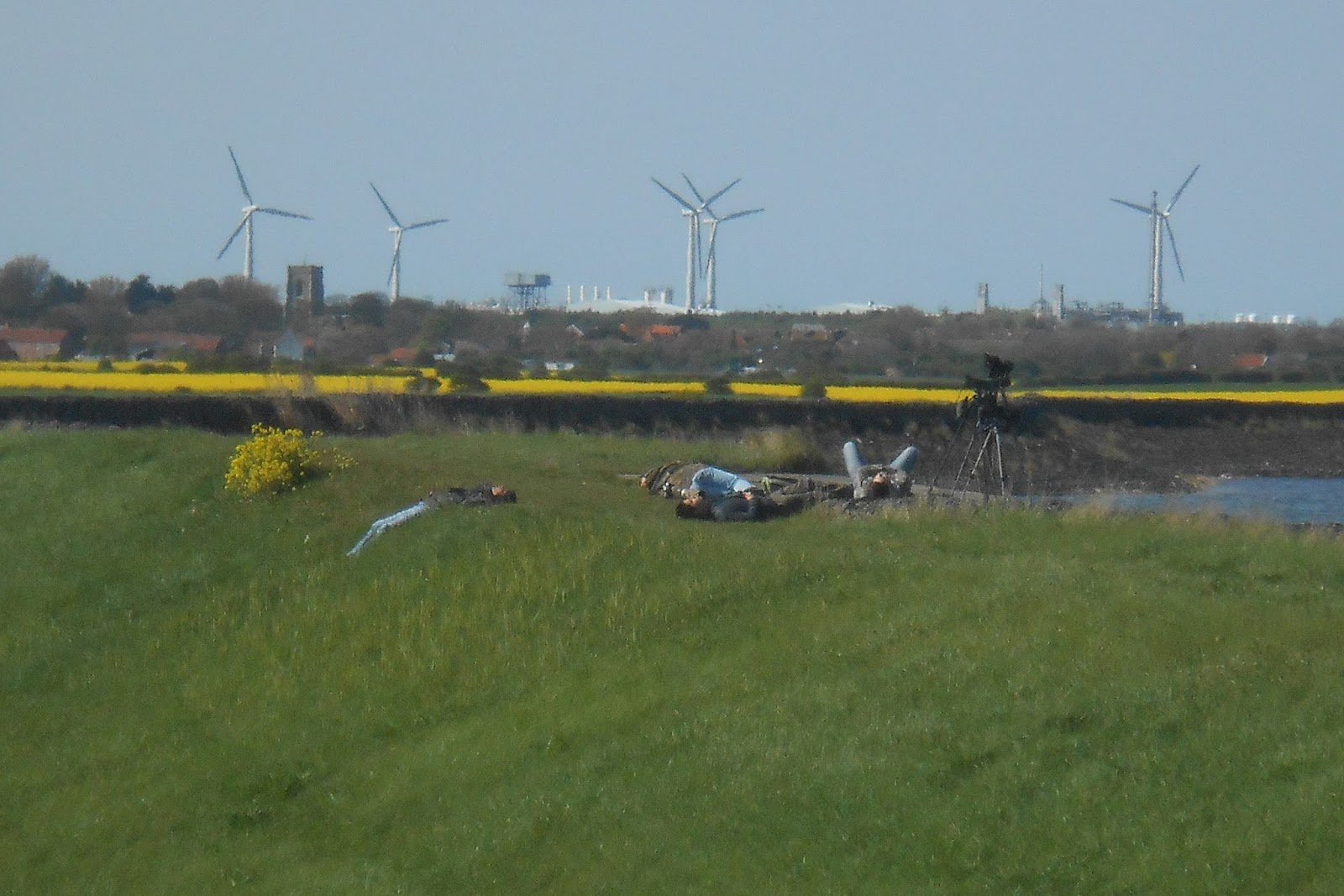
As you can see, a full days birding left some very tired NGB'S strewn about on the raised track between Kilnsea Wetlands and the Beacon Pools.
4/05/14
As you can imagine, having had a good reward from getting up early the previous day, I chose to repeat that. A much better nights sleep left me feeling in a better mood, and I head out to find some birds! The wetlands held a flock of 4 Pintail, and the Pools had 2 Shoveler, a Common Sandpiper, and the female Common Scoter from the previous day remained. A number of Little Tern were feeding in the pools, giving stunning views from the raised track. A single Snipe was showing in fields adjacent to the road
Yellow Wagtails were moving en mass throughout the day, even from very early in the morning, and it is possibly the first time I have ever said "Just another Yellow Wagtail". 2 Marsh Harrier passed through during the day, one even hunting in the field, as view from our tent! A Greenshank flew in off the sea mid-afternoon. Migration in action!
While walking up the beach side of the Beacon Pools, I met up with Sam again, and we walked up Beacon Lane, and soon after, we were treated to great views of a male Lesser Whitethroat, and then a male RING OUZEL started 'chacking' in the hawthorns next to us, showing briefly in the grounds of the caravan site and in flight!
There really did seem to be Lesser Whitethroat everywhere, and while watching ANOTHER 2 near the Bluebell, a Tree Pipit flew low over our heads calling.
Just up the road, a late BRAMBLING was showing around the grounds of Kew gardens.
Down at the Warren, a repeat of yesterdays wader flocks was again a great sight, and it was spent scanning with Martin Garner of Birding Frontiers fame. The large Dark-belled Brent Goose flock had been joined by two Pale Bellied Brents (One shown in photo).
Wader numbers were higher than the previous day, and we enjoyed larger numbers of almost the full range of Arctic breeding waders in summer plumage. With news having emerged of a couple of migrant passerines out on the point, we dragged ourselves on the long walk across the sand out to the concrete track. The recent storm tides of winter 2013/14 had washed a significant part of the road out, making access difficult.
We managed to locate a male Redstart, and after texting Justin (who was already on the point) he came to have a look. While waiting for the bird to re-appear, we heard a 'Crest' calling from an area behind us, and immediately knew this was the FIRECREST we had been wanting to re-locate. Eventually, we all had great views as it came to the edge of its favoured bushes a few times.
With time now coming to a close on the NGB trip, we made our way back to the Warren, where we were told we had just missed a flypast Spoonbill, but a hunting Short-eared Owl gave us some compensation as we rested before starting our journey.
Despite no real rarities, (being from a midland county) I had a great time seeing decent numbers of passage migrants, and certainly saw more than I would in my home counties.
Thanks to James G for driving, and for providing the tent, I would have been a little stuck if it wasn't for you! Also, thanks to all NGB's that turned up, for the banter, and for sharing news on birds that were being found, it certainly made a great break to endless revision!