Showing posts with label Common Scoter. Show all posts

Monday, 2 February 2015

Norfolk Surfie!

15/11/14
Skipping a fair number of days birding locally, my next 'full day birding' was in mid November, when with the usual crew we again headed east, and found ourselves in Cambridgeshire, scouring some rather birdless agricultural fields (admittedly with a large area of set aside adjacent) for the Richards Pipit that had been knocking around. After a good while searching, we decided to head off further east, via Guyhirn where we managed views of a superb flock of 8 Common Crane as they fed in roadside fields. It was just a shame the fog had started to descend and it hindered viewing somewhat! 

We continued east, passing into the equally superb birding county that is Norfolk and to Cley Marshes!

Walking the east bank we were soon clocking up the birds, Bearded Tits pinging and showing well in the reedbed, Brent Geese and Marsh Harrier a permanent fixture in the sky, and a loud drawn out wheezy call overhead led us onto a single Twite as it flew over east.

Our main target however (as with many of our recent visits) was the sea and we soon started scanning for Auks and Skuas. Well, we found 5 Auks, however non were particularly small and it was clear that their Arctic cousins just weren't moving today. The swells had its usual and ever-present Red-throated Divers, but things were livened up by a drake Eider flying past and the appearance of 2 adult Little Gull, always a great addition to any day list! 

 A rather pointless visit to Salthouse followed before we headed back west to Holkham, where following a very long and sandy walk we eventually found a large flock of Common Scoter loafting and feeding offshore. We set about scanning, and soon found multiple Velvet Scoter, including some absolutely stunning drakes. Eventually we setted on a total of 10+ of these stunning seabirds!
 With time, among a party of Velvets we picked out our 'yank' target. A drake SURF SCOTER! Nice! 
Personally not even a year tick for me having seen 3 off Pensarn earlier in the year however the views off Holkham were significantly closer! That bill and the white patches stood out a mile, however with sea fog arriving, it was good we arrived when we did and not any time after! 


Drake Surf Scoter

Surf Scoter among Velvets and a few Commons

With the light fading, I tried to make a last minute race to the end of the wood to look for the long staying Rough-legged Buzzard, but as we neared the end of the wood the crew decided to turn around and I dipped for the 4th time this year. Maybe one day.

MB

Thursday, 3 July 2014

The first 'official' NGB meetup- Spurn 2014

3/04/13
The first weekend in May was the proposed data for the first meetup on the Next Generation Birders, a 350 strong member group (and growing) of young birders, each of which have a common interest. birds and wildlife.
Luckily, I hooked up with local birder James from Shropshire, Justin from Carmarthenshire and Sam from Nottinghamshire, and these became my companions for most of the weekend.
As I'm sure many can guess, Spurn was chosen because of it very enviable track record when it comes to migrants, and despite being a little 'early' in the spring for passage at Spurn I remained hopeful, I was going to see birds I don't usually see in my Worcester homeland anyhow.

After a fairly uncomfortable and cold night camping, I was awoken very early on before the first few sheds of light started to appear to the sound of a Cuckoo'ing Cuckoo, my first of the year, and with the sound of 'Klupping' Avocets and piping Oystercatchers, I took that as my alarm to wake up! A couple of other NGB's, Dan and Sam, had took that as their wake up call also, so we decided to walk to the Beacon Pools via Kilnsea wetlands in the early morning gloom. We had barely got past the last house on the road before ahead of us we spotted a silhouetted SHORT-EARED OWL quartering the long grass and rape fields around us. It flew off fairly quickly though, and flew off towards Beacon lane.

Nearing the Wetlands hide, a stunning male Whinchat perched up on the adjacent rape field, giving stunning views, even despite their still being almost no light.
The pools were quiet, but we kept finding decent birds, a Marsh Harrier flew over, Lesser Whitethroats were singing everywhere and both 'Flava' and 'Alba' Wagtails were piling over in numbers.

One of the outstanding highlights of the trip on the first day however, the great numbers of both Bar-tailed Godwit and Whimbrel on the move, with decent numbers of both moving through the wetlands throughout the day, among these migrating wader flocks were smaller numbers of Curlew and a partially summer plumaged SPOTTED REDSHANK dropped onto the Kilnsea wetlands over high tide with a decent flock of Barwit and Whimbrel.


Throughout the day more birds dropped in, a Common Scoter and 4 Red-breasted Merganser dropped onto the Beacon pools in the afternoon, and the male Whinchat from the morning found a 2nd bird.


 A female Redstart was found, and that was duly located and seen, as was good numbers of Wheatear along the road between Kilnsea and the Warren.
 
 
High tide here was full of activity, with a large wader and Brent Goose flock showing on the adjacent Humber mudflats. Among the numerous Dunlin and Grey Plover were smaller numbers of Ringed Plover, Sanderling, Turnstone and a single Knot, most of which were in stunning summer plumage!
Terns were constantly moving around along the sea, and throughout the day 30+ Little Tern and 4 Arctic Tern were seen.

The rarest bird of the weekend was found in the afternoon, but was sadly not at Spurn, but a few miles up the road. However, despite the short time they saw it we decided to drive over there, we couldn't find it, but a lucky piece of mis-direction led us to find a stunningly plumaged male Pied Flycatcher.
We refound the location where the Wryneck had been, and instead head another Cuckoo and found a singing male Tree Sparrow, a fairly rare bird in my home county so I was very happy!
 
We returned to Spurn and saw the Spotted Flycatcher that had been found, which had drew quite a crowd!


For the sake of completeness, I walked out onto the point in the hope of relocating the Black Redstart seen earlier in the day. This drew a blank and food started to take over our minds, so we hotfooted it back to the Joly Sailers for food and drinks with the other 20 NGB's, via a very showy male Kestrel.


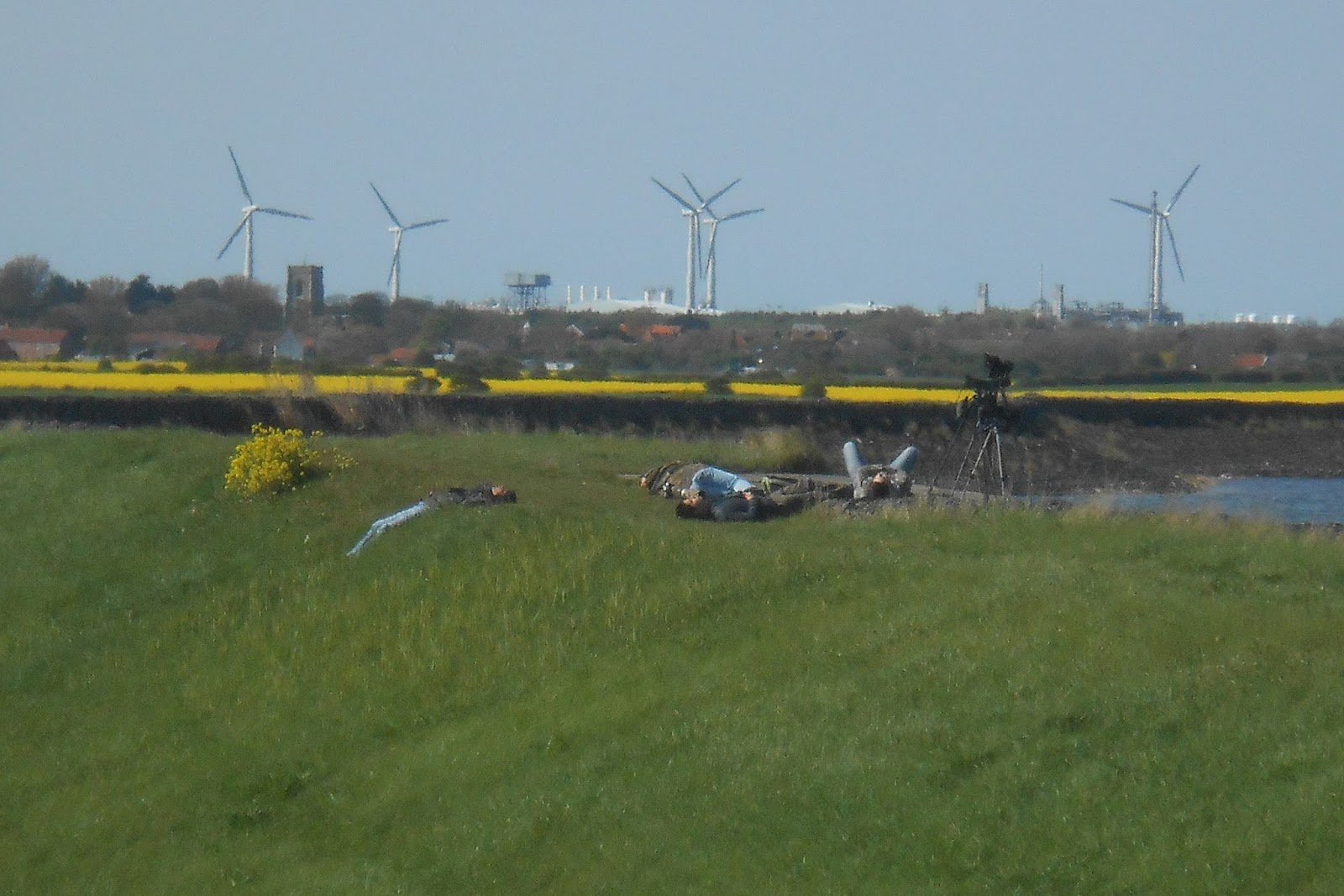
 As you can see, a full days birding left some very tired NGB'S strewn about on the raised track between Kilnsea Wetlands and the Beacon Pools.


4/05/14
As you can imagine, having had a good reward from getting up early the previous day, I chose to repeat that. A much better nights sleep left me feeling in a better mood, and I head out to find some birds! The wetlands held a flock of 4 Pintail, and the Pools had 2 Shoveler, a Common Sandpiper, and the female Common Scoter from the previous day remained. A number of Little Tern were feeding in the pools, giving stunning views from the raised track. A single Snipe was showing in fields adjacent to the road


Yellow Wagtails were moving en mass throughout the day, even from very early in the morning, and it is possibly the first time I have ever said "Just another Yellow Wagtail". 2 Marsh Harrier passed through during the day, one even hunting in the field, as view from our tent! A Greenshank flew in off the sea mid-afternoon. Migration in action!
 
 
While walking up the beach side of the Beacon Pools, I met up with Sam again, and we walked up Beacon Lane, and soon after, we were treated to great views of a male Lesser Whitethroat, and then a male RING OUZEL started 'chacking' in the hawthorns next to us, showing briefly in the grounds of the caravan site and in flight!
 
There really did seem to be Lesser Whitethroat everywhere, and while watching ANOTHER 2 near the Bluebell, a Tree Pipit flew low over our heads calling.
Just up the road, a late BRAMBLING was showing around the grounds of Kew gardens.
 
Down at the Warren, a repeat of yesterdays wader flocks was again a great sight, and it was spent scanning with Martin Garner of Birding Frontiers fame. The large Dark-belled Brent Goose flock had been joined by two Pale Bellied Brents (One shown in photo).
 
 
Wader numbers were higher than the previous day, and we enjoyed larger numbers of almost the full range of Arctic breeding waders in summer plumage. With news having emerged of a couple of migrant passerines out on the point, we dragged ourselves on the long walk across the sand out to the concrete track. The recent storm tides of winter 2013/14 had washed a significant part of the road out, making access difficult.
 
We managed to locate a male Redstart, and after texting Justin (who was already on the point) he came to have a look. While waiting for the bird to re-appear, we heard a 'Crest' calling from an area behind us, and immediately knew this was the FIRECREST we had been wanting to re-locate. Eventually, we all had great views as it came to the edge of its favoured bushes a few times.
 
With time now coming to a close on the NGB trip, we made our way back to the Warren, where we were told we had just missed a flypast Spoonbill, but a hunting Short-eared Owl gave us some compensation as we rested before starting our journey.
 
 
Despite no real rarities, (being from a midland county) I had a great time seeing decent numbers of passage migrants, and certainly saw more than I would in my home counties.
 
Thanks to James G for driving, and for providing the tent, I would have been a little stuck if it wasn't for you! Also, thanks to all NGB's that turned up, for the banter, and for sharing news on birds that were being found, it certainly made a great break to endless revision!
 
MB

Tuesday, 25 February 2014

Heading North West- Buff-Bellied Pipit and Surf Scoters!

It was late on the 27th that Tim Jones posted that he was thinking of going for the Cheshire Buff-bellied Pipit and wondered it anyone would join him, and with the next day (A Tuesday) being my day off, i inquired, and soon after plans were being made for the day!

We arrived at the end of Station Lane early the next morning, and we went about scanning the Pipit flock that was present. Some time later, it seemed as if the bird wasn't present, as we could not find it. While on a brief break from scanning the close Pipits, a scan across the fields towards the Estuary revealed a single drake Pintail, as well as distant flocks of Wigeon and Teal. A Little Egret and 50 Pink-footed Goose flew past, but we still couldn't pick it out. A pair of Stonechat kept us occupied, but soon after Tim had picked up the BUFF-BELLIED PIPIT, and soon after that we were both on it.
Initial thoughts that i may have been overlooking it were cast out as i scoped it. It really did stand out significantly from the Meadows. That fairly plain brown mantle, hindneck and crown stood out the most to me, but i was struck by a fairly clean and striking bird. Those white wing bars were very prominent and after initially being a little further away, the bird started walking and feeding straight towards us, and for a good space of time, the bird went of to preform very well for the assembled crowd!


It was as the Pipit moved closer that a familiar call rang out, and a second after, a stunning pale SIBERIAN CHIFFCHAFF flew past us, landing on the fenceline at intervals calling its head off!

After a good time watching both birds, we took the decision to move on. A brief stop at nearby Parkgate revealed little. A flyover Black-Tailed Godwit being the pick of the lot in my opinion!

The previous night, plans were made to head to my favorite country after leaving Cheshire, and after a fairly short 40 minute drive, we pulled up at the beachfront at Pensarn, and started scanning from there. Soon after, i was looking at 3 somewhat distant, though perfectly identifiable SURF SCOTER as they loafed offshore with a massive number of Common Scoter, all of which were showing in the same scopeview. Two of the birds were immaculate drake birds, but the 3rd was a fairly discreet female bird. The males almost gleamed in the sunlight, and the white patches on the hindneck and forecrown stood out like beacons, as did that huge brightly coloured bill!. Even with my fixed magnification eyepiece, it was clear that the female bird was paired to a male, and she would shadow his every move.

As with the usual MB mentality, a record shot is better than no picture, so despite the range, i took a few max zoom photos. And it seems as if one is identifiable!


Our view. The Scoter flock were about halfway between the low water tideline and the distant wind turbines.

It was crazy to see such a massive Scoter flock, as it stretched right off into the distance!

A scan of the sea revealed a few other birds also, and 5 Red-Breasted Merganser, 3 Red-Throated Diver and 10 Great-crested Grebe were seen.

What a day!

MB

Wednesday, 19 February 2014

#The Midlanders are coming! (Yet again!)

25/01/14
The opening month of the year is always an exiting one for me! And it was with great excitement when 3 of the 'crew' from our last #TheMidlandersAreComing expedition exchanged plans to thrash the North Norfolk coastline. Any birders dream!
 
So, around 4am, the journey started from deepest Worcestershire, and having met the other 2 of our crew, Gert, Neil, Mike and me started burning up some rubber eastwards!
 
Our first destination was one of Royal stature, as we pulled into the small, country roads of the Sandringham Estate. Needless to say, the shady atmosphere was on heightened by a number of cars being parked at awkward angles on the verges and the regular slow drive pasts of a number of similarly shady looking vehicles, with many occupants gazing anxiously down the roads.
Our reasoning for being there on those country roads, surrounded on all sides by large rhododendrons was perhaps no less shady. We were in search of a glimpse of the gaudy Golden Pheasants which inhabit the area.
Having sat in the car for 30 minuites, the sun now up high in the sky, and with no sign of anything 'Golden' we decided to leave, as, if i am honest, the sight of lines of non-native hedgerow were boring us.
So we drove up to the coastal 'resort' town of Hunstanton, where there was significantly more in the way of wildlife!
Our arrival was greeted by thick fog, but from the car we spied 2 Dark-bellied Brent Goose on the beach, as well as Redshank and Bar-Tailed Godwit.Having found a suitable parking spot however, we walked the promenade north, where we were greeted by the presence of a stunning flock of around 150 Dark-belled Brent Goose, with their evocative call piercing through the fog!


From the far north end of the Promenade, we quickly found at least 5 Fulmar on and around the cliffs, but we quickly became distracted when the fog started to lift by the sea. Around 30 Bar-tailed Godwit were feeding at various points along the tideline, as were numerous Sanderling, Redshank, Oystercatcher and Turnstone. A single Ringed Plover flew past, and Dunlins were also moving through.
 
With the fog having now, we were able to scan the sea, and soon our list of ' desirble' birds was increasing. 20 RED-BREASTED MERGANSER were feeding offshore, as were a few Great-crested grebes. Good numbers of Teal and Wigeon were flying past distantly, and these included 4 Shoveler, a single Goosander and oddly, 2 Mute Swans! Certainly the latter i was not expecting on a seawatch!
 
Next up, it was further north east along the famous coast road. Holme Dunes.
 
On the pool immediately opposite the car park a Greenshank was feeding, a species i have never previously caught up with in January! The pool also hosted healthy numbers of Little Egrets, Redshank and a couple if Bar-tailed Godwits, with more on the tideline. A wisp of 4 Snipe flew over us and our first Grey Plovers of the day were feeding from the wet sand.
 
 
Hundreds of ducks and geese were feeding in the fields behind the beach, mostly comprising of Wigeon and Teal. The Greylag flock held a single Pink-footed goose, but my main highlight was getting decent views of at least 3 MARSH HARRIER, including one pristine, stunning male! In my opinion, Marsh Harrier are one of the best breeding birds we have in Britain, and i still always get that moment of excitement when i pan onto one!
Bring on the day they're breeding in the midlands!

A single Buzzard, Sparrowhawk and a fly through Peregrine completed the bird of prey list for the site!

Next it was onto the site of our first twitch. Burnham Ovary, where a certain Buzzard was currently in residence. It felt somewhat blasphemous driving past Titchwell RSPB without stopping, but our plan was to take shape!

Our scanning for Buzzards was fruitless, with only 4 Commons seen, but it was more than made up for by 2 stunning RED KITE which drifted in and hunted over 'Gun hill'. In common with the aforemented Harrier, Red Kite must go down as one of the most graceful birds to watch, gracefully swaying its tail from side to side to adjust its trajectory as it sweeps low over open fields, and this time having a backdrop of the North Sea!
 
 A single Barnacle Goose was feeding in the fields, as was a large flock of Brent goose,but with time wearing away, and with their being no sign of our main target, we took a unanimous decision to head inland.
Why?
A long staying party of PARROT CROSSBILLS have taken up residence in a wood just on the edge of Holt country park. However, before we had gotten to far from Burnham we drove past Holkham, where we managed to 'tick' Egyptian Goose for the day without even slowing the car!
 
 With some excellent map reading skills from Mike, we arrived at the location of Edgefield woods without any problem!
 
A short walk later and a small crowd appeared staring into the tops of pine tree's. It took a matter of a few seconds to realise where the birds were, and soon after, we were all getting decent, if often obstructed views of 4 PARROT CROSSBILL as they fed in the tops of the tree's


 They really were quite a pain to get a decent view of! Looking almost vertically to see a bird jump from one branch to another! Occasionally however, the birds would appear in the open, showing off their massive bulk, which, even though there were non for direct comparison obviously dwarfed Common Crossbill (2 flew over calling)


Having all been satisfied with this life tick, and having got decent views, it was time to head off again. We had to pay homage to the Norfolk birding gods.

Titchwell here we come!
We rushed straight to the beach, which was sadly looking very different to the last time i was here! The recent tidal surge had all but destroyed the dunes, so much so that it is not an exaggeration to say there were non! The power of the sea!

Luckilly however, the surge did not damage the main reserve, unlike the fate of many other reserves along the coast.
 
The sea was practically dead. Around 100 Common Scoter could be seen offshore, and 30 Goldeneye in nice and close, but otherwhys it was painfully hard going.
 
We started walking back towards the Parrinder hide, birding as we went, and the birding soon picked up! A good selection of waders were present, including Oystercatcher, Avocet, Grey Plover, Golden Plover, Lapwing, Sanderling, Turnstone, Dunlin, Redshank, Black and Bar-tailed Godwits, Curlews and a very good sized flock of Ruff (28!). A single Knot joined the Lapwings on the freshmarsh briefly, but nothing could prepare us for the next 10 minutes.
 
We were guided onto a female SCAUP, and soon after one of our group picked out a nice 1st winter MEDITERRANEAN GULL on the islands.
 
 
Marsh Harriers were circling over the reedbed looking back towards the south, when all of a sudden, the hide was lashed by horizontal rain!


In the distance, a huge flock of around 6000 Pink-footed Goose battled past as the storm grew ever worse, and it was only a few seconds before the first lightening bolt struck the floor, illuminating 9 roosting Marsh Harriers as they were spooked from the reedbed.
 
It was surreal to be watching these gorgeous Raptors battling against the wind and rain, and to often share the same field of view as a lightening bolt striking the floor, a memory that I'm sure will stay with me for a long time! Absolutely amazing!
 
However, just as quick as it arrived, the storm had moved east, and we were again treated to gorgeous clear weather, and a stunning sunset.
 
 
Stunning isn't it,
 Look at those stripes on that hat!
 
If you would prefer a version without the addition of a 'Suited birder', see the additional option below.

 
But no!
 
It didn't end there, we moved down the track slightly, to where the reedbed joins the path, and we stopped and scanned. And its a good job we did, as soon after, our model from the above photo was calling out the presence of a stunning ringtail HEN HARRIER! In the fading light, its pale rump patch stood out like a beacon, and as we watching this gorgeous, rare, and sadly persecuted bird of prey, a BARN OWL flew across and started hunting in the same field of view!
 
This is what Norfolk is about folks!
 
What a way to end the day!
 
With the sun now set, a cheeky Suffolk cider in a nearby Thornham pub finished the day off nicely. 98 species, great company, and great location. That's what birding is about!
MB

Tuesday, 10 December 2013

Birding run through- Mid October- Mid November

11/10/13
News of a winter plumaged RED-NECKED GREBE at Westwood pool just outside of Droitwich had me heading down there after college as access was quickly arranged by the permit holders and finder (Cheers Wayne!) Arriving on site the bird was immediately viewable, but it stayed on the far side of the pool. However all the main plumage details could be seen, as it floated around the roosting flock of around 70 Great-Crests.


With the pre-roost building, a good count of 10 Common Gulls had arrived before we left, and this increased further one we left.

From Westwood, we decided to shoot the extra few miles down the road so we could also see the pair of WHOOPER SWANS that were currently present at Grimley Camp lane pits. Immediately upon pulling into the cutout adjacent to the gate we could see the Swans, but it was as i took my Optics off the swans i noticed a large bird flying in form the south. Instant recognition and i was soon calling my dad and the other birder who had also just arrived to get onto a juvenile plumaged GANNET! We were treated to great views as it circled the north end of the pools in front of the Wood on the west side of the pits. A few minutes later we watched it climb slightly higher, then flew off SW over said wood. 
In a way i was somewhat relieved to see it fly away, it was good to know that it stood a decent chance of re orientating and heading back towards the coast. At least it proved it was a healthy bird as most that turn up in the midlands are either found moribund or dead!
According to the Patch workers of Grimley, this was the first in its history! So well chuffed with that one!

We stayed on site until just before duck, but the Gannet didn't re-appear. The WHOOPER SWANS however were still showing. 6 Little Egret were showing and a Green Sandpiper flew past us.


12/10/13
The next day and another seabird. A female COMMON SCOTER had been found on the Moors Pool at Upton warren and i was soon enjoying good views as it swam around with the Coots and Tufted Ducks out in the middle of the pool. In fact, it was my first inland Scoter sighting, so it made for a very nice productive weekend for birds!


19/10/13
Another drop into Upton Warren was rewarded with superb views of a JACK SNIPE directly below the hide. Rather stupidly, i had not charged the camera up and it had no battery so i missed the opportunity to get some photos of this species. The bird remained here for the entire visit. The Goose flock was in eveidence, and among the Canadians were 31 Greylags and a Barnacle Goose. 9 Wigeon on the islands was also a good count for the site.


26/10/13
A drop into the Hungry Horse field at Earlswood was rewarded with great views of 489 GOLDEN PLOVER.

,

From here we headed to Upton Warren (Again!). Tonight 2 JACK SNIPE were showing well, but not quite as well as the previous weekend. Here is both of them:


A adult YELLOW-LEGGED GULL was showing with the Gull flock, but refused to come any closer than the opposite side of the pool.


8/11/13
A 1st winter drake SCAUP was showing at Bartley very late on the friday afternoon close in to the Dam but we arrived too late to be able to 'do' the Gull roost.

9/11/13
This eclipse drake GOOSANDER has been showing stunningly well in Bewdley Town center for a few weeks, often giving stupidly close views (Down to around 10ft). I even took the opportunity to take a selfie with it.


After a short time with the Goosander, i heard news of a Wheatear at Barnett Brook. Hoping it may be one of the rarer Wheatears i headed straight over there, but sadly i couldn't string the bird into anything more than a NORTHERN WHEATEAR. Still, a very good record of a very late Wheatear!


From the Gardening jobs at Earlswood i saw 150 GOLDEN PLOVER circle over the garden before eventually heading back towards the Hungry Horse.

Just to finish off what was a great days birding in the Midlands i dropped into Upper Bittel, and i had soon located 2 of the 3 SHAG that were present. Sadly, very distant as is often the case at bittel but a new bird for the region for me!
An interesting Gull attracted my attention for some time, but the light was quickly dropping. The bird seemed to show a mix of YELLOW-LEGGED/CASPIAN features, but again, the distance and the falling light meant i couldn't nail it. Here it is anyway.


MB

Monday, 17 June 2013

#TheMidlandersAreComing Part 2

11/05/13
Once we had our fill at the two Breckland sites, we decided to head North, with our destination being Titchwell RSPB.
On the way however, we were distracted occasionally. A brief stop around a small pool in the middle of a country field resulted in a Common Sandpiper, Oystercatcher, Yellowhammer and Shelduck.
Our next stop resulted in a shout from one of our group of "Partridge". Naturally, we stopped, however it proved to be 'only' a Red-Legged. Nice views of Hare's were had here also. Moving onward again, we stopped at some pig fields, where a large flock of 30c 1st summer Common Gulls were present, and a drive past of a town pond resulted in a pair of Egyptian Goose.

By this point, a journey that should have taken around an hour was nearing double that, but a couple of Red-Legged Partridge running along the road prompted another stop, which proved to be the 3rd lucky decision of the day. Jumping out of the car we spied a small pool, which we decided to have a quick look at, and in doing so two small Doves flushed out from the Hawthorn and Gorse. A brief view got us interested, as a very obvious brown tinge could be seen on the birds upperwings, but they dropped down again. A short time passed and they flew up again, confirming the suspicion that we were watching a pair of TURTLE DOVE!
Our 'quick stop' plan was abandoned as we enjoyed flight views of these birds before they flew to the opposite side of the field. And while searching for them again, we went on to find 3 GREY PARTRIDGE along the same field edge! Awesome, both of our targets from the same field! 4 Red-legs were also present, as was Oystercatcher, 3 Shelduck and 2 Greylags.

Then it was onto Titchwell. We arrived during a massive rainstorm so retreated to the Cafe before heading out.

The first marsh was heaving with birds. My own personal highlight being 2 stunning LITTLE TERN. 32 Brent Goose flew past, with a small number dropping onto the pool, all being Dark-bellied birds. A pair of Red-crested Pochard were showing.
Waders were very well represented, around 80 Bar-tailed Godwit also had 2 Knot and a Grey Plover in the flock, with Turnstones and small numbers of Dunlin also present.


Moving to the new Parrinder hide we had stunning views of Grey Plover....


 Little Tern.....


Turnstone.....


 And a mass of Bar-tailed Godwit.


It was while standing here i scanned the freshmarsh and saw a large white bird flying in from the west.

SPOONBILL!

Elation! One of my biggest UK bogeys, having dipped 5 or 6 birds in the last few years, it was finally great to catch up with one of these birds. An obvious full adult, with fully white wingtips and a strong yellow throat patch.

Waders on the brackish marsh were a little harder, but good numbers of Grey Plover were welcomed, all in summer plumage and looking amazing! A Little Stint was calling as it gave a stunning flyby at close range and a Greenshank was showing distantly. A very good smattering of year ticks!

We moved onto the beach for a spot of seawatching, and were quickly rewarded with a pair of COMMON EIDER among a small flock of Common Scoter all showing fairly nicely inshore.


 Way offshore however were much larger (in the hundreds) numbers of presumed Scoter, but just to distant to ID as anothing other than black blobs flying. A load of Little Tern were fishing, and we saw 2 Sandwich Tern offshore, as well as multiple Common and 2 Arctic. Great Black back was logged, as was a Gannet, which was very distant.

Closer however, large numbers of Sanderling, Dunlin and Ringed Plover were hunting and probing the tidal edge on the upcoming tide, with a few Grey Plover and Barwit intermixed.

 Moving back, we had further stunning views of Turnstone in summer plumage.

 And views of the Red-crested Pochards.

We then decided to tally the day list in a nearby pub in Brancaster, with a combined list o f 109, with my own personal list being 108, the only bird i didn't get which others did was a Kingfisher which was calling at Titchwell.
Anyway, i have no reason to complain, my first ever 100+ day!
MB