Showing posts with label Whinchat. Show all posts

Monday, 8 August 2016

Spring migrants on the patch

With April underway, the amount of time I spend on patch dramatically increases. Sometimes entire days are spent walking the tracks, scanning the hedges and fields to uncover all of the incoming avian delight of summer.
As always, a huge dose of optimism is needed to pull you through, after all, my patch does consist of a river, a number of fields, hedgerows and small blocks of woodland in the middle of the country. Not exactly prime migrant habitat. Despite this, combine a bit of favourable weather and a lot of optimism, and all those hours pay off, and this spring can certainly claim to have been one of my best.
It all kicked off on the 2nd April. Sudden southerly winds have forced an obvious passage of migrants into the country, however I was still resting at home until I picked up a tweet from Rob C saying he had just had an Osprey fly north over Grimley. For those not local to Worcestershire, Grimley is about 10 miles due south of my patch along the river, so in theory, anything seen flying north here would probably end up on my patch. Despite this theory however, nothing ever has, but I still went out regardless, walking to the end of the road, setting up my scope and scanning in a S/SW direction.
Light drizzle made standing motionless seem a little futile, however the determination of a number of Sand Martin flocks to move north despite the weather gave me a boost to keep going. After about 30 minutes however, my hope was starting to dwindle. My quick calculations showed the bird really should have flown over by now. At 10:55am though, while scanning over the church near Arley Kings with my bins, I picked up a large, and very interesting bird. I knew instantly that this was the Osprey, however much lower than I was expecting. The bird dropped below the treeline while I drew my scope in that direction, and a few seconds later it re-emerged.
Boom!
It was distant, probably nearing 2km however with the scope I could quite easily see the distinctive shape and flight pattern of an Osprey. The bird continued to move north, before starting to circle over Stourport town centre, just over 1km from where I stood. A couple of record shots of this momentous occasion were needed, so the camera was grabbed, and a few photos taken as the bird continued to circle.  It circled out of view behind the Moorhall marsh woodland, and that was that, not to be seen again.
However, having just seen my first ever patch Osprey, I was ecstatic! 


It wasn’t too hard to draw my optimism to get me out on patch the next morning. A patch first always has that effect. Half the walk had been completed and other than a few expected birds, I was struggling to find much. I had just covered Lickhill meadows and was just arriving next to the river when I looked up into the bright blue sky to see 2 birds of prey circling above me. One was one of the local Buzzards, however the 2nd, directly above me immidiatly hit the paic button. Flying less than 100f above me, gleaming white was another Osprey! Litterally frame filling views were had until I decided to try to improve on my record shot of the day before, at which point the bird decided it had had enough of lingering around, and started flying off north, gaining height as it did.


Conidering I have birded this site for 15 years without a hint of an Osprey (although a number of locals have seen them flying over while I have been away from patch) to have 2 birds in two days was ludicrous, and gave a great start to what turned out to be a great spring on patch.
I had been searching for Wheatear as the Osprey flew over, so it was a relief when on the return leg of my walk, a pale ‘blob’ out on a a distant field gave itself up as a male Wheatear. A great start to spring!
For a couple of weeks, activity died down again, however it hit back with a vengeance on the 17th. A bright and sunny day, with light winds, and lots of birds moving. Hirundies and Pipits were flying about, Phylloscs flicking about everywhere. I had just made it out onto Lickhill Meadows before another bonus bird appared, with my first Yellow Wagtail of the year bouncing overhead calling. By the end of this walk, this day proved to be my best ever day on patch for this species. A rattling Lesser Whitethroat gave itself away near the quarry before an obvious, and regular ‘huit’ sound emerged from the ‘Redstart hedge’. It didn’t take long to figure the first Redstart of the year had dropped into the patch. Soon great views were had of the bird sitting in the hedgerow, glowing red, blue and black.


I spent a while watching as the bird sang softly from the hedgerow, flicking down to feed from the floor. It was stopping and waiting which gave me another bonus when a distant, but obviously large Accipiter prove itself to be an immature Goshawk, flying south along the ridge. Over the years, this species has become almost expected on patch at this time of year, with juveniles moving around to find a secluded woodland away from their parents. The bird, as usual, flew straight through, without showing any signs of stopping.
From the air, a number of Yellow Wagtail calls alerted me to a small flock flying over, and from this flock, 3 birds peeled off and dropped down to feed from the paddock inhabited by a pair of horses. Over time, these horses have come to know me, and so regularly approach. This time however, and for the first time in my patch history, a pair of Yellow Wagtails were exploiting the numerous flies around the horses, and so as the horses moved towards me, so did the Wagtails, until the views I had were nothing short of crippling!


With time getting on, I continued down the track towards the old quarry field, now reverted back to pasture. The short grass here, combined with extensive muck spreading had obviously given rise to large numbers of insects, and a quick scan across the field broke another patch record, with a single flock of 5 Wheatear being present on the field. 3 males were looking absolutely superb as they mingled among pipits and Larks in the grass.

My list the end of the day included Goshawk, 11 Yellow Wagtail, Redstart, 5 Wheatear and 2 Lesser Whitethroat. Not bad for a little patch of land in the corner of Worcestershire.

The last patch visit to the moth took place on the 24th, and the pace of earlier in the month continued. I had again reached the Quarry, the favoured area for migrants on patch when I heard the distinctive ‘huit’ call of a Redstart from its namesake hedge and as I walked towards it, I was struck by another bird which flicked up on top of a pile of cut branches. The boldness in the way it perched proved it was a Chat species without need for my bins. However upon raising them, a bold white supercillium and orange throat secured the identification in milliseconds, my very first patch Whinchat! Not very often I manage to find 2 new patch birds within a few weeks of each other.


The bird favoured one of the scrubby paddocks for much of the remainder of the day, despite flying off strongly on a couple of occasions. While waiting for the bird to re-appear, a quick look over the Gull flock in the quarry revealed a very out of place 1st winter/summer Great Black-backed Gull, another scarce bird on the patch! This didn’t hang around long, obviously not enjoying the company of many of its smaller LBBG cousins.
Once again, the hedges and fields were alive with birds, with Yellow Wagtail, Wheatear, a pair of Redstart and plenty of Lesser Whitethroats. What more could you want from a few hours on patch!

What a way to conclude a month of birding the patch!

Friday, 26 December 2014

Norfolk! Steppe Grey Shrike! (3-5/10/14)

It was with great kindness that I was offered a weekend away in Norfolk by a local birding family and recent birding partners in the start of October, and it was eagerly anticipated!
 
Following the long drive across over to mid Norfolk, we first stopped at Sculthorpe Moor NR, where a Purple Heron had been residing. However, it was clear very quickly that the bird had not been seen, with gloomy faces all around, and unfortunately, there was very little to make anyone too exited.
 
A Golden Plover flew over, as did a Fieldfare, but after what felt like a painfully long time on the reserve we decided to leave, knowing our luck would be better tried elsewhere.
 
So we moved quickly onto Cley Marshes, which improved the day somewhat very quickly. Even from just our first glances at the sea, it was clear that there was significant amounts of Geese moving, with hundreds of Brent Geese flying offshore, flock after flock!
Similarly, Wigeon, Teal and Common Scoter were all moving, proving very easily that winter was on its way. 2 drake Eider flew past offshore. which was a long awaited year tick after missing them on every coastal visit this year!
Small numbers of Red-throated Diver had started to appear, with some feeding relatively close in as the tide rose. Also on the upcoming tide, 2 Guillemot drifted past.
 
 
Good numbers of ducks and waders kept us entertained as they flew around the marshes, constantly harassed by 4 hunting Marsh Harriers.
 
One of the spectacles of North Norfolk I had always wanted to experience though was that of the Pink-footed Goose roost. With a few small to medium sized flocks seen flying over during the day, we fancied our luck at Burnham Ovary Marshes, and we were not disappointed.
 
We arrived with plenty of time to spare, and we quickly located the Black-necked Grebe on the pool next to the seawall, as well as good numbers of waders, which were commuting between the pool and the estuary behind us. A few Snipe probed the reeded edges of the pool, and a Water Rail sauntered across the gap as the sun began to set, and the real show began!

 
With the light fading, we very quickly noticed large numbers of Little Egret, Grey Heron and particularly Cormorant flying towards Holkham. Eventually, we spotted another of our targets for the weekend, 3 very distant Spoonbill as they dropped into roost with the other birds in the trees. While these birds were flying east, the Marsh Harriers were going the opposite way, and 8 flew west as we stood vigil on this high point.
 
The Starlings started to murmerate in front of us, and then it began.
 
Geese!
 
And more Geese...
And more..

 
By nightfall, and estimated 15,000 Pink-footed Geese had dropped in to roost at Holkham, a simply breathtaking spectacle!
Add to this the superb flight views of two Barn Owls, this is why we love Norfolk right?
 
 
We were up bright and early the next morning, and our first destination of the day was the superb site of Holme Dunes NNR. The tide was out, but on the turn, so the attention turned to scanning the beach and the sea. Again, large numbers of Brent Geese were moving, as were Wigeon and Teal, but we were treated to a nice range of other species, 3 Eider powered past, as did a female Red-breasted Merganser. It was also a pleasure to see 3 each of Arctic and Sandwich Tern, both moving east along the shoreline, but unfortunately the real targets eluded us. On the water, Red-throated Divers, Great crested Grebes and a good count of 7 Guillemot were bobbing about like corks.
 
The lack of our targets however was more than made up for by the huge numbers of birds on the beach. Hundreds upon hundreds of waders. Huge spiralling flocks of Knot, with smaller numbers of all the regular seashore species. More than enough to keep us midlanders happy!
We did have a Spotted Redshank and a Whimbrel fly over calling though, and 2 Greenshanks were feeding on the pools. Among the extensive Gull flocks feeding on the wet sand, a single adult Mediterranean Gull added some variety.
 
Moving away from the sea, our attention turned to migrants, and it was obvious (as we had predicted), with the winds in the wrong direction, and clear conditions, we were not going to be in for a 'migrant fest' this weekend. However a rather dapper Whinchat did its best to keep us entertained, with little bit ands bobs vismigging over.
 

Following a drive around Choesley, where at least 5 Grey Partridge, 2 Golden Plover and 2 Yellowhammer were found we headed to the mecca that is Titchwell RSPB.
 
We covered both the pools and the sea, with good numbers of wildfowl being present. The reeds adjacent to the benches was 'alive' with 'Pings', and it didn't take long for its source to appear, and we were treated to some good flight views of at least 5 Bearded Tits. A single Common Tern flew past offshore, as well as the now expected Red-throated Divers. With a rather daunting weather system developing though, we hot footed it back to the car.
 
 
As planned, after dumping a lot of rain on Norfolk, and as we had lunch back at the Hostel in Burnham Norton, the clouds broke, and it was a beautiful day once more!
 
Being just down the road, we moved back to Titchwell RSPB for the high tide and Harrier roost.
As you come to expect with Titchwell, a number of the birds are very habituated to humans.
 
A Little Egret shown well..

 
As did a rather smart Bar-tailed Godwit.


Scanning the muddy shorelines led us onto the two Little Stints which we had missed earlier in the day, but as expected, much was repeated from earlier in the day. 3 Common Scoter were seen from the beach, as was 2 Guillemot, but Skuas were still managing to avoid us.
 
We moved back to the reedbeds, where Bearded Tits were pinging, Cetti's Warblers singing, with both Marsh Harriers and Starlings pursuing in aerial acrobatics as they jostled for roosting spots.
 
It was a rather stunning sunset also!

With a slight change in wind direction forecast for our final day, we planned our attack strategy, and were again out by dawn....
 
Sunrise over Burnham Ovary was rather spectacular, with thousands of Geese, Wildfowl and wading birds flying out of their roosts. Pink-feet were calling as we got out the car in still near darkness and a single Barn Owl took its last flight of the night as we walked down the track.
Over 100 Little Egrets flew past us as we stood scanning from the raised viewpoint. 70 Egyptian Geese flew off the pool, where the Black-necked Grebe was still present. The same great variety of waders was present as our last visit as we slowly made our way along the embankment.
 
A few birds flicked up onto the fencelines as we walked, Meadow Pipits and Stonechats, and eventually we found our first 'migrants' of the day, 2 Wheatear.
 
 
A large covey of Grey Partridge were flushed from behind a ridge, which then flew out into the fields opposite where they dropped in and became invisible once more.

We moved out into the dunes to check Gun Hill and the sea. A quick scan along the shoreline revealed the expected waders, and the sea was again rather quiet, other than a passing flock of Sandwich Tern.
Unfortunately, our migrant search came a blank, and the scrub held very little. Moving back towards the car, a party of Bearded Tits was pinging in the still conditions.
 
Wanting to be that little closer to home, we decided to move onto Titchwell RSPB, where we had heard there had been a bit of movement on the sea with some Whooper Swans and Little Gulls. Moving up the track, we managed to log all the species we did the previous day, including the 2 Little Stint again as we moved up towards the beach. Perched distantly atop the Sueada on Thornham marsh, a Whinchat and a Stonechat perched side by side.
 
With a large crowd overlooking the sea, I jokingly made a comment about them no doubt having seen multiple Skua's fly past this morning as we walked past, to which a lady replied to her friend "Did you see the Skua's (insert the friends name)".
 
As you would expect, I took this as somewhat of a joke, but the look on the old couples faces proved otherwise.
They had had a passage of Skuas that morning!!
Doh!
 
Having recounted my woeful story about dipping them all weekend, I quickly got a reply saying that someone was watching one on the water now!
Panic!
 
Scope set up, and then it flew....
 
Directly into my scope view! A juvenile Arctic Skua! Ok, not a Pom or a Great as I had hoped, or even a Long tailed as I have dreamt, but it was a Skua!
 
With a Black Redstart having been reported out at Thornham point, we bode farewell to the large crowd (no doubt missing a bucketload of Skuas going by our luck) and headed out there. Unfortunately I didn't see anything of it, however a couple of the group did. I rejoined the group, but before we went looking for it again, Liz shouted out some rather unexpected news. A possible Steppe Grey Shrike had just been reported near where we had been this morning!
 
Mega eek!
 
Decisions were made. At worst it would be a Great Grey, so we went for it, wading through mud, across dunes, jumping down a 15ft cliff where the dunes had been washed away and the long 2km trek back to the car! Some real paramilitary action!
 
Nobody knew about the Shrike as we walked back to the car, so we mentioned it as we walked briskly past. It was rather fun watching people spinning on their heals and changing course for the car park!
 
A drive later, and another brisk walk and there it was!
Perched distantly on a hawthorn in the middle of a field, a STEPPE GREY SHRIKE!!
 
Even from this distance, it was rather obvious. The colour hues to its plumage were off in every respect. It was almost a peachy/ sandy colour! It obviously had more white in the wings, but I just couldn't see the lores due to the distance.
 
But that didn't matter, as after being ousted from its perch by a Kestrel, the bird repeatedly moved closer to the ever increasing crowd. Until eventually, you were getting simply stunning views!
 
No denying those pale lores!! 


What a perfect way to end the weekend!
 
Again, a huge thanks to Rob, Liz and Luke for a great weekend! Some great birding was had! I'm sure one day I'll get to pay you back.
 
Same time next year?
 
MB

Wednesday, 10 December 2014

Burton Mere RSPB- The rare Trio! (10/09/14)

September often brings up a a good number of passage waders, so it wasn't a surprise to hear of a good build up of birds at Burton Mere RSPB, a place I have been only once before when I twitched the Buff-bellied Pipit earlier in the year.
A nice trio of scarce birds had been hanging around for some time, and so plans were arranged to head up there.

We had only walked to the visitor centre before our first target was seen, and the Cattle Egret was found as it sat on the islands among the Canada and Greylag Geese! I have only seen this species once in the UK (a flock of 4 near Slimbridge), so it was good to catch up with another!
Cattle Egret
There were a lot of people in the visitor centre though, so it didn't take much of a decision to head over to the IMF hide at the opposite end of the reserve to try to locate both of our next targets.

It is the flash here that has seen a large build up of wading birds, and it is fair to say I was impressed very quickly.

It didn't take long for the rather stunning juvenile Red-necked Phalarope to appear, and given some time, but bird swam closer, eventually feeding just the other side of the small reedbed! With the sun moving in the sky, the light got continually better, and the bird just looked even better!

Red-necked Phalarope

This also allowed for us to scan around as the birds were no longer in silhouette. By far the most common wader on the flash was Lapwing, with around 200, but it was more quality than quantity, and small numbers of desirable wader species kept appearing.
3 Curlew Sandpiper, 2 Little Stint, 5 Spotted Redshank, 7 Greenshank and 15 Ruff among the more common Redshanks and Black-tailed Godwits! A great mixed flock.

The 3rd and final target was soon picked out, and we were watching the Pectoral Sandpiper, and following a slight wait, the bird flew and landed on the island in front of the hide, giving superb views.
With the light now shining onto the birds, you really could see every plumage detail on each of the wader species, which made it all the more enjoyable!

Pectoral Sandpiper
Pectoral Sandpiper


The wider reserve also held a Whinchat, a Cetti's Warbler, as well as good numbers of Pintail, Shoveler and Teal among the other common wildfowl. A single Peregrine flew over, doing its very best to flush as many birds as possible!

All in all a very good visit to this reserve, and one I look forward to visiting again in the future!
MB

Tuesday, 28 October 2014

Ash Brownies! Butterfly watching

24/08/14
Usually when I go looking for Butterflies I like the solitary aspect, and I spent many hours this year walking around and stalking these dainty beauties.

However, I was approached by a friend from Hereford saying there was an open day at Grafton Wood and wondered if I wanted to go.
As a site I have never previously visited, a guided walk seemed the more sensible option.

Grafton is considered to be one of the the main strongholds for one of the UK's slightly more scarce butterflies, the Brown Hairstreak. It wasn't a very hard decision, and plans were made to join the group in the Church carpark at Grafton Flyford in the morning.

A large crowd had developed, and lots of familiar faces started to emerge from the crowd!

Following a walk around the entire south end of this rather appealing woodland, but having seen very little, 2 Purple Hairstreak being the obvious standout highlight, we heard news that the group at the north end had found a couple of Brown Hairstreaks!

A walk to the opposite end of the wood followed, and soon after a rather stunning female BROWN HAIRSTREAK was showing rather beautifully on trackside vegetation, moving between bouts of sunning and egg laying!


A 2nd 'Ash Brownie' was flying about but they were part of only a few Hairstreaks seen by the entire group during the open day. It had been a poor year!
 
We managed to find a few birds on our jaunter too, and a male Redstart was flitting about in the hedgerows outside the main woodland, as was a male Yellowhammer. A Yellow Wagtail flew over calling.
However, a short walk away, 2 Spotted Flycatchers were feeding on a fenceline, and were showing superbly as the adult would fly in to feed its speckled juvenile.


A nice mixed flock were also moving through the adjacent willows, a Lesser Whitethroat and 2 rather stunning juvenile Willow Warblers showed well as they moved past among the usual Blue and Great Tits.
 
Having completed the task for the day, I dropped into Grimley CLP on the way home, which was rather quiet, however there were some very nice birds around, 8 Little Egrets were still on show, and a large Wagtail flock included 5 Yellow Wagtails.
 
 
A adult Hobby was showing nicely but the highlight of the visit was my first Whinchat which was perched very distantly on fencelines far to the south.
 
A check of Waggon Wheel pits was needed but again it was rather quiet.. 
 
However, a Whinchat showing superbly on the eastern side of the pools certainly made a good highlight. I always enjoy seeing (and moreso finding!) these rather smart birds, and it is always a pleasure to do so!

 
MB

Thursday, 3 July 2014

The first 'official' NGB meetup- Spurn 2014

3/04/13
The first weekend in May was the proposed data for the first meetup on the Next Generation Birders, a 350 strong member group (and growing) of young birders, each of which have a common interest. birds and wildlife.
Luckily, I hooked up with local birder James from Shropshire, Justin from Carmarthenshire and Sam from Nottinghamshire, and these became my companions for most of the weekend.
As I'm sure many can guess, Spurn was chosen because of it very enviable track record when it comes to migrants, and despite being a little 'early' in the spring for passage at Spurn I remained hopeful, I was going to see birds I don't usually see in my Worcester homeland anyhow.

After a fairly uncomfortable and cold night camping, I was awoken very early on before the first few sheds of light started to appear to the sound of a Cuckoo'ing Cuckoo, my first of the year, and with the sound of 'Klupping' Avocets and piping Oystercatchers, I took that as my alarm to wake up! A couple of other NGB's, Dan and Sam, had took that as their wake up call also, so we decided to walk to the Beacon Pools via Kilnsea wetlands in the early morning gloom. We had barely got past the last house on the road before ahead of us we spotted a silhouetted SHORT-EARED OWL quartering the long grass and rape fields around us. It flew off fairly quickly though, and flew off towards Beacon lane.

Nearing the Wetlands hide, a stunning male Whinchat perched up on the adjacent rape field, giving stunning views, even despite their still being almost no light.
The pools were quiet, but we kept finding decent birds, a Marsh Harrier flew over, Lesser Whitethroats were singing everywhere and both 'Flava' and 'Alba' Wagtails were piling over in numbers.

One of the outstanding highlights of the trip on the first day however, the great numbers of both Bar-tailed Godwit and Whimbrel on the move, with decent numbers of both moving through the wetlands throughout the day, among these migrating wader flocks were smaller numbers of Curlew and a partially summer plumaged SPOTTED REDSHANK dropped onto the Kilnsea wetlands over high tide with a decent flock of Barwit and Whimbrel.


Throughout the day more birds dropped in, a Common Scoter and 4 Red-breasted Merganser dropped onto the Beacon pools in the afternoon, and the male Whinchat from the morning found a 2nd bird.


 A female Redstart was found, and that was duly located and seen, as was good numbers of Wheatear along the road between Kilnsea and the Warren.
 
 
High tide here was full of activity, with a large wader and Brent Goose flock showing on the adjacent Humber mudflats. Among the numerous Dunlin and Grey Plover were smaller numbers of Ringed Plover, Sanderling, Turnstone and a single Knot, most of which were in stunning summer plumage!
Terns were constantly moving around along the sea, and throughout the day 30+ Little Tern and 4 Arctic Tern were seen.

The rarest bird of the weekend was found in the afternoon, but was sadly not at Spurn, but a few miles up the road. However, despite the short time they saw it we decided to drive over there, we couldn't find it, but a lucky piece of mis-direction led us to find a stunningly plumaged male Pied Flycatcher.
We refound the location where the Wryneck had been, and instead head another Cuckoo and found a singing male Tree Sparrow, a fairly rare bird in my home county so I was very happy!
 
We returned to Spurn and saw the Spotted Flycatcher that had been found, which had drew quite a crowd!


For the sake of completeness, I walked out onto the point in the hope of relocating the Black Redstart seen earlier in the day. This drew a blank and food started to take over our minds, so we hotfooted it back to the Joly Sailers for food and drinks with the other 20 NGB's, via a very showy male Kestrel.


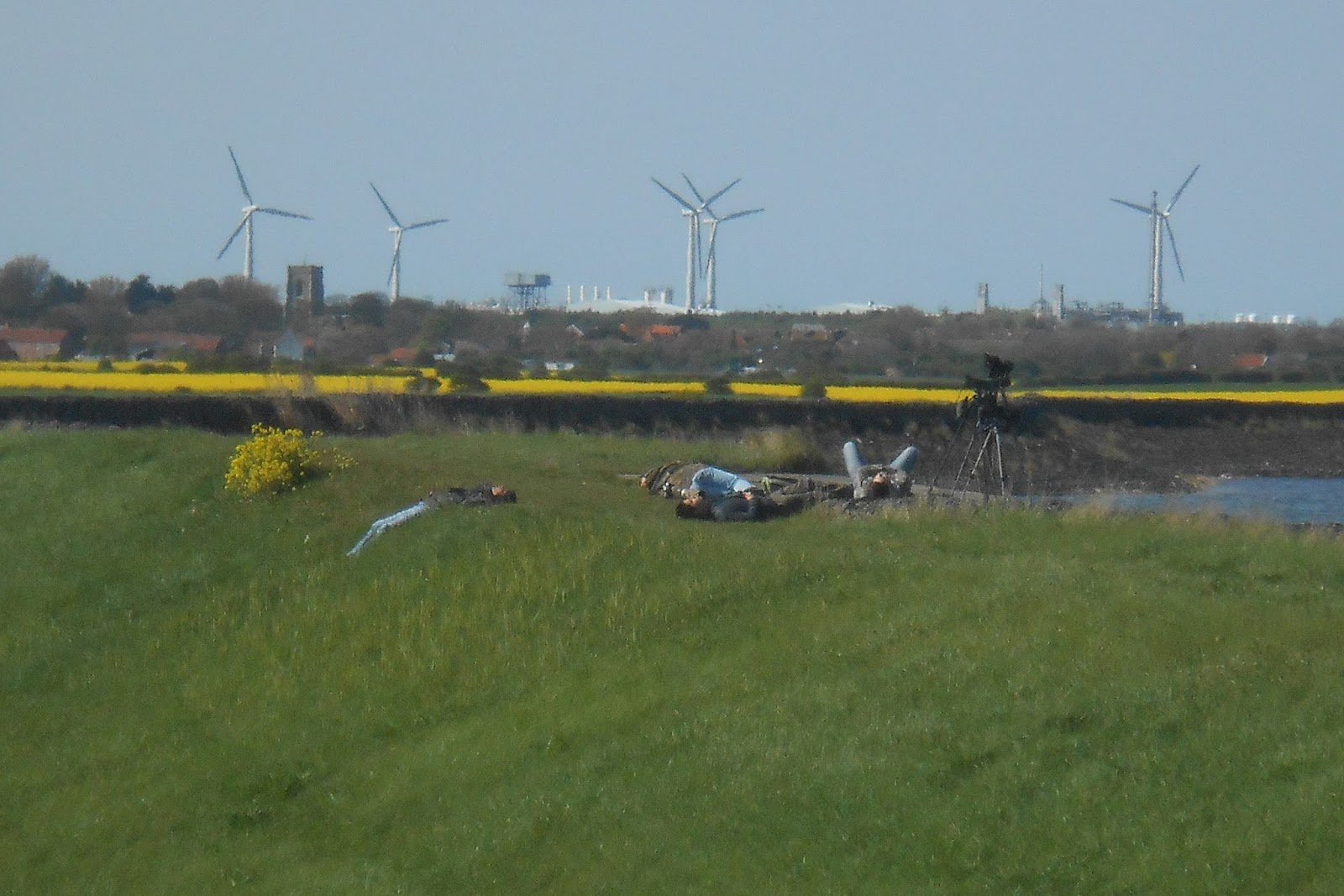
 As you can see, a full days birding left some very tired NGB'S strewn about on the raised track between Kilnsea Wetlands and the Beacon Pools.


4/05/14
As you can imagine, having had a good reward from getting up early the previous day, I chose to repeat that. A much better nights sleep left me feeling in a better mood, and I head out to find some birds! The wetlands held a flock of 4 Pintail, and the Pools had 2 Shoveler, a Common Sandpiper, and the female Common Scoter from the previous day remained. A number of Little Tern were feeding in the pools, giving stunning views from the raised track. A single Snipe was showing in fields adjacent to the road


Yellow Wagtails were moving en mass throughout the day, even from very early in the morning, and it is possibly the first time I have ever said "Just another Yellow Wagtail". 2 Marsh Harrier passed through during the day, one even hunting in the field, as view from our tent! A Greenshank flew in off the sea mid-afternoon. Migration in action!
 
 
While walking up the beach side of the Beacon Pools, I met up with Sam again, and we walked up Beacon Lane, and soon after, we were treated to great views of a male Lesser Whitethroat, and then a male RING OUZEL started 'chacking' in the hawthorns next to us, showing briefly in the grounds of the caravan site and in flight!
 
There really did seem to be Lesser Whitethroat everywhere, and while watching ANOTHER 2 near the Bluebell, a Tree Pipit flew low over our heads calling.
Just up the road, a late BRAMBLING was showing around the grounds of Kew gardens.
 
Down at the Warren, a repeat of yesterdays wader flocks was again a great sight, and it was spent scanning with Martin Garner of Birding Frontiers fame. The large Dark-belled Brent Goose flock had been joined by two Pale Bellied Brents (One shown in photo).
 
 
Wader numbers were higher than the previous day, and we enjoyed larger numbers of almost the full range of Arctic breeding waders in summer plumage. With news having emerged of a couple of migrant passerines out on the point, we dragged ourselves on the long walk across the sand out to the concrete track. The recent storm tides of winter 2013/14 had washed a significant part of the road out, making access difficult.
 
We managed to locate a male Redstart, and after texting Justin (who was already on the point) he came to have a look. While waiting for the bird to re-appear, we heard a 'Crest' calling from an area behind us, and immediately knew this was the FIRECREST we had been wanting to re-locate. Eventually, we all had great views as it came to the edge of its favoured bushes a few times.
 
With time now coming to a close on the NGB trip, we made our way back to the Warren, where we were told we had just missed a flypast Spoonbill, but a hunting Short-eared Owl gave us some compensation as we rested before starting our journey.
 
 
Despite no real rarities, (being from a midland county) I had a great time seeing decent numbers of passage migrants, and certainly saw more than I would in my home counties.
 
Thanks to James G for driving, and for providing the tent, I would have been a little stuck if it wasn't for you! Also, thanks to all NGB's that turned up, for the banter, and for sharing news on birds that were being found, it certainly made a great break to endless revision!
 
MB

Tuesday, 3 December 2013

Waterbirds and a Chat

5/10/13
An evening drop into Upton Warren was fairly eventful. A stop at the Moors revealed a pair of PINTAIL which were the first i had seen here this year.
The flashes faired slightly better though, with a nice little array of waders. A single winter plumaged DUNLIN was feeding at the back of the flash before flying north towards the Moors Pool after only a few minutes. The other wader highlight was a flock of 5 RUFF which were very mobile around the flashes, feeding incessantly.
It has in fact been a very good year for this species at Upton Warren, with an almost continual presence throughout the entire autumn period, which contracts significantly to the last few years which has seen relatively few records of fairly short staying birds. Singles of both Green and Common Sandpiper were also present.

6/10/13
As i had still failed to connect with a Whinchat this year i became very tempted by news of the presence of 3 around Holt, so early the next morning i headed down there, and after a short walk, a single stunning juvenile WHINCHAT perched up close by, flycatching from an area of amazing looking habitat.


I find it incredible that i could manage 10 months into a year without seeing a Whinchat, considering the numbers of them i saw last year it came as somewhat of a shock. It has been clear that they have been either scarce or short stayers for most of the summer and i also haven't found any this year, so i was very grateful for this chance so late in the year to catch up with one.


As you would expect, a visit to this area couldn't be completed without the visit into the Camp lane Pits, where i was surprised to see the large number of 8 LITTLE EGRETS, the 2nd largest count in Grimleys history. They were well spread out across the pools but occasionally a number of them would join up briefly for a fly around.
5 were feeding in the small pool below the north end viewpoint.

It was also great to have the sight and sound of 100+ Wigeon around the pool, with also small numbers flying over. It is a sound i look forward to every winter and i'm very glad its back !
MB