Showing posts with label Goldeneye. Show all posts

Tuesday, 3 June 2014

Sheepwash Mega!

 8/04/14
With news of a made rare duck at Sheepwash emerging, I just had to rush off over there!

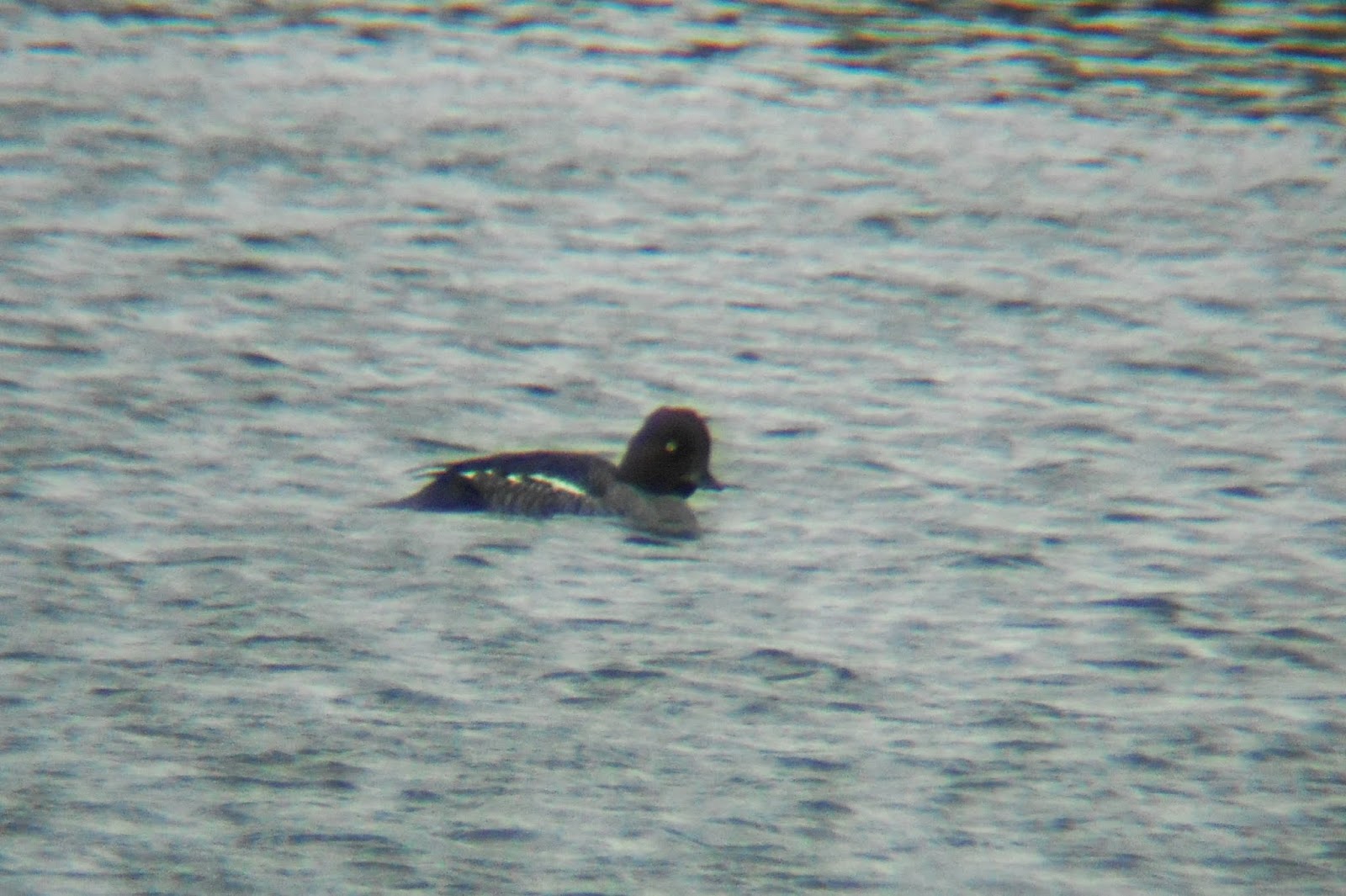
After 2 buses, and a brisk walk down to the main pool, it was within a single quick scan that i managed to pick up the female type GOLDENEYE as it swam, and dived along the far bank of the pool. After some time, the bird moved slightly closer to the raised path, and I managed some nice views of this new bird for me at the 'wash'.

As it moved closer, I noticed the bird lacked a pale patch on the bill, presumably indicating a 1st winter, or juvenile male bird. As it flapped it also seemed to have more white on the upperwing than i would expect for a female, and therefore I am inclined to the latter suggestion


A flock of 4 female Goosander were still hanging on, but being very elusive, hiding behind the islands for long periods.
MB

Wednesday, 14 May 2014

Out birding in Cambridgeshire with the Worcester crew

5/04/14
 
Road trip!
 
It was another day out with the Worcester crew, and with Mike, Jarad and Neil, it was going to be a good trip!
 
Having seen last years 'proven' wild Baikal Teal I wasn't in much of a fuss to see the bird that had chosen to appear at Fen Drayton RSPB in Cambridge, but when I was offered a lift, and with a rather mouth-watering array of 'rares', I just couldn't say no!
 
So, our first destination was Fen Drayton, and sadly, the day soon reached its low. The Teal had gone, and hardly any ducks remained whatsoever! We were joined by another foreigner to this 'distant land' when Hughie appeared along the path.
Infact, it was a struggle to be too exited by anything that was present, a single female Marsh Harrier made a brief fly through visit and decent numbers of Goldeneye were present on the many pools. Infact, it was the hybrids that were the best birds of the trip. A Tufted x Pochard was present on one of the pools, but the most interesting bird came in the form of a rather odd looking Wigeon, which showed characteristics of both Eurasian and American Wigeon. However, the crew had practically fallen asleep at the lack of birds by this point, and we chose to head on.
 
We moved to Pymoor, where a drake American Wigeon was being reported, but in our searching of the masses of ducks we failed to locate it. Later in the day it also became obvious we had also not picked up another duck......
 
Stunning females of both Marsh Harrier and Peregrine flew through, flushing everything in the process.
 
Despite the lack of yanks, I was amazed by  the huge numbers of ducks still present, Pintail, Wigeon and Teal all being represented by very large numbers, and a flock of 40 Whooper Swan remained, which I thought was quite late, and indeed proved that this trip would work out to be worthwhile.
 
It was while scanning we received news of a female RING NECKED DUCK just up the road, so a quick car journey and we were soon pulling up, and within a few moments an obvious female 'Ring Neck' could be seen distantly from the river banks. It really was very distant, but very good light meant that it was perfectly identifiable. Even on shape alone it stood out a mile!
 
From this viewpoint, it was also clear of the huge volumes of ducks that remained on the Ouse Washes! Literally thousands!


With the weather feeling so 'springish', it was also great to see, and hear a Yellow Wagtail as it bounced over our heads! Always a great bird to have so early in the year!
 
With limited time remaining before having to head back, news of a Spoonbill at Ouse washes RSPB had us making a detour, and soon upon arrival at the hides, we were greeted by stunning views of a rather beautiful looking summer plumaged SPOONBILL!
 
What was even more outstanding though, was the fact that the bird was awake THROUGHOUT our visit, and was constantly feeding, which made a rather refreshing change to most Spoonbill records!
 
Again, it was somewhat of a "Midlander meetup" as again Hughie was present, and we all enjoyed this rather scarce visitor to our home counties.


Perhaps more  impressive though, were the sheer numbers of waders that were present, mostly consisting of two species. Hundreds upon hundreds of 'islandica' Black-Tailed Godwit were roosting on a couple of the spits, creating carpets of red, and many Ruff were strutting around in fine summer garb! What could be better! We had 60+ of these rather gaudy waders as they waded their way through the shallow waters outside the hides
 
 
Our time here was as I said, limited, and therefore we had to leave, but my first taste of the Ouse washes certainly 'whet my appetite', and I can see a return visit coming on soon!
 
MB

Thursday, 10 April 2014

Birding in the local area, Gulls and Farmland birds.

28/02/14
With a juvenile Iceland Gull currently roosting at Bartley, the decision was taken to rush down there to try and get one of these gorgeous white winged beauties from up north.

The usual scrum of local Gull roosters had assembled, and it wasn't long until the Gulls started to pile in. While panning the Gull flock as they settled in front of us, I was suddenly stuck by a small white headed bird towards the left hand end of the flock. Being larger than the surrounding Lesser Black-backed and Herring, and with its pale back it stood out like a beacon from the flock. It was only another CASPIAN GULL! And a stunning example of a 1st winter bird!
In my honest opinion, 1st winters are by far the best looking age of Caspian Gull, so to have self found one in the roost at Bartley (where I rarely manage to find many birds) was pretty awesome!

As I shouted this bird out to the next car along, occupied by Andrew, a return came, the juvenile ICELAND GULL, and soon after, I was watching this very crisp looking stunner!

As the Gull flock was very restless, they soon relocated, and most dropped in by the sailing club. We quickly adjusted our viewing position, where we had stunning views of the Iceland Gull, but I couldn't refind the Caspian. And then the phone call, Terry was watching it sitting on the pontoon from the dam!


With a quick powerwalk to the car, and an equally quick drive around to the dam, we arrived to the news that it had flown off!
Relentless scanning until the very last shreds of light revealed only one other brief view, as it again returned onto the water near the pontoon. But once again, the flock flushed and it was not seen again!
 
1/03/14
 
The next day was spent birding in the home county with fellow young birder and NGB Espen. Having trained it up from his home the main intention was trying to find him his first Casp, so, following a drop into Shenstone, it was up to the local tip and onto the beautiful location of Bartley Green!
It was great to exit the car at Shenstone to the sound of singing CORN BUNTINGS, and it took a ridiculous amount of effort to walk the entirety of 20ft to get a view of these. And not just a couple, a superb flock of at least 25 as they commuted between a hedgeline and the ploughed field. Unfortunately however, viewing was cut short when a local dogwalker walked along the hedgeline, flushing the vast majority of the Finch/bunting flock, which also consisted of a few gorgeous Yelowhammers!

 
Moving onto Wildmoor, it didn't add too much optimism when a local birder, who was just leaving and had been present all morning said that it was very quiet. Regardless, we headed up, and were soon scanning the amassed Gull flocks in the adjacent fields.
 
Which contained not a single bird of interest...
 
So, refocusing my attention, and the juvenile ICELAND GULL was picked up flying about over the tip, moving back and forth in the airspace between our location and the far side of the tip. However, it refused to land, and after some time circling with the gull flock, was seen to fly off west!
A single Green Sandpiper within the quarry was a first for the year, but one I had been trying to hold back for later in the year. In this instance, the bird found us!
 
Our last port of call was Bartley, via Hopwood, where we failed to find the Shrike!
 
Pulling up on Scotland lane revealed the presence of very few Gulls, and it remained that way until the very last available light, when masses of gulls piled in. Sadly, a little to late, and we soon gave up, the light was just unworkable by that point!
 
7/03/14
Another roost session at Bartley was again fairly uneventful, but the presence of 4 Goldeneye was something different, as I haven't seen too many of them at Bartley this winter!
 
8/03/14
It about time I gave the patch a good old thrash right?
Of course!
 
So, at a relatively early time (please do remember I am a student after all!), I grabbed the scope and the bins and set off. It was great to see the Mandarins still haunting the river margins, with a minimum of 4 found (2 pairs). Also adding a splash of colour to the drab greys and browns of the riverside vegetation were a pair of resident Goosander, which were diving in their usual area as they have done all winter! Needless to say, they were as timid as always and soon scooted upriver.

 
What really made my patch visit though were the small numbers of 'farmland' birds present around the paddocks, a flock of 18 Lapwing fed in a flooded field, and a party of 7 Meadow Pipit were flitting around the area.
I couldn't help but think that spring was on its way, and I would soon be joined in these very fields by stacks of migrants!
On the return leg, I managed to find a singing Marsh Tit well away from the normal areas they visit! So I am also very hopeful that they may finally expand their range a little more on patch!
 
Later the same day, I couldn't resist another drop into Shenstone, and this is why!

 
Standing on the roadside I was completely surrounded by the flock of 30c CORN BUNTINGS, most of them singing that lovely jangly song that is so reminiscent of the English countryside! Its so sad to think that now that this exact sound is missing from most areas of the UK, fields that once were filled by the sound of birdsong now lies quiet and desolate.
 
It makes me feel somewhat glad I have a location such as Shenstone so close to home.


MB

Monday, 15 April 2013

Its been a long time!

It really has been such a long time since my last post, and am just dropping by to say that posting will again commence from now onwards as i am now mostly done towards my coursework, which has been one of my biggest inhibiting factors. Having just returned from a birthday weekend away with 'The Girlfriend' it seems like a good time to fill in the gaps of the last month!

21/02/12
Talking about the Girlfriend, all the way back in February we went for a walk at Arrow Valley Lake as i knew that Goosanders had been seen there recently, and we quickly located 13 of these stunning ducks, including 7 drakes. 15 Tufted Duck were also around the lake, and a Reed Bunting was seen near the visitor center. We were also able to get some great close up views of BHG's, including a few nicely marked 1w birds!


A couple of Tufties were showing very closely nearby!

27/02/13
I again went for a walk to look for LSW in a woodland to no reward, i'm really struggling to catch up with them this year! A stunning male BRAMBLING was still showing, starting too acquire some aspects of summer plumage.

2 Green Woodpecker were showing well on some short cut grass.

 And i was happy to see that both of the resident pair of Tawney Owl were out on top of their stump.

28/02/13
A visit to sheepwash was fairly productive, 37 Goosanders was a very good count, one of my highest of the winter infact, as was 47 Pochard. 8 Shoveler were still present, and the Tuftie flock numbered 20. 30 Linnet were still up on the 'mound' proving as flighty as always. 5 Lesser Redpoll were showing well in the wooded bits.

1/03/13
Roost birding at Bartley revealed a Yellow-legged Gull, but i manadged to miss the Caspian that was being watched from the dam.

2/03/13
A quick twitchy stop into Bittel reveled that the stunning adult drake SMEW was still present, choosing to reside in the furthest corner possible from the viewpoint on the Bittel farm Causeway. The Smew was keeping company with a single female Goldeneye, while a flock of 10 Goosanders were also present.


3/03/13
A patch visit was fairly uneventful bar 2 Snipe which flew over my head at Blackstone.

6/03/13
Another visit for LesserPecker and again drew a blank. I have been spending regular 3-4 hours in this woodland frequently and still am failing to see them. 4 BRAMBLING were still around, as was a Peregrine and the Tawney Owl was perched up on the top of the tree in beautiful sunlight, highlighting those gorgeous rufous tones.


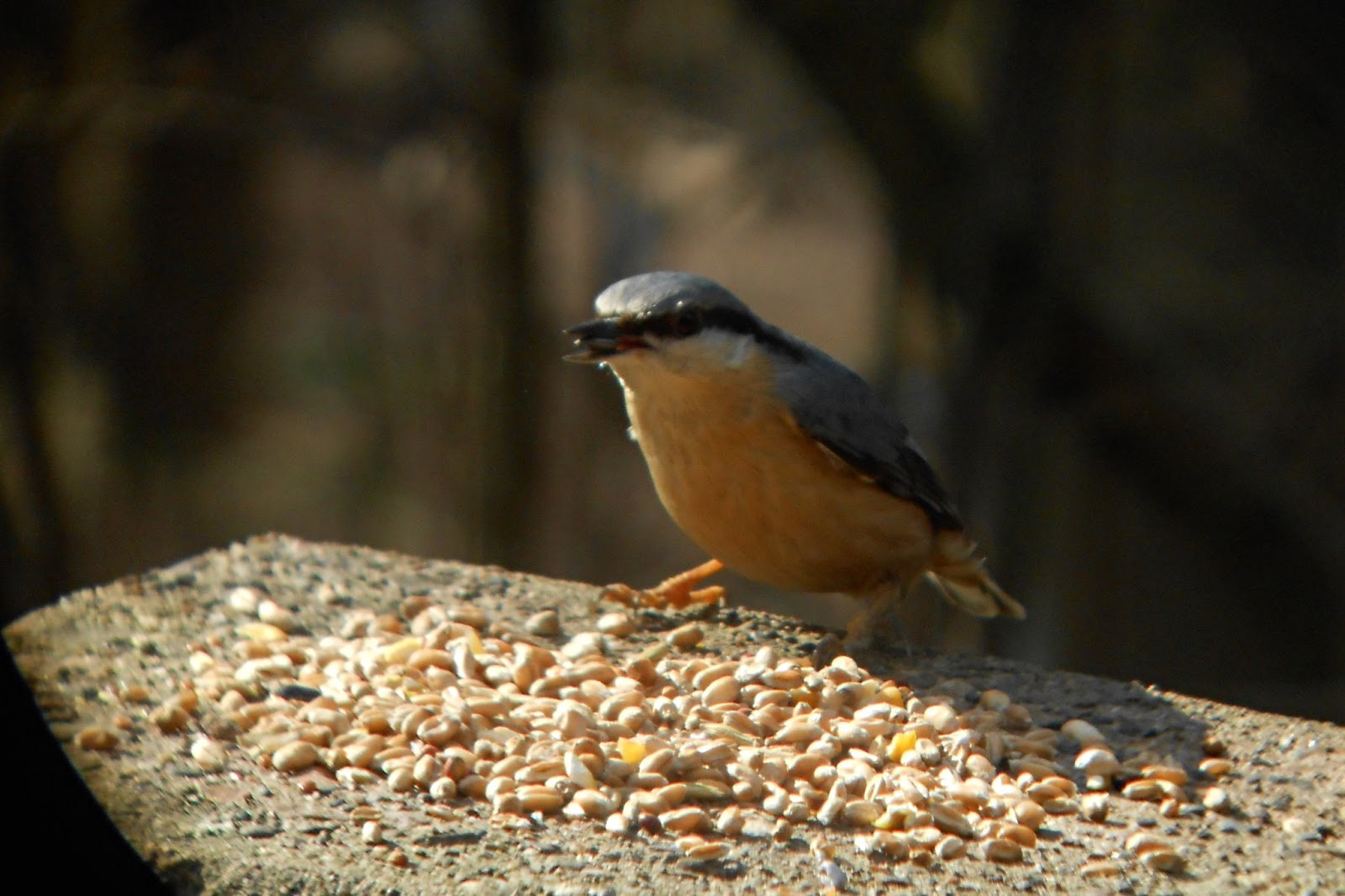
A Nuthatch was showing down to 6ft on some food that had been put out.

13/03/13
Another failure to find LSW. A male and a female BRAMBLING were still near to the feeders. The Tawney was still out, and the Peregrine was still in residence. A small flock of 10 Siskin were flighty.

14/03/13
Sheepwash was doing well at retaining the Shoveler flock, as there was now 9 birds, including 3 birds showing very well adjacent to the path. 13 Goosanders were widely spread across the pool, but the Pochard flock had halved to 20 birds. A Kingfisher did a flypast along the river.

15/03/13
I do love my roosts. Again i visited Bartley as a Med Gull had been roosting regularly  Neil Duggan was also in the area and dropped in also. It was like a big birders meet up as 8 birders were present, the most i have ever seen at the location. Eventually the stunner of an adult MEDITERRANEAN GULL was located while suffering the freezing wind. For me however, the highlight goes to a pair of Peregrine which shown very well off the dam, apparently a very rare bird at Bartley, as they hunted the roosting Gulls. A Curlew flew off as the Peregrines entered.

16/03/13
I have a fondness for Grimely due to its superb looking habitat, and with waders starting on the move it seemed like a logical choice. We first dropped into the Holt flashes, where a flock of 75+ Wigeon were feeding, along with a fair few Lapwing and two Oystercatchers. I picked up two GREEN SANDPIPERS which were either migrants or some of the wintering birds. Moving onto the Camp lane pits we added a drake Pintail and a small flock of 6 Curlew, 2 Redshank were on the flooded middle section as were 2 Oystercatcher.

Following this we dropped into Upton Warren where i quickly got the 14 Avocet. 3 OYC flew north and 1 Curlew was showing. 3 Chiffchaffs were my first 'spring' birds and 2 Water Rail shown. A single 1w Common Gull dropped in among the roosting Gulls.

17/03/13
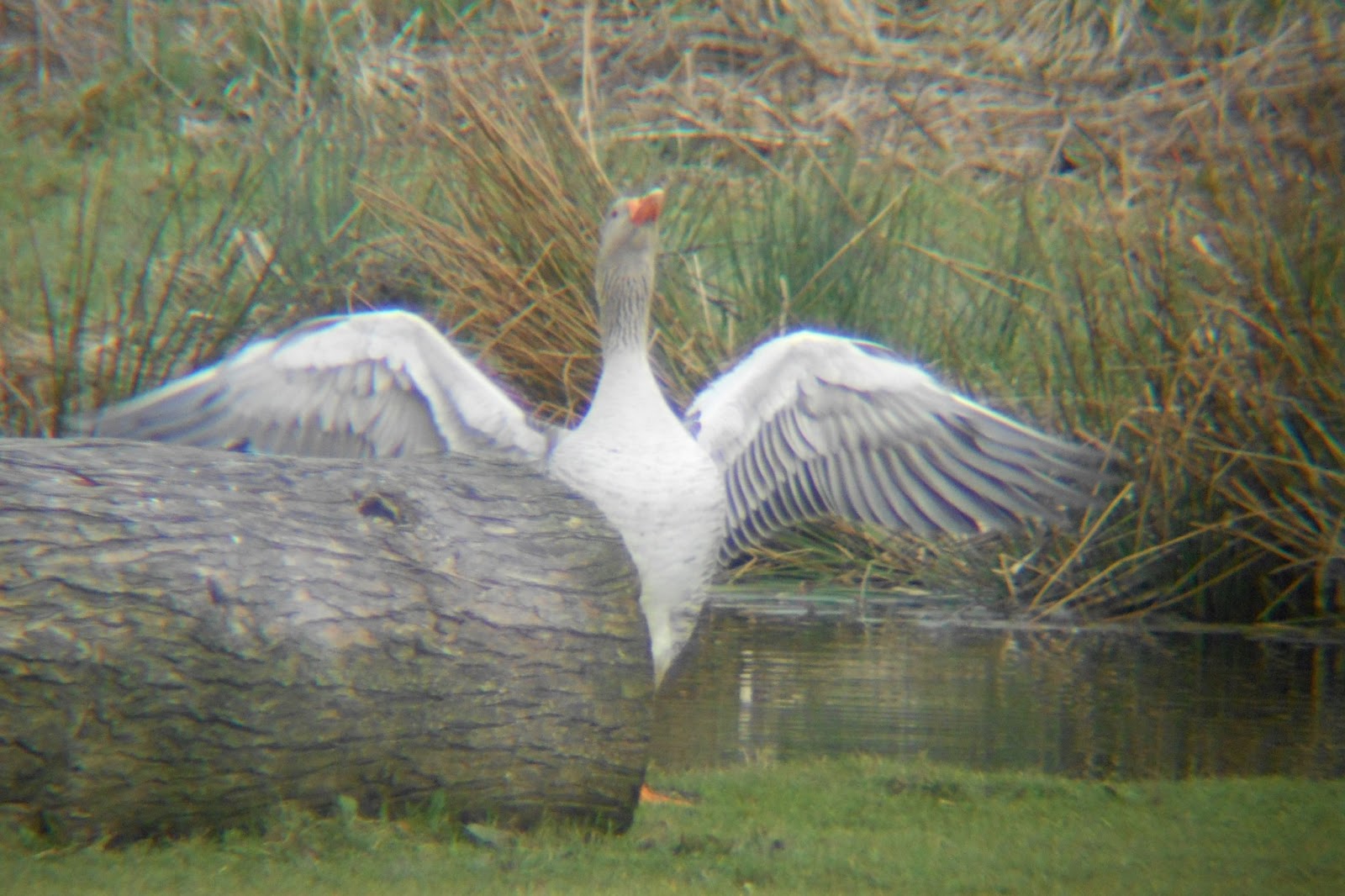
I struck lucky on patch with 2 Greylag Goose, an insane patch rarity. I have only previously had fly overs but these two birds were 'decked' and were showing on the Lickhill pool.
  (You can see both birds in this photo, even if only a tiny portion of the 2nd birds head)

And now i can get into the more 'juicy' recent birds in my posts following this,
MB

Monday, 25 March 2013

Staffordshire Gull Watching!

19/02/13
Staffordshire is generally one of the best counties within the WMBC region for Gulls, primarily because of the large Gull roosts that appear at the counties larger reservoirs  and for an avid Gull watched like me, Little can beat the Gull roost at Chasewater. So we decided to spend the day Cannock area of the county, taking in the Chase, kingswood and Chasewater.

The day didnt start very promisingly, as untill about 11 am thick fog covered the landscape, meaning we didnt leave untill it had started to burn off. Following this we slogged it around the chase for a few hours, with very little reward, with the only birds seen being a Yellowhammer in the car park and 2 Raven cronking overhead. 10 Roe deer were showing in the valleys, including a single stunning stag!

With half the day gone already, we decided to head to my new found favorite gulling spot of Kingswood lakeside following our sucessful visit back in January. Immidiatly upon driving up the road it was apparent there were hundreds of Gulls on the main pool, and there was around a thousand or so circling over the tip. We had a brief stop around the back of the first factory to have a look through the circling Gulls before moving back to find somewhere to park back near the main pool because some numpty had blocked the entire parking space with a single car!
We found somewhere to park and found a viewpoint of the lake, looking into the sun to have a quick scan through before we move to a better position. It was only a few seconds in before i was rewarded when the darkest juvenile GLAUCOUS GULL was sat on the water among the commoner Gulls! I could see there was a few dog walkers approaching the lakeside, so quickly continued scanning, and only another 20 or so Gulls to the right of the dark juvenile Glauc i picked out an absolutely stunning smack in the face 1st winter CASPIAN GULL! But i again continued scanning without stopping for photos as i knew the birds would fly very soon, and with only 100c Gulls out of the 700+ gone through, i had a few to go. I continued scanning further and further into the reflected sunlight, as far as i dared infact, and on nearing the end of the flock i was struck by a completely white Gull. And i mean WHITE! Back on its huge size was apparent, and when it turned its head showing its massive bi-coloured bill confirmed it to be a 2nd GLAUCOUS GULL!

As the dark Glauc and the Caspian were the closest out of the trio, i aimed the scope back at them, grabbed for my camera and took some record shots into the sun. The dark Glauc was easy to pick out again, because it really was a beast! Easilly one of the larger examples of Glauc you can get, and a very dark one at that, being one of the darkest possible biscuit colours you can get!


I also got some quick video footage of the bird as it swam around. The back-lit image actually emphasizes the pale transparent quality to the birds primary's. Its clear from the birds structure how much of a beast the bird is, with a huge chewing gum pink and black bi-coloured bill, chunky head, and very short primary projection all adding to this image. What a bird!


Scanning back to the right again, i picked up the CASPIAN again, and got a few photos before, as expected, almost 2/3rds of the flock were flushed as the owner of the dog then proceeded to let it then jump into the water.
In my quick picture, you can see the Caspian-esque structure so reminiscent of Caspian, with its long Bill, pale head, fairly dark 'shawl', completely dark eye placed well forward, fairly small, pear shaped head and pale back base colour combined with its large size. All this becomes very distinctive after some studying, all of these amounting to a fairly standard stunning 1st winter CASPIAN GULL.


With a fair chunk of the flock now gone, we now changed our position to view the lake, so that more of the flock was out of direct back light.
And i was overjoyed when scanning through the flock that this absolute stunner shone back at me!


Is there anything other to say that Wow? Again, an absolute BEAST of a GLAUCOUS GULL, it completely dwarthed the LBBG adjacent to it, in every single way.

So, 2 GLAUCOUS GULL, both at completely opposite ends of the spectrum of plumage at 1st winter, and both absolute brutes!
This bird is obviously very very faded, being almost an entirely white bird, but there are a few small clues to the birds true age. Its fully black eye being the most prominent. It is also apparent that the bird had many juvenile type feathers, with darker edges, revealing that the bird is infact a faded 1w rather than an older bird.


I went back to scanning the flock again, and i was amazed when the CASPIAN GULL again jumped out at me, with slightly better light this time.

Additionally to the points mentioned earlier, Caspian Gull also have fairly pale white underwings, which contrasts to most other 1st winter Gulls, and if only to further secure the identification, the bird then decided to have a quick stretch for a video!


CASPIAN GULL is one of those really birder's birds, and probably one that not many of the readers of this blog will be interested in (Well done if your still reading). Gulls are one of those very specialist subjects that a fair few birders shy away from, but even non-gullers have to admit the potential prizes that could become apparent in the thousands of Gulls that arrive here each winter. The sheer complexity of the subject only helping to heighten my enjoyment from these greatly overlooked species.
It does make you wonder just how under recorded birds like Caspian Gull are (Less so for the more obvious white wingers), but recent trends shows the midlands as being one of the best places to catch up with them, so get checking those flocks people!

We started to leave for the Chasewater roost, walking past a few large Gulls sat fairly close of the water. I knew the Caspian had been fairly close into the bank at times, and i was glad to see that one of the closest birds was infact the CASPIAN GULL!
I grabbed the camera and fired of a series before taking some video!


Moving onto Chasewater i was fairly dissapointed to see the Gull flock had again pitched up at the north end, but a section of the flock was within scopable distance. I scanned the entirety of the Reservoir  picking up 19 Goldeneye. We stayed until dark, and the birds did eventually come slightly closer, allowing me to pick up the familiar 2nd winter GLAUCOUS GULL that i saw in January. A distinctively different bird to the other 2 birds, with fairly tatty plumage, which is very 'blodgy', with alternating white and grubby brown patches. A few Yellow-legged gulls were also in, but my biggest prize was the one that completed the 'set', when i picked out the dinky ICELAND GULL, a very small and petite bird, small, cute looking head  and long primary tips. Still a decent biscuit colour on the bird too, just a shame it was too far away and came in too late for any photos.

But as i have said, that completed my 'set' of rare winter Gulls for the day. 3 GLAUCOUS GULL, 1 ICELAND GULL and 1 CASPIAN GULL, as well as all the usuals. It was about as good a winters day gulling as your going to get!
MB

Thursday, 14 March 2013

Gulling with local birder's

17/02/13
Local Redditch birder Neil Duggan had kindly offered an evening out at the biggest Gull roost in the region, at Chasewater, and Matt G the Ealswood Birder and i tagged along in the hope of jamming in on some of that White winger action, and checking a few of the nearby Gulling sites in the hope of picking something up.

We were meeting at Upton Warren, and i got there early to have a check of the Flashes. A Lapwing flock was commuting between the fields and the 2nd flash, making it awkward to get a decent view from the feeder hide. Upon exiting the hide i was watching 2 Goldcrest in a trackside bush when Matt walked down the path towards me that he'd just had a Golden Plover in the Lapwing flock! We moved back into the feeder hide and started scanning the Lapwings at the back of the flash, and there it was, a Golden Plover sitting among them! We watched it walking around in the flock before taking flight and giving us some nice views. Cue a digi-scoped record shot.


Heading north, we first dropped into the West Midlands gull hotspot of Stubbers Green which was practically devoid... A few Great Black Backs and Lessers. Errr, not the best of starts.

It was still some time until the roost, so we then headed over to my new found Gulling spot, at Kingswood lakeside. At least we had Gulls this time! But again it seemed out luck wasn't there, as in the flock were only the expected Herring, LBBG and BHG. Scanning the Gulls flying up above the tip i got exited when i saw a Gull with white wing tips circling with about 10 other Gulls. Sadly however, it didn't seem to be one of the true white wingers. Despite having obvious white wingtips, the had a fairly dark grey 'saddle' on its back, obviously wrong for either of the hoped for species. The bird was at some distance however, but in good light we agreed to call it as an abbarent gull sp.
A lot of the birds were staring to fly over to Chasewater so we decided to follow in the hope we would have more luck there, and then it just got worse. The birds had obviously decided to pitch up at the furthest reaches of the Reservoir, right at the north end, making viewing from the south end almost impossible.

2 Goldeneye were showing fairly well


As was this Common Gull

A adult MEDITERRANEAN GULL was picked out of the closest large flock of BHG at the end of the dam. A stunning 90 % summer plumaged bird, with bright white primary's and an almost fully black hood. If you ask me, one of the most stunning of the small Gulls, and probably one of my favorites!

As the light got worse, i picked up another adult MED Gull, this time a winter plumaged bird, which i believe Neil got onto, but quickly disappeared within the flock (A very common occurrence at Gull roosts). These two alone made my day as it was the one Gull that i had missed on previous roosts this year, so it was nice to have caught up with two of them!

Going back onto the large Gulls they had still failed to move any closer. A adult Yellow legged Gull was showing in the birds in front of the sailing club but that's as good as it got. Many birder's didn't even bother to stay around as they knew the task was almost impossible. But the three of us soldiered on until dark, with absolutely no reward. The day got even worse later that night when news emerged on what the gullers had seen from the west shore.

So yeah, not the most 'to plan' day you could have had, and it is a real shame that we didn't pick up any white wingers, as at the time any would have been lifers for my companions. Sorry i couldn't get you them, i'll just have to owe you a repeat visit so we can get them!

MB

Wednesday, 27 February 2013

Another Big Worcs day.

2/02/13
An early morning visit onto the patch revealed that the drake Goosander was still roosting on floods, sleeping on one of the small islands.
Moving onwards, we moved to Eyemore Wood, looking for a certain species, and they didn't prove too hard to see. I was quite surprised however to find the entire flock of CROSSBILL completely silently feeding on larch seeds adjacent to the road. Usually, you can hear the 'Glip' call while trying to locate them. A few local birders appeared soon after. Of the 12 Crossbill that were present, there was at least 3 stunning red males.
The males birds in particular are absolutely gorgeous birds, i mean just look at them!


Saying that however, the bright green females are great aswell!


Not wanting to spend to long here we then headed to Grimley Pits, to have another look at the female Smew, which had been joined by a 1st winter drake!

We arrived at the north end to be greeted with largely silhouetted views of the hundreds of waterbirds. I scanned the middle section, and after some scanning i picked up the female SMEW, only briefly however, and after getting my dad a look at it through my scope, it duly disappeared! In the time being though, we were treated to views of a female Goldeneye. There was also small flocks of Gadwall, Teal and Shoveler, with larger numbers of both Pochard and Tufted Duck.
Following this, we then moved to the south end of Camp lane pits, in the hope of picking out the Smew's in better light, and after a while scanning, i picked out the female bird as it swam and dived further to the north. Very soon after, the bird was joined by the 1st winter drake SMEW. Both birds then sailed around the pool, and we were treated to decent, if fairly distant views! From this new viewpoint, i also clocked onto 3 Goldeneye (2 adult fem, 1 juv).


Infact, the birds were so distant i couldn't even be bothered to get any video footage, combined with the fact that the wind was buffeting my scope like crazy! It really was windy!

So we moved onward.
I haven't had Jack snipe this year, so we headed to Upton Warren Moors pool in search of the long staying, occasionally 'showing well' bird. The lake itself was fairly quiet, so much concentration went onto scanning the edges of Amy's marsh and the track to the left of the hide. This was rewarded fairly quickly when a Water Rail strode into view.
 

A second bird joined soon after, and they had a brief fight before moving away from each other. With the light now rapidly dropping, and having only seen 20c Common Snipe, i went back into Snipe mode, and on my final scan of the evening, there it was! A JACK SNIPE perched in the shallow water on the 'boat peninsular' opposite the hide. I quickly got my scope onto the bird, and pulled out the camera. While doing so, the bird began to bathe in the shallows, and i was able to get footage of the interesting behavior!


Once the Jack had moved back into the Reeds, it wasn't long until we decided to end the day and head home.

All in all a good days birding, Crossbills, Smews, Goldeneyes and Jack Snipe, as well as fairly decent views of Water rail! Not a bad way to spend a early February day in Worcestershire!
MB

Thursday, 7 February 2013

At the forefront of a 'Purple' patch!

20/01/13
I am a dumb-ass!
After trying (and ultimately failing) to photograph Marsh Tits with my bridge camera the day before, i forgot to switch the SD card back into my compact Nikon. That i hear you yell is not a problem..
The problem emerged when i arrived at Grimley to twitch the GREY PLOVER that had been found in the morning. Turing on my camera i saw the disastrous message 'Internal memory' and i found out that i hadn't got the memory card in, and it only got worse.
With only 8 pictures to play about with i kept having to go back to delete photos to take new ones, and with the weather being nothing better than shite, with sleet, snow and heavy rain, the prospects never looked good. Anyone (and as it seems, most sensible birders within Worc's) would avoid this weather, but, for the reasons set out in the last post, i love this weather, despite it being very hard to bird in.

They GREY PLOVER gave decent views feeding on the flooded Causeway.
Sadly, that's about all i'm going to write about it, i really lack any inspiration to try and make a Grey Plover in winter plumage sound exiting. Yes, its a good county bird, and I've only ever seen a few, but it is a bit dreary and the only thing to say about it is that it does show what cold weather can do to displace birds.

 As you can see from the photo's, the snow was getting fairly thick, preventing anything decent. Similarly showing around the Causeway was a pair of Goldeneye. The cold weather had brought a huge flock of Wigeon (252+) which is easily the largest  i have seen in Worcs, and among the grazers were a similarly good number of Dabbling ducks, 50c Gadwall, 20+ Shoveler, 30+ Teal among many hundreds of Mallard and Coot. Scanning along the few un-frozen edges revealed 2 winter plumaged Dunlin and at least 7 Common Snipe.

After everyone bar me and SMW had left, the snow eased slightly, allowing us to scan the distant ducks on the flooded middle section in the hope of finding the Pintail. And it was only a couple of minutes into this that Steve called out that a Smew had just popped up among the Coots. Soon after, i was onto a superb looking female SMEW as it dived almost incessantly. I had infact only a day previous said that this weather was bound to 'dump' some of these gorgeous small ducks in the country, and then hopefully the county. The views were far from great to say the least, but they were good enough to secure an early year tick!
Again (in my 8 photo memory space) i tried for some distant, snowy crapographs.


(Hey, you can see what it is!)

It was around this point that i picked up a 'pale' wader feeding on the ice on the far edge of the pools. Was that what i thought it was?
The Grey Plover came slightly closer (see, i did my best to mention it again!),


However, it was again quickly forgotten when my 'pale' wader dropped in closer, showing prominent wingbars similar to Common sand, very pale white underparts and pale grey upperparts ! A SANDERLING! We were treated to great views as it fed along the near shore, showing through tall weeds, a wire fence, falling snow, and fogged and wet optics!


So there we go, 3 for the price of one, and testament that when bad weather hits you should be out there birding! If you don't come back with drenched optics, soaked hair, a snifly nose and a bright red nose, your not doing it right. Get out there birding when its like this, you don't know what your missing!
MB

Monday, 5 March 2012

Bi-county Twitching

15/02/12

AS readers may know, i like seeing 'rare' birds, so, although primarily being a patch birder, i do like to visit odd locations for out of range birds.
And there happened to be one quite close by, a Firecrest had been found near Penn in south Staffs, so with a day free, we decided for a look!
The 2 'crest' species being particular favorites of mine, so i was enthusisatic, as i had heard both were showing side by side in the small woodland.

And here we were.


After about an hour looking, we finally clocked onto a stunning FIRECREST darting about between Holly, and adjacent Tree's, we were treated to great views of this stunning crest at about 30ft range.
I must say, it was great to catch up with this species again!
After about 20 Minuites watching the bird, we left for another site, Sandwell Valley RSPB

As i didnt get any photos, here is a drawing of the FIRECREST (Life sized)


So onwards and upwards, Sandwell Valley RSPB had been holding a redhead Smew for the last few days so we decided to head off there.
On arrival at the lakeside hide, we were treated to views of a stunning drake PINTAIL feeding within the reeds, a great bird to see anywhere, never mind at an urban reserve!


However, the lack of Smew got me edgy, i was informed it flew out 5 minuites before, so decided to stick around, and forfit the visit to Stubbers Green after.
I was kept entertained by a female GOLDENEYE and a decent flock of Goosander. I picked out a adult Common Gull in the gull flock.


However, a good time later, i finally heard the sound was hoping for as someone spotted the SMEW!


Although there was debate as to the age/sex of this bird, i am quite confident that this bird is an adult female despite the small amout of white feathers on the brown 'hood'. The lores were black, and the belly was white (would be grey in 1st win drk).

As the hide closed soon after the bird returned, we headed to the feeders, where i soon got onto a WILLOW TIT. i even manadged a crap photo!


We then headed into a nearby wood, where we saw a single female RING-NECKED PARAKEET


With 5 year ticks, i can say that it was a good day!
MB