Showing posts with label Mandarin. Show all posts

Wednesday, 24 June 2015

March 2015- Alpine Swift, YBW & RND

A lot of uninspiring 'patchworking' of multiple sites was very similar to the latter of last month. A Little Grebe and Water Rail remained on Patch on 1st. 
It was brightened up with a very unexpected site first at Parkes Hall Reservoir on 4th though, when a drake Shelduck was present. Something I didn't expect at all while heading out for an evening walk!


The first highlight of the month came on 6th, when news emerged late evening of a Yellow-Browed Warbler at a sewage treatment works just outside Sedgeberrow, near Pershore. It was in county, so it wasn't too hard a decision to head over there the next morning. It didn't take long to get out first views. A really smart winter gem!
It seems as if these things are now yearly in Worcestershire, which is an anomaly compared to the track record of other midlands countys.

Cracking views were had as it initially used the barbed wire fence adjacent to the sewage beds as a launching post before dropping down to feed on the pans. As it warmed up, insects became more active, and the bird followed them out into the trees, and it spent the latter half of the visit feeding up higher in the trees.


It wasn't exactly far to Ashleworth Ham from here, and with the sporadic appearances of a drake Green winged Teal we gave it a go. Sadly no yank Teal, but a top class list of winter birds. A very good variety of dabbling ducks, and a very good flock of Common Gulls. It didn't take long for my curiosity of the Gull flock to materialize, and it took a matter of seconds to locate one of my targets, a Mediterranean Gull, a rather pretty 2w bird, but soon more Common Gulls flew in, and with them, an adult Mediterranean Gull, Nice!


A Red Kite flew low over, which added another unexpected bonus to the day.

On the 8th,a Barnacle Goose joined a few Canada Geese on the patch. Interestingly, a bird also appeared around this time 2 years ago. Similarly, the both stuck around for some time, and this bird became a permanent fixture of the patch for a number of weeks.

Sometimes in birding you have surreal moments that you simply can't begin to comprehend what just happened, and the 9th March was one of those days. A fairly typical day, a number of lectures, and just a bit dull weather wise. Nothing in the slightest to get exited about right?

With lectures over, I was out into the courtyard and out of reflex the first thing I did was look to the skies, a couple of Feral Pigeon, typical... But as I glanced up, the unmistakable shape of a Swift rose up from behind the building opposite me!!
A Swift in March is always going to hit the 'PANIC' button, more so for the fact I didn't have my bins in hand and I couldn't see any sort of plumage details on it due to the white sky. It was merely a silhouette, but instantly it was obvious it was big and bulky. A few seconds, a couple of flaps, and it was across the top of the building and towards the Church/town centre.

Other than the certainty it was a Swift, which one?!?

Wanting to get people looking to the skies, a panicked tweet went out on my twitter and texts sent to all locals who may be in the area (including a number who were working in the office buildings around me!) in the hope it would be picked up/ people would run out of work.

Minutes of anxiety followed, I now had bins in hand and was scanning the skies, please tell me that wasn't it! As a gut feeling I knew it was an Alpine, but I just couldn't say it with that view.
A minute turned to 5 minutes, 5 turned into 30.

I was now standing around the opposite side of the church, facing towards the town, skies darkening by the minute. And then there it was, 35 minutes after I first saw it, a large Swift came cruising down the road below the height of the buildings, initially with its wings tilted showing its upperwing, then banking to show me its underside, with its huge white belly patch. ALPINE SWIFT! Absolute frigging MEGA! I watched it until it disappeared behind a building and I ran to get a better viewpoint, tweeting about its reappearance as I ran (hence the barely comprehensible message). The first birder arrived only 5-10 minutes after this, and as they arrived so did the rain. And  that was that. It disappeared. Did it roost before the rain? Did it push off ahead of the weather system? Who knows. I stuck around until after dark, and spent most of the next day looking, but nothing, the skies above Wolverhampton returning to the Feral Pigeons and F-15s.


With my enthusiasm levels up high, it didn't take much effort to wake up early on the 14th and get out on patch, and I was in for yet another treat. The Barnacle Goose was still around, but I was anxious to check the quarry, and it was a good job I was, because as I arrived I picked up two waders on the mud at the far end of the flood. RINGED PLOVERS!! Getting the scope on them, I then realised that there were infact 3 waders, a pair of Ringed Plover and a Dunlin! Absolutely mega patch birds! They fed on the mud for around 30 minutes, before taking flight, climbing high and flying off north. Exactly what I had been waiting for when the quarry flooded last autumn!


A late evening visit to Upton Warren that evening gave me a showy Redshank and a Green Sandpiper, the former being a species I don't see regularly at the site anymore.


The next morning (15th) I was out on patch again, and I again found a good number of decent patch birds, with the highlight being a drake Teal, which came off the 'Wigeon lake' at Blackstone. A Snipe also flew out from the edge of the pool and the Water Rail scurried along the edge of the willows. 2 Yellowhammer gave me a flyover and it was a 3 goose day, with Canada, Barnacle and a flyover flock of 3 Greylags.

On 17th, I journeyed over to Sandwell Valey RSPB to meet with a couple of Uni friends. A few hours of walking around Forge Mill and the RSPB area gave us a few nice birds. My First Little Ringed Plover of the year, a flock of 20 Barnacle Geese, 3 Parakeets and a Jack Snipe in the marsh.
Perhaps the most unusual addition being a Harris Hawk, which repeatedly flew over the RSPB area.

I have been watching Parkes Hall regularly, to not much reward, however on the 18th, a Red Kite flew south over Tenacre Fields. The first in the area for me!


After a fairly standard patch walk on 21st, and working in the afternoon, I was able to drop into Upton Warren flashes for the roost. All pretty standard stuff until late on when a superb adult summer Mediterranean Gull dropped into roost. What a looker!


With news having emerged that a drake Ring-Necked Duck had turned up at Priorslee Lake, Shropshire the previous day, we journeyed up there the next morning. News hadn't been released so we were going in blind but it was great to see on arrival that the bird was still present, and showing increasingly well as the morning progressed. Much better views compared to my previous (and only other) RND in the UK, a very distant bird on the Ouse Washes.


On our success we took a punt to go looking for a specific species, and a while later we were out searching. Not really hoping for much due to it getting towards mid morning it was somewhat shocking to find our targets within a few minutes of leaving the car, and we were soon getting crippling views of 3 Woodlarks, with a 4th singing off in the distance! You really couldn't have asked for much better, feeding in short grass right next to (and often on) a public footpath. Easily the best views I had managed of this species to date!


It then went quiet for a few days, visiting my usual local sites for not a huge reward. So instead I used the lull to practise some digiscoping skills, and this Chiffchaff obliged.


With the month coming to an end, and with migrants arriving, I journeyed over to Ryders Mere with a friend on 26th. Originally we had planned to drop into Stubbers Green but the Brent Geese had flown off, and following an uneventful stop, we carried on to the Mere. A good selection of birds were present but we knew out main target was on the marsh so we walked over there. It didn't take long before the female Garganey flew past us, and over the next hour we had a number of brief views. We walked to check elsewhere, but while doing so I saw a duck in the distance briefly which circled the Marsh. "Looked like a Mandarin" I thought to myself, but given the view it wasn't even worth calling.

We however walked back past the Marsh, and instantly there on the water was a drake Mandarin! Apparently only the 3rd site record and a couple of local patchworkers were soon on their way to twitch it! As we waited for them to arrive, the Garganey flew in, and swam about with the Mandarin for a while, before swimming off into the rushes. We stuck around until the first birder arrived, but as he approached, the Mandarin had flown. It seemed to drop down again in the distance, so following a brief search, the bird was refound on a 'puddle' at the north end of the site. Job done. Everyone was happy.

I was back in the home county on the 28th and again it was time for a roost session at Upton Warren. Again quiet until another Mediterranean Gull, this time a 2s dropped in to roost. Equally as stunning as the adult the previous weekend. Those primarys are just... Wow!


The last birding day of the month was spent on patch, and my effort was rewarded with a very good view of a female Merlin, which barrelled through the Quarry as I was unsuccessfully trying to find a few waders. I wonder why with this bundle of anger and feathers bombing around. Needless, a very good patch bird, and I left the patch very happy that day.

MB

Tuesday, 5 August 2014

Sheepwash Mega's!

2/06/14

It's not very often I 'twitch' Sheepwash, but with news of a 3rd record for the site paddling about on the pool, it was time to get moving.
Despite seeing them on every patch visit I was still going to travel across to Great Bridge to look for a male Mandarin Duck that had been found that morning.
From the raised track, it took a while scanning, but eventually, sitting on a half sunken log below the overhanging trees on the west shore was a stunning drake Mandarin! It was fairly distant, and combined with them being common on my patch I didn't try to get many photos other than a quick record shot.


Mark then appeared, and after scanning around, we decided to head over to the mound and as we reached the top, I heard a brief 'reel' from the riverside vegetation. Immediately I knew it was a 'locustella', but it quickly went quiet, and following a very long wait sitting next to the large area of reeds and small plants, it finally piped up again, and reeled briefly a number of times, but still refused to show! But at least it was certain it was now a GRASSHOPPER WARBLER!


Not a bird I had thought I would find at the park, as they're aren't too many dotted about in urban Birmingham.

With a last look at the main pool, an explosion sound flushed the still present Mandarin, and it flew off east, but after a few minutes it returned and dropped onto the 'mud bank'. Sadly, I was on the opposite side of the pool again, and similar to before, I didn't have the willingness to try to find a closer viewpoint, but I took a couple more photos.


MB

Wednesday, 4 June 2014

Patch thrashing and Ouzels on Titterstone Clee

13/04/14
Today was just one of those days. I decided to get out early onto the patch, and within a few minutes of walking along the river I realised why I had done this. I saw a shape swimming down the opposite side of the river, and soon after, having swam level with me, I realised I was watching a stunning female OTTER! Only my 2nd I have recorded on patch!

For the next 40 minutes, i was treated to stunning views as it crossed the river onto the near bank, and even sat out on a fallen tree for a while between fishing trips! I was absolutely gob-smacked!
Sadly, my viewing was cut short as the first rowing boat of the morning moved through, and as that disappeared up the river, so did the Otter!

A little further upriver, a call I had not heard for many months rang out, and a Common Sandpiper flew its way upriver, my first of the year!

After this point, it was all about the ducks, and I managed to count 9 Goosander and 12 Mandarin (of which only 1 was female!) dotted up the river. The Goosanders were particularly satisfying as they rarely stay in this kind of number this late in the year, raising brief hopes that a couple of pairs may attempt to breed. Sadly, they have now left, as they so often do as the river waterlevel starts to drop!

The Common Sandpiper flew past me once more, again moving northwards, and this was the last I saw of it!


After a great few hours on patch, I decided to take a punt and head up onto Titterstone Clee, mainly in the hope of finding some black and white Thrushes.

To cut the story short, after a significant effort, with a good few hours walking, searching and scanning, a brief flight view of a female RING OUZEL had us moving very quickly back towards the old quarry as it flew in that direction.

Sadly, once getting around there, it had again disappeared, and another significant time searching failed to find anything.
Rather reluctantly, it was back to the car, and while doing so, I saw a dark bird fly briefly from rocks where a few screaming children had just ran through, straight into a dense clump of gorse.

Again, another significant wait followed, but it was completely worth it! A stunning male RING OUZEL, rather slowly and nervously emerged from the gorse, before eventually dropping back down to feed where it had been previously  near the rocks at the bottom of the hill, giving great scope views!


Other than the 2 Ouzels, another highlight was the outstanding number of Wheatear present across the summit and quarry's, with at very least 20 present! They were everywhere!
MB

Friday, 16 May 2014

The Mega Geese and the Hood

6/04/14
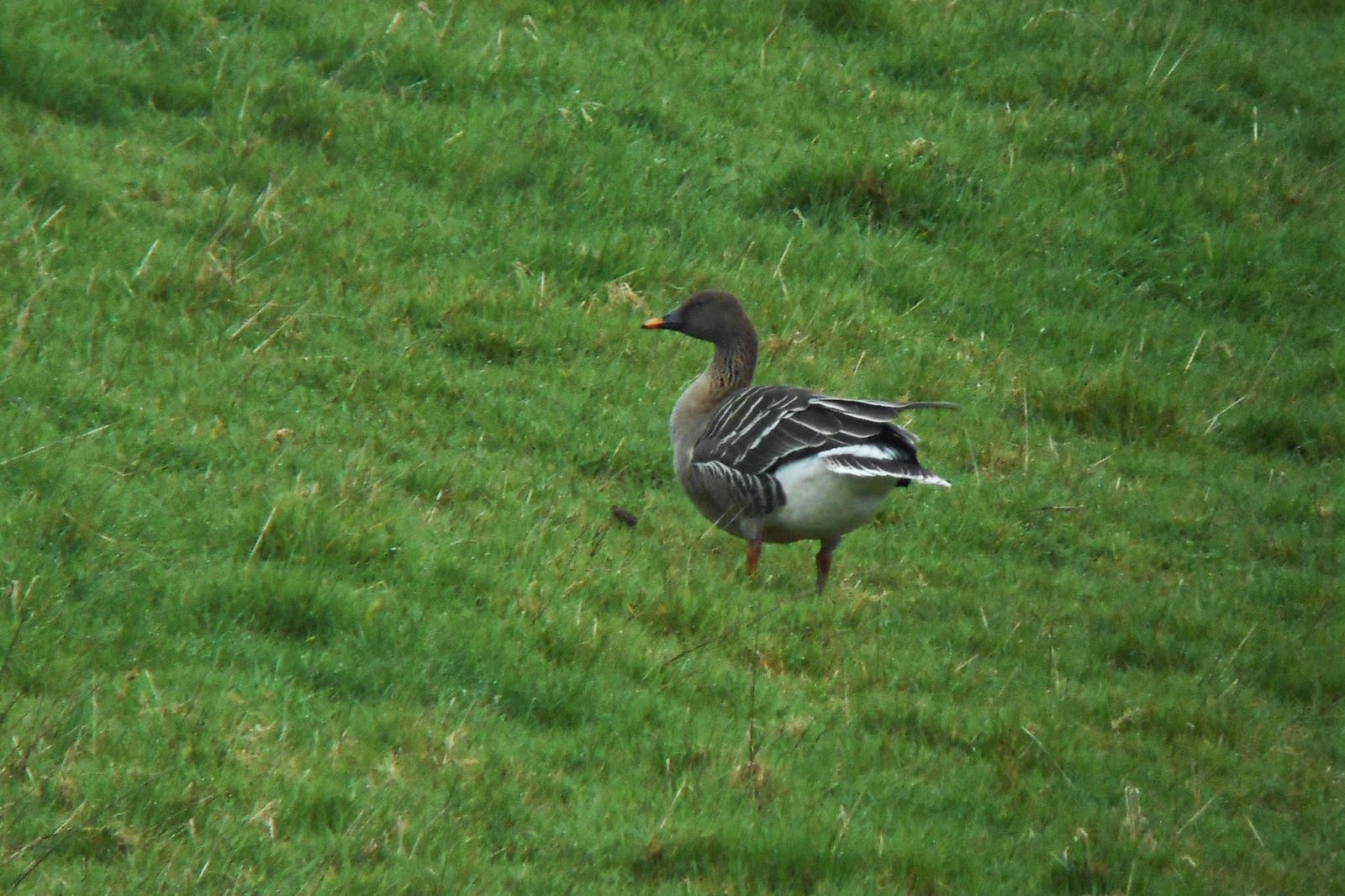
Taiga Bean Goose is a true mega.

Records in the midlands are so rare that even some 'true' national rarities have occurred on more occasions in our humble 4 counties, so therefore it was quite gutting to hear that the two 'Bean Goose at Kemerton' were late on in the day confirmed as both of the Taiga race!

I had not gone to see them as a Bean Goose is an irregular, but not unexpected discovery, that is in its usual 'Tundra' form, as birds can get latched onto Greylag flocks and hang around the region (such as the long staying Chelmarsh bird) or with the wintering White-fronts at Slimbridge.

With it now being to late to 'respond' to the news, it would just have to wait, and they left.

Luckily however, they didn't move far, and soon relocated to Slimbridge, where, while away in Cambridge with the Worcester crew, me and Neil made arrangements to drop in the next morning, with the added bonus of a rather smart looking adult Hooded Crow.

The great thing about being a WWT member is the ability for early access, and we chose to exploit that today, so, following a brief foray onto the patch to see the Mandarins (5) and Goosanders (2), we set off south.

It was great to see the car park and Holden Tower as empty as it was, as I'm sure many of you who bird Slimbridge can tell you, it gets rather scrum like up there later in the day.

Luckily, 4 birders had the hide to ourselves, and the small flock of Greylag the TAIGA BEAN GEESE had chosen to associate with were feeding remarkably close to the hide, giving rather stunning views of this rare race.
For an hour, we were treated to great views as they grazed close to the hide, before dozing off to sleep. While watching these, a flock of 14 Golden Plover dropped onto the Dumbles in heavy rain.

With the first people starting to arrive, we chose to head off to search for our other target.


Following some time in the rather aptly named hide, and still remaining Hooded Crow-less, we moved back around to the Zeiss hide for a wider view, and and soon after, Neil was shouting out that he had it!

It was showing in the field right next to the hide we were just in!
Following distant views, and getting the two birders we had been watching the Bean Geese earlier with onto the bird, we made the quick exit to hopefully reach the hide to get a good view. We got to the hide and it had gone!

A very showy Cetti's warbler kept me interested however in the Crows absence, which contrary to the rule, chose to sing from an exposed perch right outside the hide! To further emphasise the coming spring shown by out trip out east the day before , my first Swallow of the year hawked around outside the hide, always adding that glimmer of excitement as you remember late nights and Hirundines hawking above your head!

While watching that subtle brown warbler bird yell out its ear shatteringly loud song, the call went up the Crow was back, and soon after I was watching a rather snazzy looking HOODED CROW, the northern and western subspecies/Full species/ race or whatever you want to think it as.

No matter what its genetics tell us, this is a really smart bird! Infact I had forgotten just how good looking since I last saw them in Turkey!


All too briefly, and the bird flew back up into the Rookery, and with limited time, we ran away, happy at our outstanding success.

Not bad for a few hours birding on a Sunday morning!

MB

Friday, 25 April 2014

The Wyre, The Patch, A Green-Winged Teal and a Yellow Browed Warbler!

16/03/14
Having spent over 8 hours in a car the previous day, I decided to stretch my legs, so I decided on a very long walk from within the county of Shropshire back to Stourport, a route which would take me through a variety of woodlands, farmland and along the river. A good mix of habitats and hopefully I would check some areas that I may not have previously visited!
I didn't particularly plan very well though, so no map, or compass, just me, a sense of direction and some common sense.

The first standout bird of the walk came when I found one of the TWO-BARRED CROSSBILL at Postemplain, calling its head off from deep within the pines. Sadly however, apart from this though the surrounding pine plantations were rather devoid of life.

Moving across the road I then worked my way through the main bulk of the forest, along a variety of rather confusing path! Although very little wildlife was seen, it was great to be able to be somewhere, and not see, or hear a single person! I really was in the middle of no-where! I managed to find my way onto the Dowles Brook valley, and followed this all the way until it outflows into the River Severn. Sadly, again this was rather devoid of life, sadly still a little too early in the year for the forest to be back in the full swing of things!

At the outflow of the brook, a pair of Mandarin and a single drake Goosander were perched together on a log.
Continuing south, I finally made it back onto patch, where 2 Mandarin and 3 Goosanders were quickly located. Again though, from here, it all went quiet, and I finally plodded back home many hours after I first started out! A very tiring, but enjoyable walk!

17/03/14
A drake Tufted Duck was present on the reservoir behind my Dudley house! My 2nd of the spring!

20/03/13
A journey out to Sheepwash was rewarded with a flock of 11 Goosander, but other than that, it was rather hard to be enthused by the visit. Sadly, it has been very quiet at this location for most of the winter!

21/03/14

It was with luck, that the Green-winged Teal that had been found the week before had stayed around all week, and late on the Friday, some spare time had me heading over to Warwickshire for a couple of birds. Eventually, we made our way down to the flashes at Morton Baggot. Initially, there was no sign of the Teal as we scanned the closest flash (e.g. where it had been seen), but when walking further still, I could scan the distant flash, and among a small flock of Eurasian Teal was a 'yank' interloper with some white on it going the wrong way!

Drake GREEN-WINGED TEAL!

With the light fading, it was near impossible to digi-scope, but in my typical enthusiasm, I still tried!


A single Wigeon joined the Teal flock on the distant flash, but the most interest was on the near flash, where my first 2 LITTLE RINGED PLOVER of the year were feeding! I always have a moment of joy when picking up my first migrants of the year, and with LRP they are one of my favorites, so it was great to have seen them fresh in from Africa! 5 Green Sandpiper also probed the muddy edges of the pool, and a single Common Snipe made an appearance in the tussocks!

22/03/14

This morning was all about the Mandarins, and I fairly quickly located 7 along a stretch of the river. As you would expect, they were being very flirty this morning, and the males were rather aggressive towards each other. A fairly even split could be seen, with 4 drakes and 3 females, which is a typical count, with there usually being more drake Mandarins about than females.

One of the pairs were checking out one of the nestboxes, but had some trouble getting back out.  

Two of the 3 females:


And three of the four drakes.


Later the same day, we took the same route as we had the previous night, and after dodging a heavy rainshower, we arrived again to Morton Baggot, where we again found the GREEN-WINGED TEAL, but in much better light.

However, it was again distant of the far flash, but after about 10 minutes, it flew across to the near flash where we had great views of it as it fed adjacent to a small flock of Eurasian Teal again.

It spent much of its time hiding from us in the 'channels' in the field, and often dropped out of view, but it slowly dabbled its way closer to us. It never approached really closely, but scope views were decent. In the times the bird was running across between the channels, you could see just how different it was to Teal. Other than the obvious vertical white bar along the breast side, the extent of the salmon colour was also noticeably stronger. The head pattern also differed, with the yellow border of the green eyestripe being very pale, and almost non-existent.


Soon after though, and unknown reason sent the bird  into the sky with the rest of the Teal flock and dropped back onto the flash, where it fed alongside one of the Little Ringed Plovers from the previous night!


23/03/14
I had been wanting to catch up with the Yellow browed warbler again since i had brief, and somewhat unsatisfying views just before it went back to roost back in February. So, having arrived at Uffmoor wood for yet another visit we made our way along the track.
Within minutes, we had been thoroughly soaked and pelted with hail as we walked, but by the time we arrived at the far end of the wood it had cleared and we were treated to bright sunshine!

It was after just clearing the dreaded mud patch that i heard a call that i had been hoping for! The search had been made a whole lot easier!
The distinctive, loud 'Psweet' call rang out from the small birches adjacent to the track, and soon after, there hopping from branch to branch in a small area of holly was the stunning  yellow and green  of the YELLOW BROWED WARBLER!

Much easier than last time!

Over the course of the next 30 minutes, we were treated to good on/off views and it moved around, occasionally latching onto a passing flock of other small passerines. It quickly came clear it was particularly prone to doing this in the presence of both Goldcrest and Long-tailed Tits, but if it strayed from 'its' area too far it would double back and wait for the next flock to pass through its temporary territory.

In one of these 'passes' the bird gave stunning views down to about 15ft, but being so restless, i couldn't find it while trying to digi-bin it! A shame because at that range i may have actually got a decent photo of it!
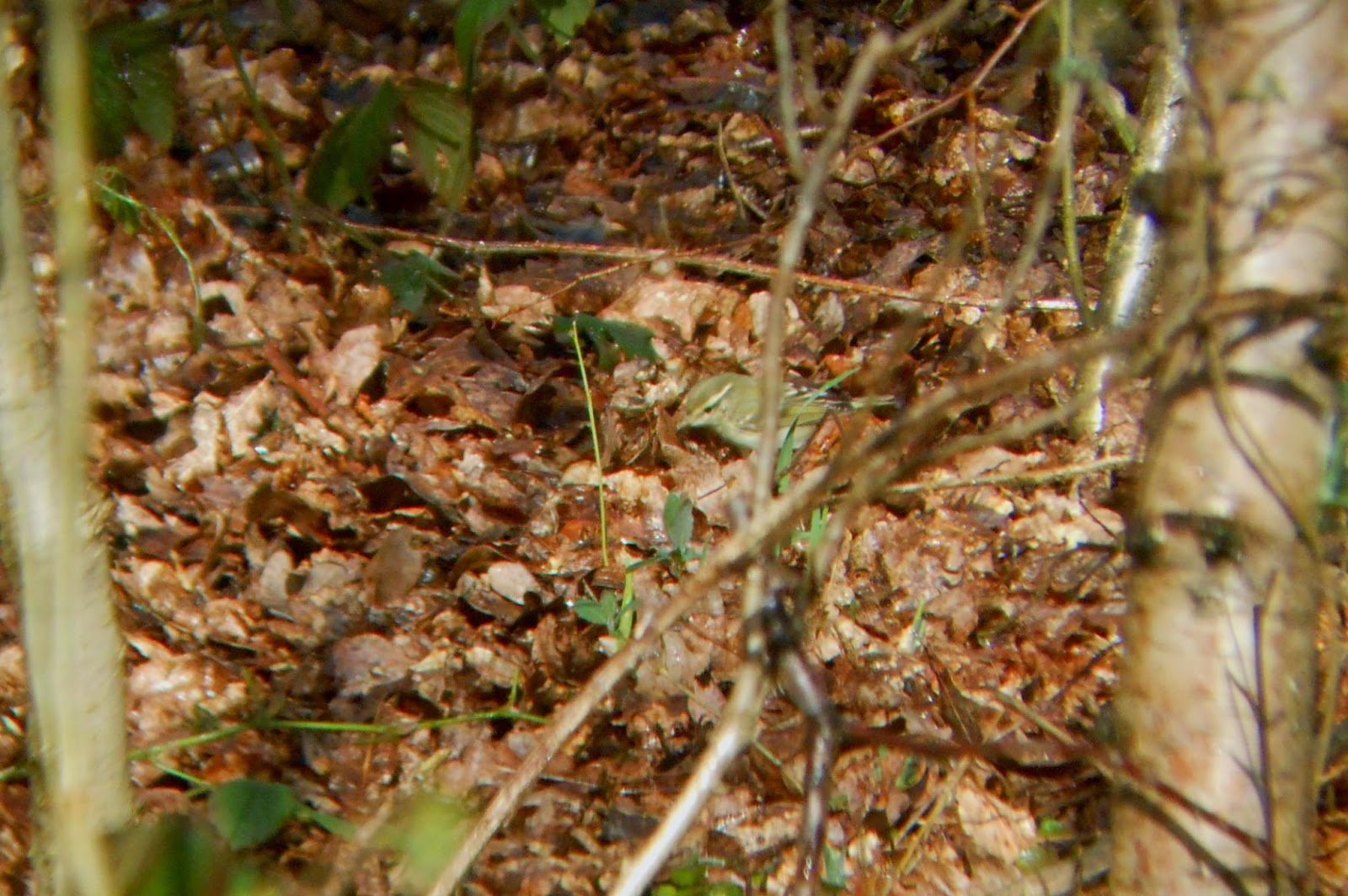
I did manage to get one photo though that doesn't completely hide the bird behind twigs, but it was just flying off.

Take a look at those legs however! Bright yellow! Stunning!


The bird did manage to elude us for some time after this though, until it proclaimed its present from right next to the track!

It was feeding in the leaf litter!

Here we had prolonged views as it slowly hopped its way through the leaves, flicking them to find food underneath, in a similar fashion to Thrushes! I couldn't help but feel privileged to see this behavior, as it is something that I was not aware this species did! It just seemed so wrong for a 'Phyllosc' to be hopping around on the floor like that. Presumably this is something the bird had learnt in its presence within Uffmoor, as it would have been one of/the only place where it would have been able to find food during the 'colder' winter months?

If so, that is a great piece of opportunistic learnt behaviour from this eastern migrant!


As many of you many know, I have a bit of a 'thing' with 'Leaf warblers'. Each of them are incredibly smart looking birds, with those mossy greens and lemon yellows contrasting to clean white underparts! Combine that with their tiny size, their epic migrations and their scarcity, and you have a truly incredible bird!

To have one wintering in a rather shoddy Worcestershire woodland has been a pleasure!

MB

Monday, 21 April 2014

Birding in the Wyre forest area!

8/03/14
The good thing about having some free time on a weekend is you can guarantee that a good thrash of the patch is in order!
And it was with the intention of early migrants I headed out in the hope of some early migrants. Sadly however, it was more of the 'old' than the new. A good number of  winter visitors were still hanging on, with a good party of 18 Lapwing, and both Redwing and Fieldfare still in evidence on the riverside fields. Additionally to these, 2 Goosander and 4 Mandarin remained on the river.

It was however, fairly quiet, so later in the morning i headed over to Stanklyn Lane, where the wintering flock of Corn Bunting was still in evidence! With some patience and some cover behind an oak tree along the road, i was eventually treated to stunning views as they were flushed down the field by dog walkers. At a few points, I was surrounded by the whole flock, a number of which were singing constantly!


After a little while, a number of the birds started dropping down and started feeding among the plowed soils of the field, giving brilliant, and prolonged views!


Many people may look at these birds and think 'yet another LBJ- Or little brown job to the folks that don't have the grasp on the birding lingo'.

To me however, the sound of singing Corn Bunting, and its family relative, the Yellowhammer are two sounds that are synonymous with a picture of British farmland, and it really is such a shame to witness numbers dropping so quickly!


9/03/14
Following some survey work at a variety of undisclosed sites, I decided to drop into Postemplain, and i soon heard at least 2 TWO-BARRED CROSSBILL calling, but rather than investigating further decided to head off and do some more survey work!

MB

Thursday, 10 April 2014

Birding in the local area, Gulls and Farmland birds.

28/02/14
With a juvenile Iceland Gull currently roosting at Bartley, the decision was taken to rush down there to try and get one of these gorgeous white winged beauties from up north.

The usual scrum of local Gull roosters had assembled, and it wasn't long until the Gulls started to pile in. While panning the Gull flock as they settled in front of us, I was suddenly stuck by a small white headed bird towards the left hand end of the flock. Being larger than the surrounding Lesser Black-backed and Herring, and with its pale back it stood out like a beacon from the flock. It was only another CASPIAN GULL! And a stunning example of a 1st winter bird!
In my honest opinion, 1st winters are by far the best looking age of Caspian Gull, so to have self found one in the roost at Bartley (where I rarely manage to find many birds) was pretty awesome!

As I shouted this bird out to the next car along, occupied by Andrew, a return came, the juvenile ICELAND GULL, and soon after, I was watching this very crisp looking stunner!

As the Gull flock was very restless, they soon relocated, and most dropped in by the sailing club. We quickly adjusted our viewing position, where we had stunning views of the Iceland Gull, but I couldn't refind the Caspian. And then the phone call, Terry was watching it sitting on the pontoon from the dam!


With a quick powerwalk to the car, and an equally quick drive around to the dam, we arrived to the news that it had flown off!
Relentless scanning until the very last shreds of light revealed only one other brief view, as it again returned onto the water near the pontoon. But once again, the flock flushed and it was not seen again!
 
1/03/14
 
The next day was spent birding in the home county with fellow young birder and NGB Espen. Having trained it up from his home the main intention was trying to find him his first Casp, so, following a drop into Shenstone, it was up to the local tip and onto the beautiful location of Bartley Green!
It was great to exit the car at Shenstone to the sound of singing CORN BUNTINGS, and it took a ridiculous amount of effort to walk the entirety of 20ft to get a view of these. And not just a couple, a superb flock of at least 25 as they commuted between a hedgeline and the ploughed field. Unfortunately however, viewing was cut short when a local dogwalker walked along the hedgeline, flushing the vast majority of the Finch/bunting flock, which also consisted of a few gorgeous Yelowhammers!

 
Moving onto Wildmoor, it didn't add too much optimism when a local birder, who was just leaving and had been present all morning said that it was very quiet. Regardless, we headed up, and were soon scanning the amassed Gull flocks in the adjacent fields.
 
Which contained not a single bird of interest...
 
So, refocusing my attention, and the juvenile ICELAND GULL was picked up flying about over the tip, moving back and forth in the airspace between our location and the far side of the tip. However, it refused to land, and after some time circling with the gull flock, was seen to fly off west!
A single Green Sandpiper within the quarry was a first for the year, but one I had been trying to hold back for later in the year. In this instance, the bird found us!
 
Our last port of call was Bartley, via Hopwood, where we failed to find the Shrike!
 
Pulling up on Scotland lane revealed the presence of very few Gulls, and it remained that way until the very last available light, when masses of gulls piled in. Sadly, a little to late, and we soon gave up, the light was just unworkable by that point!
 
7/03/14
Another roost session at Bartley was again fairly uneventful, but the presence of 4 Goldeneye was something different, as I haven't seen too many of them at Bartley this winter!
 
8/03/14
It about time I gave the patch a good old thrash right?
Of course!
 
So, at a relatively early time (please do remember I am a student after all!), I grabbed the scope and the bins and set off. It was great to see the Mandarins still haunting the river margins, with a minimum of 4 found (2 pairs). Also adding a splash of colour to the drab greys and browns of the riverside vegetation were a pair of resident Goosander, which were diving in their usual area as they have done all winter! Needless to say, they were as timid as always and soon scooted upriver.

 
What really made my patch visit though were the small numbers of 'farmland' birds present around the paddocks, a flock of 18 Lapwing fed in a flooded field, and a party of 7 Meadow Pipit were flitting around the area.
I couldn't help but think that spring was on its way, and I would soon be joined in these very fields by stacks of migrants!
On the return leg, I managed to find a singing Marsh Tit well away from the normal areas they visit! So I am also very hopeful that they may finally expand their range a little more on patch!
 
Later the same day, I couldn't resist another drop into Shenstone, and this is why!

 
Standing on the roadside I was completely surrounded by the flock of 30c CORN BUNTINGS, most of them singing that lovely jangly song that is so reminiscent of the English countryside! Its so sad to think that now that this exact sound is missing from most areas of the UK, fields that once were filled by the sound of birdsong now lies quiet and desolate.
 
It makes me feel somewhat glad I have a location such as Shenstone so close to home.


MB

Monday, 18 November 2013

Back to patching!

21/09/13
After the week away in Pembrokeshire i was fully rejuvenated to get back into Patch birding, having not been able to 'work' it properly for around a month!
So early in the morning i headed out with the intention of vis-mig counts and just generally surveying the progression/build up of bird species around the 'North Circuit' of the patch.

From early on, it was clear that good, but not outstanding numbers of Mipit were moving, and over the coarse of the 4 hours on patch i counted at least 98 Meadow Pipit, with 80% of those flying over south as to be expected. The remaining 20% i will come to in a little while. The usual wildfowl counts were undertaken at Blackstone, where 6 Mandarin remained, two of which were drakes.


My highlight however was catching up with the locally bred GOOSANDERS, a flock of 15 (Adult female with 14 juvs) on the rocks below the bridge. It was great to catch up with them, as they are still a relatively rare breeder in Worcestershire and to my knowledge there have been no breeding records of this species along this stretch of river before!

Moving onto the paddocks, i quickly noticed a fairly decent flock of Meadow Pipit (The remaining 20%) and it was while walking past the first paddock, i heard the distinctive buzzing 'tziee' call of a TREE PIPIT! It took a good while, but 30 minutes after i locked onto a pale Pipit which upon getting my scope on the bird revealed it to be the bird! 
Unexpectedly, while watching this bird fly to the far right of the paddock i heard an identical call originate from my left! Scanning in that direction and there it was, a 2nd TREE PIPIT! Unbelievable, i have never had multiple Tripits away from breeding sites so i was very chuffed!

After seeing so many White Wagtails while away in Pembrokeshire i also grasped at an ounce of courage and started scanning the flock of 60 Wagtails. All 'Alba' type Wagtails, and started assigning them to species. A further hour and i was sufficiently happy to have found 5 White Wagtails among the flock, looking just as obvious as they did on the coast among the 'British' subspecies. To add to this, a further 20 'Alba' sp Wagtails flew over to the south.
Hirudine movement was limited, but 100 Swallow south was noticed, with smaller numbers of House Martin, but for the first time in a good few months, i was unable to pick up a Sand Martin. 2 Grey Wagtail went over south.
MB

Thursday, 3 October 2013

Patch Migrants

11/08/13
A momentous discovery in patch terms, i was very happy to find an adult SPOTTED FLYCATCHER flycatching off one of the hedges wedged between Lickhill and the riverside fields, a likely location for migrants on patch. I enjoyed a good period watching it, being my first patch SpotFly for around 5 years! The last record being of a juvenile around the same time of year.


However, been stationary at this one spot paid extra dividends when not long after the discovery of the Flycatcher i spotted a large raptor flying up from the south, towards me. As it got closer the long winged look got me immediately interested, and as it circled to the right flicked its wing up, revealing a long and forked tail.

RED KITE!

Not the patch rarity that is SpotFly, but a great bird to see, and one i always love to see on patch, usually on a yearly basis. I got a few minutes viewing before it circled off, and flew back south.


It was also great to catch up with a stunning singing Marsh Tit at a regular patch area, and i managed to get some stunning views as it fed around the Willows.


 15 Mandarins were still present along the river, of which 7 were drakes of varying ages (Juvenile males can be separated from females).

(One of the juvenile drake Mandarin Ducks)

 An impressive 25+ Chiffchaff were counted, but only 2 Willow Warbler and a single Whitethroat.
MB