10/03/18
We don't often day trip any more. It is always an excellent day, with 6 hours driving, with a long day in the field is always a little daunting..
Some birds are enough to get you off your backside though, a mythical bird that will be on your lips for weeks to come, and with the weekend approaching, boom. Snowy Owl in Norfolk! A hasty made plan, and we found ourselves driving around a familiar triangle at dawn, a short hop from the north coast where the bird had been seen the previous day. It had flown west at dusk, so my betting was Thornham Harbour for its reappearance. We slowly made our way north, checking the fields and beach before hitting the north coast road. As we drove through Thornham village, out came the hoped for tweet 'Snowy Owl- Thornham point!'.
2 minutes later, we were screeching to a halt in an empty RSPB Titchwell car park, and soon 'walking' up the track to the beach. A Woodcock got a brief passing glance and a pair of mating Common Frog were hastily avoided as we sped past.
A few cursory scans up the point oddly couldn't find any birders, but a large 'blob' perched up on a branch was a little curious. A couple of further stops and curiosity got the better of me, and set the scope on that 'distant blob'...
Massive, white and heavily barred!
The SNOWY OWL!!
Elated, we paced the rest of the distance to the beach, where we met a couple of birder already in-situ, watching the Owl at about 1km distance. What a beast!
Drying out from the heavy overnight/ early morning rain, she shook off the rain from her plumage and preened and stretched her wings. Over the next couple of hours, the crowd grew, and eventually the bird dropped out of sight at which point those who had recently arrived started getting twitchy. Anxiety grew and, leading on from a few 'forerunners' who had already managed to flush the bird onto the beach, a mass commute began. The Snowy sat comfortably in the open, and the twitch grew. Eventually, with few people remaining at the RSPB viewpoint, we gave in, and walked for closer views with the rest of the crowd.
With the crowd thoughtfully standing back and allowing plenty of room for the Owl, everyone managed excellent scope views and the bird slept here for the remainder of the day.
With news of a putative Elegant Tern being found in Hampshire in early June, it was sure to attract a fair few admirers. The species has been reported on a number of occasions in the UK, (5 accepted and 3 pending), but most of the previous records have been tarred by the messy prominence of hybridization within the species in Europe. A number of birds have been semi-resident in Sandwich Tern colonies on the Atlantic coast for many years, and have allowed for close study while they hybridized with Sandwich Terns.
It is particularly the results from this study that interest many listers in a UK sense. This bird, along with 3 others, all of which show Elegant Tern like plumage have been caught, colour ringed and DNA analysed. Cut short, the results showed that the hybrid offspring do not resemble Elegant Terns in any way, and the original adults that were tested using DNA, matched specimens of pure Elegant Terns from the pacific coasts of the USA.
And the Hayling Island bird? It was soon confirmed to be a colour ringed male, and with DNA confirmation, it proved without doubt that this was an Elegant Tern. In terms of listing within the UK, the first unequivocally confirmed Elegant Tern was sure to attract a big crowd... Had the bird stuck around...
A couple of brief appearances followed, each lasting around an hour, before eventually the bird was tracked down in the Tern colony within Pagham Harbour, on the other side of the Selsey peninsula.
11/06/17
Plans for a day birding at Ham Wall was postponed so we could join in the excitement of a UK 'orange-billed' Tern. As we approached Hayling Island en route to Pagham, news circulated that the bird had flown out to sea. Having seen the birds routine the previous day, of going out to feed every 3-4 hours, for around 2 hours each time. So a quick stop, breakfast, coffee and we drove the remaining 15 minutes around an hour later.
20 minutes later, after leaving a crammed RSPB carpark and we saw the crowd. And a rather large one it was!
The bird still hadn't returned, but we were entertained by frolicking flocks of Med Gulls, hovering Little Terns and flocking Sandwich Terns.
Around an hour later, a shout came that the bird was flying back in, but before anyone could react, it had dropped down onto 'its' spot in the colony, out of sight, and leaving a good few hundred birders without a view!
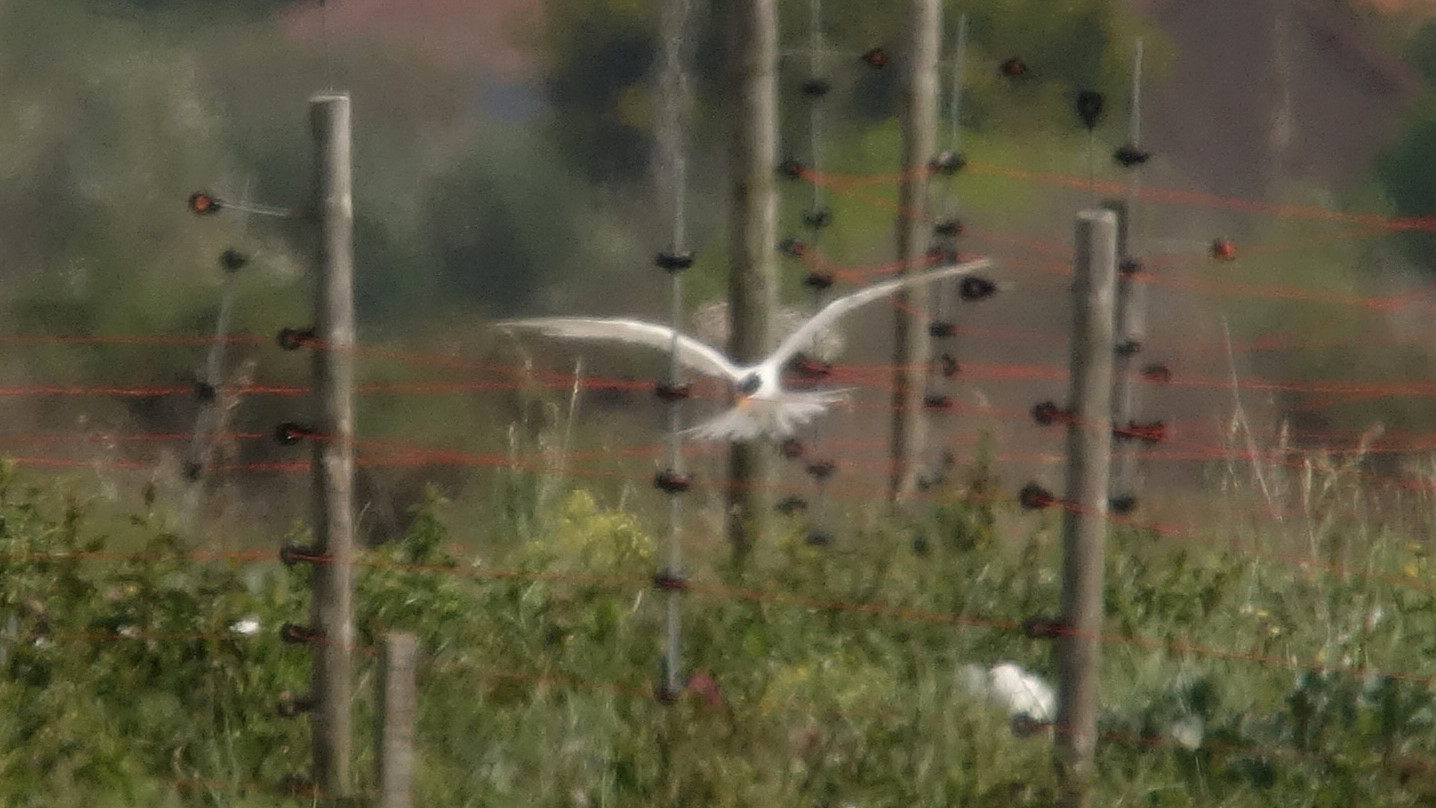
A tense 10 minute wait, after patiently having the scope fixated on the area were it dropped in, and up flew a carrot billed large Tern. It hovered around for about 5 seconds, before dropping down again. This process was repeated a few times across the next hour, as we pieced together views of this world lifer for both of us.
Eventually, after a couple of brief flights around the Tern island, the bird took a more distant circular route around the harbour, giving its closest view so far, before it flew across the seawall and out to sea.
And on that, we chose the walk home, together with a quick drop into the New Forest.
1/06/17
I try to visit one of the Pembrokeshire islands every year. It is always great to leave the mainland and visit the seabird colonies out on the cliffs of these remote havens. Being based around an hour away from Martins Haven, an early start is needed to get anywhere near the front of the queue for tickets.
Arriving around 45 minutes before the lodge to buy tickets opens, we arrived to one of the largest queues I have seen at that time in the morning. This resulted in us not being booked until the 11am boat.
The Deer park is always worth a scout around, and with a fair bit of time to kill, a full circuit was walked, giving some of the first views of the rafts of seabirds offshore and flying Choughs. A strong SW wind was howling across the headland, the start of a storm arriving the following night, which made it difficult to stand upright on occasions!
The winds however died later in the morning, leaving a smooth crossing to North Haven on Skomer, to be greeted by the usual hoards of Puffins on the water and cliffs around us. Following the introductory talk, most of the boat bolted towards The Wick, well known as one of the better spots on the island to watch its most famous resident. Being a creature of habitat however, I walked northwards from the farmhouse, through the north valley bushes. Sedge Warblers boldly sang and a Blackbird warbled quietly from deep within.
As we walked further, Meadow Pipits parachuting into the trackside vegetation as we approached the Garland stone, where sandwiches were eaten as we took in the seabirds offshore. A few Manx Shearwater were fairly unusual to see so close to shore in the middle of the day, however scanning didn't reveal any cetaceans.
We continued along the north coast, passing breeding Oystercatcher and GBBG nests before heading down along the west coast, past Skomer head and down towards the Wick, where the Puffin flocks were turned up to maximum....
It has been interesting to compare numbers from year to year, and this year certainly seemed to be good one, with very large numbers present here. It seemed as if many of the birds were at home and many were feeding newly hatched chicks, resulting in regular visits to their nestholes. At the top of the Wick viewpoint, the numbers along the clifftop in front were staggering, even more so considering many were only a few feet away! Despite this though, it is always worth remembering the sobering point that Puffin populations have declined dramatically over the last few decades and all is not well with our seabird populations.
With the wind being fairly strong, I didn't take many photos (digi-scoping+ wind = failure) so instead I spent a while watching the behaviour of the Puffins. A lot of territorial battles and pair bonding were taking place, with lots of bill clattering and squabbles taking place.
With the stunning view down the cliffs and a carpet of Puffins at the front, the view is spectacular. This photo sums it up quite well, taken on a 'point and shoot' camera, showing just how close the action is. The Puffins in this one remind me of a number of rock album covers.
Having seen a few photos on social media of a leucistic Puffin on the island, it made for quite a target to try to find it. With 27,000 Puffins on Skomer currently, it was not an easy task without insider knowledge. We were pointed in the right way, and after a short while, out popped a head from a burrow to our right. Strikingly white, we could see it was the leucisitic individual! With white all the way from its forehead, down its nape and across its ears, it certainly stands out from the crowd. After only a few seconds, the bird spun around and walked straight back down its burrow.
With our time coming to an end on the island, a walk back towards the interior of the island was taken to look for an Owl. With it now being around 4pm, it seemed a perfect time for a day hunting Owl to be out, and with a drop in the wind, our chances seemed good!
Walking back towards North Haven, a Short-eared Owl was hunting ahead. We continued to walk onward, before the bird disappeared. As we stood on the track, the Owl flew up and straight towards us, passing closely. Some of the best views I remember having of the species (a concussed electrocuted individual doesn't count....) .
After having watched it for a couple of minutes and with the bird still hunting in view, I scrambled to set up my scope and camera. A few seconds later, and it was again flying towards us, this time even closer.
The Owl passed within 20ft of us, with no-one else around. Bliss.
What a way to end another superb visit to a superb island!
Our annual trip to Pembrokeshire rarely provides me with a
new bird species for my list. Back in the day when I first started visiting,
many species like Guillemot, Razorbill, Chough, Storm Petrel and Manx
Shearwater were all seen for the first time here. Around 12 years later though,
I still visit to enjoy the coastline and its wildlife ever year. With our visit
in late May, the majority of the migration period is tailing off on the west
coast. A few arctic breeding waders or a late Skua can liven a day up so what I
was not expecting to occur on the first day of this years trip was for a
national rarity to turn up. A Turtle
Dove as soon as we arrived at our accommodation already made for a good
trip, however late evening, news filtered out of an American Golden Plover at
the Gann.
As well as being a lifer, ‘AGP’ would complete the trio of
Golden Plovers in the UK, added to the fact it was at one of my favourite sites
in Pembrokeshire, it was clear where we were heading the next morning. Luckily,
by the time we were just ready to leave, news was already out confirming the
bird as still present. With the tide now coming in fast, we arrived and walked
the shingle to the river mouth. A couple of birders were present and quickly
gave a relieving message that is was still present and was on the small section
of beach still not covered by the rising tide.
What a stunner!
A full breeding plumage male American Golden Plover!!
Sleek, sexy and leggy, this out of place yank gave good
views as it slowly walked its way towards the shingle spit it roosts on as the
tide rose. We had about 10 minutes viewing at ‘close range’ (that still being
around 150ft away) where the bird fed and showed off all its defining features,
primaries beyond the tail, short tertials, extensive black on underbelly/tail
as well as the bold golden and white spots on its mantle and wing feathers.
The last feature to be given away was the dark grey/ bronze
underwing colour, when the bird took flight with a Grey Plover and flew around the bay, before coming back to settle
on the shingle bank with a flock of Oystercatchers
at the river mouth.
We stayed around across high tide, hoping the bird would
come out to feed onto the fresh mud, however it moved more distantly with its Grey Plover companion and fed on the
saltmarsh north of bay. It looked stunning in the freshly emerged sun, but
unfortunately a little too distant for any photos.
A good spattering of waders made for an enjoyable visit,
with 6 Whimbrel joining the roosting
Oycs, 3 Black-tailed Godwit dropped onto the lagoon, 17 Dunlin, 1 Ringed Plover and 2 Redshank.
A couple of colour ringed Oystercatcher
took a while to read, however 20 minutes of effort gave me 1 code to report.
All in all a good visit and an excellent start to the trip!
If Extremadura was famous for something more than its steppe
habitats, it would be its wealth of raptors that make it world famous. With
around half of the world population existing within Spain, and one of the
highest densities, Extremadura is renowned for its populations of European
Black Vulture. Together with good populations of the endemic Spanish
Imperial (Iberian) Eagle, among a wide range of raptor species, it makes
Extremadura a must visit destination for Raptorholics.
It is the Spanish
Imperial Eagle which I was most hoping to connect with and over the course
of the week, we were well and truly spoilt for the species. We managed to see
the species on almost every day, with superb views from our very own balcony,
with regular views of at least 3 overhead. It was great to get to grips with
this species, often at close range as they soared along the ridgeline above.
Most commonly seen was this adult bird, which we very quickly saw has a
satellite transmitter on its back. It would be very interesting to see who was
tracking it and where it has been!
Also commonly seen was this immature bird (4cy) with a very
interesting mixture of juvenile and adult plumage. This also happened to be a
very vocal individual, often scrapping with (presumably) its parent. Its low,
and fairly quiet ‘barking’ call was often heard while enjoying our lunch on the
balcony! It also happened to be one of the last birds I saw when we were
packing the car to leave!
As well as getting a bit of gip from its younger companion,
a number of the more common species also chose the opportunity to mob the
larger Bird of Prey, with this Black Kite giving a fair bit of effort for a few
minutes.
Like the Spanish Eagle,
Black Vultures were seen regularly throughout the trip, in many habitats. They
were commonly seen from our accommodation, over the plains, sitting among
livestock and around breeding sites within Monfragüe national park. Some
great views were had with patience, including one a number sitting in fields on
the Santa Marta loop, looking rather like the grim reaper among the sheep and
cattle.
The Montagu’s Harrier is one of my favourite raptor species,
their light elegant flight, stunning plumage and rarity (particularly in the
UK) all add to their appeal. It is always a pleasure then to see good numbers
in the Iberian peninsula, where they are significantly more common than my
homeland. As with any extensive area of habitat, views tended to be distant,
however we also managed a number of close flybys, often from the car while
driving past. Later in the trip however we dropped into a site well known for
large gatherings of the species, and as we did were lucky to see a ‘flock’ of
Montagu’s Harriers perching on fence posts next to the road a little further
up. With a bit of curb crawling, excellent views were had from the comfort of
our car seats! The female birds in particular were rather showy, happily sitting
on the fence posts until another birder pulled up in a car behind us, and
proceeded to get out!! And that was the end of that!
The male bird on the other hand proved more difficult, not
being helped by an ongoing territorial dispute which had him chasing a rival
male every couple of minutes. He did join the females on the posts briefly, but
was mostly seen in flight. It was nice to watch sky-dancing Montagu’s Harriers
again, something I haven’t seen for a couple of years.
Although nowhere near as common as I have seen elsewhere in
Iberia (probably due to their positions close to raptors flyways), good numbers
of both Short-toed Eagle were seen, with just under daily sightings. We managed
our best views from the balcony of our accommodation, where 2 birds often
patrolled the ridgeline.
Booted Eagle in my opinion are one of the more striking
birds of prey in Europe. Being smaller and less imposing than their larger
Eagle cousins it is easy to not be so impressed. Many of the birds in Iberia
however are examples of the pale morph, with its striking contrast between
white underwings and body, black flight feathers and warm brown head and
mantle, this creates one stunning bird. All 3 colour morphs were seen; pale,
intermediate and dark, allowing for some good scrutiny of their variances in
plumage.
Being so close to Trujillo, and the nestbox scheme on the
Santa Marta loop, another Raptor commonly seen was Lesser Kestrel. The smaller,
lighter and more agile relative of the Kestrel. Many good views were had as the
birds held territory around ‘their box’. A visit to the Trujillo bullring in
the heat of the day meant that the birds were hunting in the fields around the
town rather than perched near their nests, however good views were had of them
hunting above the town centre as we explored the winding streets of an old
Mediterranean town.
Although it is easy to highlight the rarer raptors, it is
hard not to ignore the more abundant species. Species like Griffon Vulture and
Black Kite can be regarded as two of the most commonly seen species of the
trip, however the spectacle of seeing so many large raptors in the sky is
rather awe inspiring. Even this far inland, far away from the migration
hotspots of Tarifa and Gibraltar rock, large kettles of both species were seen
almost daily. Combined with mixed White Storks and a various assortments of
rarer raptor species, it was always a sight to behold.
Excellent views were had of both, including some phenomenal
views of Griffon Vultures within Monfragüe, perched at their cliff face nesting
sites.
Despite still being common, it is poignant to end on a note
that even now, the populations of many of these species have declined. As with
any developing country, space for the species is gradually being restricted and
as land use change occurs, the resulting population levels suffer. With the use
of the veterinary drug Diclofenac still being discussed for use in Europ, it is worth looking at the effect that is has had in Asia. Having spent
some time in India earlier this year (more in an upcoming blog post), it was
shocking to see the extent of the damage to the vulture population that the
drug had had, with a handful of individuals left in a tiny relic population. It
is not difficult to imagine a similar outcome here in Europe.
Here is hoping that the right decision is made, and efforts
are made to protect the superb Raptor species present in Iberia.
Following a number of successful birding trips in the UK for
the last few years and with an increasing desire to explore to a wider scale,
plans were hatched in late 2016 for a short trip birding to the Iberian peninsula.
As one of my favourite European countries, it didn’t take a huge effort to be
on board for a group trip. Following some discussion, plans were formed looking
to explore the pseudo-steppe habitats in Extremadura, an area that I had not
previously visited, and with a small list of specialist species which I had not
seen to date. For the rest of the group however, it was the first time many of
them had ventured to the Iberian peninsula.
Our base for the week was located on a ridgeline overlooking
one of the best areas of Steppe in Extremadura on the edge of a picturesque
Mediterranean town, Sierra de Fuentes. Our accommodation proved to be very
lively for birds, with many of our ‘target’ species being seen from the balcony
of our accommodation!
One of our main reasons for our choice of accommodation was
due to its proximity to the Steppe habitats of the Santa Marta loop, well known
for its populations of many range restricted species.
The area is well known for its populations of both European
Bustard species, Great and Little, however both have declined significantly, as
mirrored across many areas of Iberia. However, both still exist in good numbers
in the ‘loop’, with many giving fairly good views from the tracks and roads
that cross their preferred habitat.
Great Bustard in
particular proved particularly easy to find, with one seen flapping its way heavily
over the motorway before we had even reached our accommodation for the first
time. Not a bad way to start the trip! Needless to say, with our proximity to
the Santa Marta loop, the species was seen on most days, with many sightings
from the motorways. When venturing onto
the plains, we often managed half decent views of the species, with good scope
views on many occasions. A few
displaying males were seen in full ‘bubble bath’ mode, gleaming white on the
short grass fields. Varying numbers were seen, with flocks of up to 25 noted,
but sightings of one, or a small number were much more common.
Little Bustard,
(almost in contrast) was fairly difficult to find. Although seen frequently
when birding the area, numbers were very low and we were often lucky to note
more than a couple at a time at a single location. Maybe due to their habit of
inhabiting longer grass areas they may have passed undetected, but few were
also heard calling their ‘raspberry’ like call. Small numbers were noted
throughout the trip though, and we managed a nice view of 1 male, displaying
from atop a rock near the road.
For me in particular, one of my main targets for the trip
were the 2 Sandgrouse species. Having previously visited areas with small,
fragmented populations of these species, I had missed them on previous trips.
However, we were well into their core range in Extremadura however they still
proved difficult to pin down. On our first morning we managed to hear both
species, but frustratingly could not locate the source of the sound. A number
of mimicking Calandra Larks did not
help the matter, with some remarkably similar sounds replicated in their songs
by at least 2 individuals in areas we checked regularly. An early morning trip
on the 13th to the area we had heard them previously finally
produced the goods. Following a number of calls being heard, 3 Sandgrouse flew
up quickly from behind a ridge. As they rose, we could hear them calling and
with a slight movement, revealed a large black patch on their belly. Black-Bellied Sandgrouse! They flew
straight towards the horizon, meaning only 2 of our group saw them before they
disappeared. While scanning the same small ridge, another familiar call could
be heard, Pin-tails! In a similar
fashion to the earlier Sandgrouse, up rose a large flock from behind the ridge of
Pin-tailed Sandgrouse, skimming low
across the plains. Following a short, circling flight, the flock dropped onto
the near side of the ridge, allowing us some distant, but very enjoyable views
of a flock of 17 Pin-tailed Sandgrouse!
As we watched, a distant sounding Black-bellied Sandgrouse led to great views of a pair as they flew
towards us and across the road very quickly, by far the best views we managed
of the species. A couple of rushed digi-scoped shots were taken in record time
as they continued away from us.
Many other birds were seen over the course of the trip, and posts over the next week or so will show some of the highlights. of which there were many!
With the stresses of uni now being a thing of the past, free time for writing for enjoyment has came about. So why not start with today!
I don't 'subscribe' to notifications for many people on twitter, I struggle to cope with the sound of constant notifications, however I have followed Steves @BelvideBirding account for a number of years. As one of the foremost birding sites locally, and with now regular visits during the summer months due to bird ringing, the updates have proved first class.
Just 2 weeks ago, a notification popped up 'Belvide mega', and a few hours later, following a couple of successful meetings, I was standing next to the small reedbed that held a singing Great Reed Warbler. Great! 3 hours later, staring at reeds to not even get a glimpse of it!
Needless to say however, a first record for the site, and a 2nd for Staffordshire. Surely a contender for bird of the year already?
Roll forward to today. [15/05/17] And there it is again. 'Belvide mega'. This time, Spotted Sandpiper.
I have put off twitching this species for a while, as with Rose-coloured Starling, it is a species that seeing them in their 'typical' plumage in the UK means their drab winter/ juvenile clothes. Interesting non-the-less, but a little below par for what can be stunning birds.
A quick text to Steve confirmed a summer plumaged adult, and I was on my way to Belvide a few minutes later. Twitching has dropped off my radar recently, so dropping everything to go and see it felt like spreading my wings a little. (feel free to mock me for that comment).
For anyone who knows Belvide, the walk to the west end is not for the faint hearted, the midlands equivalent to the trudge along the Blakeney shingle or the point at Spurn. In reality, the walk is only around 1.5 miles, childs play when considering I walked 8km in search of a Pallid Harrer last week (and didn't even see it!). However, at the end lies one of my personal favorite hides, the Hawkshutts hide. Being right next to some superb muddy shoreline, the views from here are often crippling. If coincided with an evening visit, with the light behind you and the reserve completely to yourself, it makes for some great birding.
A 'brisk' walk got me to the hide in record time, only even beaten by the occasions I have acquired the 'belvide bike', entering the hide to see the 'yankee Common sand' running straight towards us.
What a time to arrive!
For the next 2 hours, phenomenal views were had of a 'spotty' Spotted Sandpiper as it ran back and forth along the shoreline in front of us. Being a mere 40ft away on occasions, it was the best views many have had of this species on this side of the Atlantic. In this plumage, truly unmistakable! Stunning!
A great bird at a great reserve, found by a hardworking patchworker, bringing valuable points towards their Patchwork Challenge score. However, on a final note... Upton Warren still thrashed you on the all dayer...
23/04/16
Sometimes, twitching is one of those pasttimes where either
things go completely right, or completely wrong, and today was one of those
days.
With news of a Broad-billed Sandpiper having been found on
the Friday at Goldcliff pools, South Wales, it didn’t take too strenuous a
decision as to where to head on a planned day out the next day.
With spring blooming, what better way could a calm morning
be spent than standing in a Gloucestershire woodland, with the sound of
Nightingales reverberating through the sun dappled vegetation. With one bird
singing deep within the vegetation behind us, away from prying eyes, further
music to our ears. The Sandpiper had just returned onto Goldcliff for the tide!
Being around 40 minutes away, we were in a good spot.
We drove southwards, pulled up near the entrance track for
the pools to be greeted with hoards of smiling faces “Still there, showing
well” repeated with reassuring certainty. “Asleep on the islands, it won’t be
going anywhere”. It took a mere minute to walk to the platform the bird was
showing best from….
All the waders were gone.
“Peregrine literally just flushed them, they flew off
towards the estuary…”
And that was that, gone. No sign. Slight compensation was
offered with one of the Little Stints crawling around on one of the shingle
islands, but at this time, it all seemed a little dire. The tide was still
high, but after an hour, it was clear they weren’t coming back. We walked out
to the seawall with a vain hope. After
only a few meters, a Short-Eared Owl flew across the path in front of us, very
low before suddenly somersaulting towards the floor. Firstly I thought the
bird had dropped onto prey, so we changed position to get another view. We
moved a couple of meters before the bird came into view, and it was clear
something more disastrous had happened. The bird had collided with an electric
wire and was lying stunned among the vegetation. A couple of local birders
arrived, who contacted the site rangers and vet, who quickly came to check the
bird out.
(After being
collected and looked after for a short while, the bird recovered and flew off
strongly)
With no sign of a wader flock, and a view of a perched
Peregrine looking rather smug with itself, we decided to head for the RSPB
reserve. However, we left with a grand plan, till the next tide!
A particular corner of the reserve has previously resulted
in good views of Grasshopper Warbler and it didn’t take a long time before our
first was heard reeling away. Luckily, the bird was singing from an area of
nettles right beside the path, and soon we got our first view. Over the next 5
minutes, a few more brief views were had, until the bird climbed to the top of
a nettle bed and started reeling in full view. Crippling!
Good views of ‘gropper’ have been something that has proved
difficult for me. So to finally have one showing so well was fairly exciting!
After exploring the site further, finding other reeling
Groppers, we moved back down towards Goldcliff pools. We stopped around half
way along through to view from a hide overlooking an extensive area of
marshland. A Glossy Ibis had been seen on/off here for quite some time, but it
often proved elusive, and hadn’t been seen in nearly a week! We tried however
and it proved we were in luck. While walking along the field edges towards the
hide, a number of migrant Redstarts flicked out, their rusty tails glowing in
the sun. In total, we found 4 flicking around this small area, feeding and
chasing each other throughout the time in the hide.
After a short time, a dark bird emerged from among the dense
vegetation before quickly dropping down, a couple of seconds in the bins was
enough to confirm the Glossy Ibis! A couple of further views were had, and soon
a number of wannabe Sandpiper twitchers appeared to make the most of the dip.
For the next 30 minutes, the bird wandered in and out of the tussocks. Once we
had moved back to the car however, we struck lucky, the bird had wandered into
view, and was significantly closer!
With the day now progressing, and the tide soon to be on the
rise, we moved back to the Goldcliff Pools. A summer plumaged Spotted Redshank
was giving good views among the Redshanks, and a party of Whimbrel flew over.
Small flocks of waders were arriving off the estuary, dropping onto the shallow
pools in front of us.
The stunned Short-Eared Owl from earlier in the day was now
hunting the long grass around the edges of the pools, flying closer and closer
until it flew past the screen a mere few meters away.
The bird dropped onto a nearby fencepost, where it scanned
for potential prey.
The bird took off soon after, but as it did so, a birder scanning
the incoming waders asked for others to get onto this bird…
All scopes changed direction and there it was.
A superb summer plumaged Broad-billed Sandpiper!
That bird that had caused so much pain earlier in the day
had just made a group of birders elated! Its striking black and white plumage,
its humbug head pattern, its massive bill. Celebrations were shared as we all
enjoyed this eastern wader.
The bird waded around with a mixed flock of Dunlin and
Redshank, often in far deeper water than the rest of its short legged cousins.
This however, meant it was ‘slightly’ closer than the rest of the flock, but it
was still fairly distant at the back of the pool. With our target acquired, and
having watched it for some time, we decided to head back north towards home.
The early dip perhaps improved the day significantly,
without having missing the bird, we perhaps wouldn’t have spent so much time in
the area, seeing so many species and having such great views. Sometimes, things
do just work out. This time, for the better!
With April underway, the amount of time I spend on patch
dramatically increases. Sometimes entire days are spent walking the tracks,
scanning the hedges and fields to uncover all of the incoming avian delight of
summer.
As always, a huge dose of optimism is needed to pull you
through, after all, my patch does consist of a river, a number of fields,
hedgerows and small blocks of woodland in the middle of the country. Not
exactly prime migrant habitat. Despite this, combine a bit of favourable
weather and a lot of optimism, and all those hours pay off, and this spring can
certainly claim to have been one of my best.
It all kicked off on the 2nd April. Sudden
southerly winds have forced an obvious passage of migrants into the country,
however I was still resting at home until I picked up a tweet from Rob C saying
he had just had an Osprey fly north over Grimley. For those not local to
Worcestershire, Grimley is about 10 miles due south of my patch along the
river, so in theory, anything seen flying north here would probably end up on
my patch. Despite this theory however, nothing ever has, but I still went out
regardless, walking to the end of the road, setting up my scope and scanning in
a S/SW direction.
Light drizzle made standing motionless seem a little futile,
however the determination of a number of Sand Martin flocks to move north
despite the weather gave me a boost to keep going. After about 30 minutes
however, my hope was starting to dwindle. My quick calculations showed the bird
really should have flown over by now. At 10:55am though, while scanning over
the church near Arley Kings with my bins, I picked up a large, and very
interesting bird. I knew instantly that this was the Osprey, however much lower
than I was expecting. The bird dropped below the treeline while I drew my scope
in that direction, and a few seconds later it re-emerged.
Boom!
It was distant, probably nearing 2km however with the scope
I could quite easily see the distinctive shape and flight pattern of an Osprey.
The bird continued to move north, before starting to circle over Stourport town
centre, just over 1km from where I stood. A couple of record shots of this
momentous occasion were needed, so the camera was grabbed, and a few photos
taken as the bird continued to circle.
It circled out of view behind the Moorhall marsh woodland, and that was
that, not to be seen again.
However, having just seen my first ever patch Osprey, I was ecstatic!
It wasn’t too hard to draw my optimism to get me out on patch
the next morning. A patch first always has that effect. Half the walk had been
completed and other than a few expected birds, I was struggling to find much. I
had just covered Lickhill meadows and was just arriving next to the river when
I looked up into the bright blue sky to see 2 birds of prey circling above me.
One was one of the local Buzzards, however the 2nd, directly above
me immidiatly hit the paic button. Flying less than 100f above me, gleaming
white was another Osprey! Litterally frame filling views were had until I
decided to try to improve on my record shot of the day before, at which point
the bird decided it had had enough of lingering around, and started flying off
north, gaining height as it did.
Conidering I have birded this site for 15 years without a
hint of an Osprey (although a number of locals have seen them flying over while
I have been away from patch) to have 2 birds in two days was ludicrous, and
gave a great start to what turned out to be a great spring on patch.
I had been searching for Wheatear as the Osprey flew over,
so it was a relief when on the return leg of my walk, a pale ‘blob’ out on a a
distant field gave itself up as a male Wheatear. A great start to spring!
For a couple of weeks, activity died down again, however it
hit back with a vengeance on the 17th. A bright and sunny day, with
light winds, and lots of birds moving. Hirundies and Pipits were flying about,
Phylloscs flicking about everywhere. I had just made it out onto Lickhill
Meadows before another bonus bird appared, with my first Yellow Wagtail of the
year bouncing overhead calling. By the end of this walk, this day proved to be
my best ever day on patch for this species. A rattling Lesser Whitethroat gave
itself away near the quarry before an obvious, and regular ‘huit’ sound emerged
from the ‘Redstart hedge’. It didn’t take long to figure the first Redstart of
the year had dropped into the patch. Soon great views were had of the bird
sitting in the hedgerow, glowing red, blue and black.
I spent a while watching as the bird sang softly from the
hedgerow, flicking down to feed from the floor. It was stopping and waiting
which gave me another bonus when a distant, but obviously large Accipiter prove
itself to be an immature Goshawk, flying south along the ridge. Over the years,
this species has become almost expected on patch at this time of year, with
juveniles moving around to find a secluded woodland away from their parents.
The bird, as usual, flew straight through, without showing any signs of stopping.
From the air, a number of Yellow Wagtail calls alerted me to
a small flock flying over, and from this flock, 3 birds peeled off and dropped
down to feed from the paddock inhabited by a pair of horses. Over time, these
horses have come to know me, and so regularly approach. This time however, and
for the first time in my patch history, a pair of Yellow Wagtails were exploiting
the numerous flies around the horses, and so as the horses moved towards me, so
did the Wagtails, until the views I had were nothing short of crippling!
With time getting on, I continued down the track towards the
old quarry field, now reverted back to pasture. The short grass here, combined
with extensive muck spreading had obviously given rise to large numbers of
insects, and a quick scan across the field broke another patch record, with a
single flock of 5 Wheatear being present on the field. 3 males were looking
absolutely superb as they mingled among pipits and Larks in the grass.
My list the end of the day included Goshawk, 11 Yellow
Wagtail, Redstart, 5 Wheatear and 2 Lesser Whitethroat. Not bad for a little
patch of land in the corner of Worcestershire.
The last patch visit to the moth took place on the 24th,
and the pace of earlier in the month continued. I had again reached the Quarry,
the favoured area for migrants on patch when I heard the distinctive ‘huit’
call of a Redstart from its namesake hedge and as I walked towards it, I was
struck by another bird which flicked up on top of a pile of cut branches. The
boldness in the way it perched proved it was a Chat species without need for my
bins. However upon raising them, a bold white supercillium and orange throat
secured the identification in milliseconds, my very first patch Whinchat! Not very
often I manage to find 2 new patch birds within a few weeks of each other.
The bird favoured one of the scrubby paddocks for much of
the remainder of the day, despite flying off strongly on a couple of occasions.
While waiting for the bird to re-appear, a quick look over the Gull flock in
the quarry revealed a very out of place 1st winter/summer Great
Black-backed Gull, another scarce bird on the patch! This didn’t hang around
long, obviously not enjoying the company of many of its smaller LBBG cousins.
Once again, the hedges and fields were alive with birds,
with Yellow Wagtail, Wheatear, a pair of Redstart and plenty of Lesser
Whitethroats. What more could you want from a few hours on patch!
What a way to conclude a month of birding the patch!