Showing posts with label Avocet. Show all posts

Tuesday, 26 August 2014

An Eagle and Stilts!

21/06/14

What has this spring been like! Hot, muggy, you'd think you were in the Mediterranean, and I'm sure the birds did too!

With the appearance of a mobile but long staying Short-toed Eagle, multiple breeding pairs of Black-winged Stilt and now we hear of successfully fledged Bee-Eaters, it has been a summer to remember, whether you take that as a good or a bad thing.

Needless to say though, with a 3rd for Britain now touring much of the south coast, and one as highly impressive as a stunningly pale Short-toed Eagle, it wasn't too hard a decision to take up an offer and head down with a car full of the Next Generation Birders!
After a quick check of Sheepwash before catching my train, I then met up with Espen in Birmingham New street, before catching out next train out to Rugby for our base for a few hours, at Matt, our drivers house.
I have been on a twitch with both of these guys a few times previous and I have never missed a bird, so optimism was high (Baikal Teal, Ivory Gull). With our train having being cancelled, we arrived in Rugby fairly late on, and following a few preparation tasks, we chose to stay up and drink coffee rather than suffer the horrible feeling of  grogginess you get after only a hour or so sleep.

But, in the early hours, we started on our way down, and the miles passed...


Our final stop before heading for the current location of the Eagle in Ashdown forest was to pick up Josie from her house, which rather remarkably gave us our first bird of the day as we could hear a NIGHTJAR churring from the road outside the house!

With that bonus, we continued on, and before long the sun started to rise, illuminating the sky in red and purple.

It was a increasingly long and nervous wait as we pulled off the main roads and turned into small, overgrown forested road as we arrived near Ashdown, and then a large area heathland appeared from behind the tree's and the Gills Lap carpark appeared in view.

We set up our scopes and camera gear and waited....

A TURTLE DOVE purred from the opposite side of the road, one of the species I had hoped to catch up with on this 'southern' expedition, and following some fairly regular calling, 2 Turtles then flew up the road giving stunning views as they flew past with one in pursuit of the other. My only Turtle Doves this summer!

With the bird obviously not roosting in the open as it had done on a couple of occasions, we chose to have a look around, where we were entertained by a number of Tree Pipits, Garden Warbler, Stonechats and a colony of Heath spotted Orchid. All nice stuff, but upon returning to the crowd we only grew more anxious, there were now a large number of cars and birders present.

With it just starting to warm up, with a few of the suns rays beaming down on the heath, a shout from behind us had multiple people scanning onto a huge bird of prey which had just appeared over the ridge of tree's. Bright white, massive, but very distant, but no doubting this was the 2nd summer SHORT-TOED EAGLE!

A mass exodus of the car park followed as all the twitchers moved down the road to the opposite end of the heath, and soon enough, still distantly, the Eagle could be seen perched up on the tops of a few tree's!
A Woodlark on a tree next to us was almost ignored, but soon after the eagle took flight and flew along the heath, giving much better views, showing what a truly stunning bird it was!


It dropped onto multiple treetops, where a few digi-scoped images were possible, despite the distance.
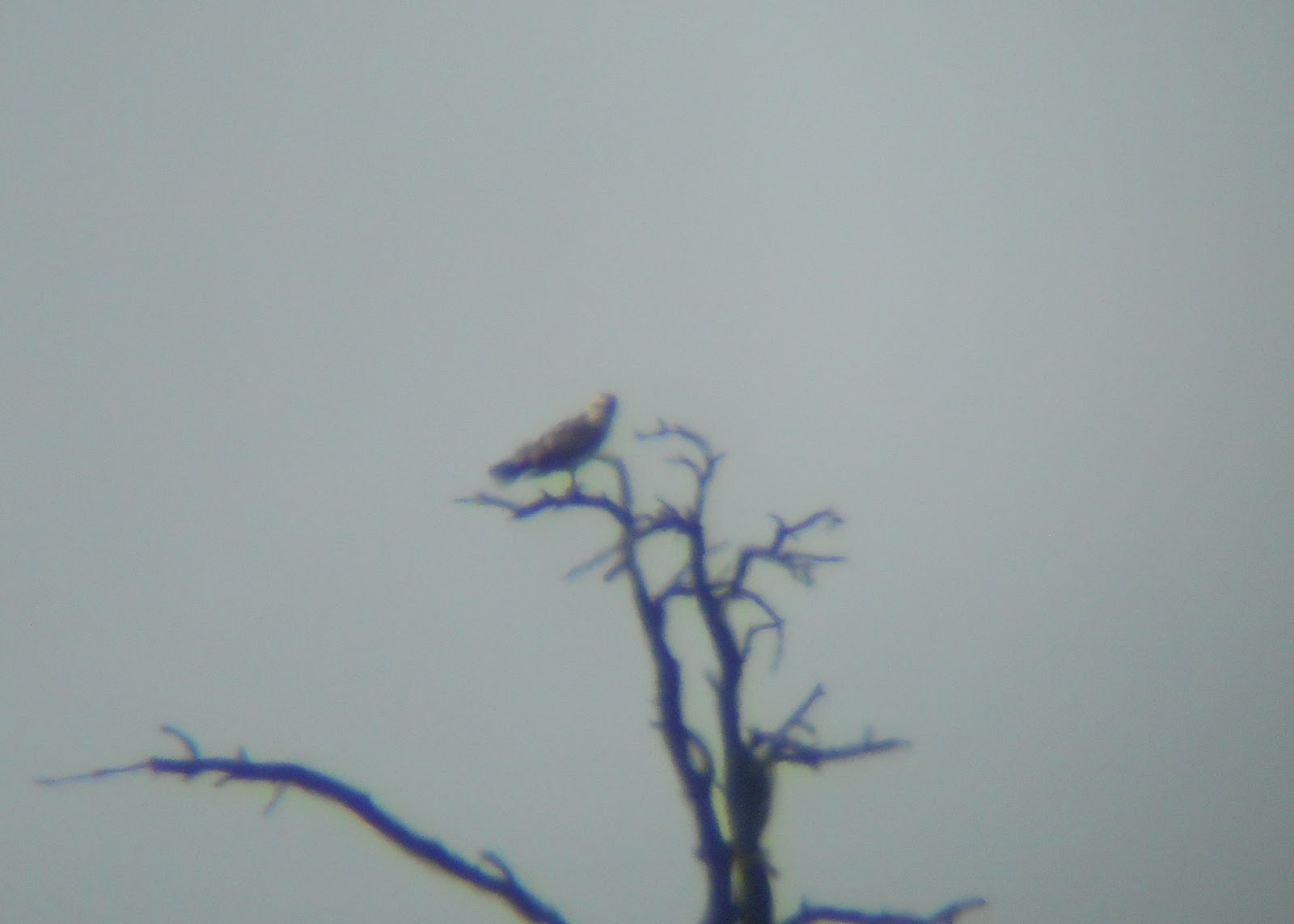


The bird hunted back and forth over the heath, dropping down out of sight and at one time came up with a Snake, and proceeded to eat it on the wing!
 
Me and Espen lost the others, so we decided to move our viewpoint back towards the carpark as the bird was flying that way, but unfortunately, after a brief hovering session at closer range, the bird then moved to the other side of the heath where we watched it distantly in our scopes.


Having been watching the bird for nearing 3 hours, we agreed to head off to our next location, to a newly formed RSPB reserve where a pair of Black-winged Stilt had raised 3 chicks.
 
Even in its very early stages, you can see this reserve has huge potential, with the ever present Avocet's being on most of the pools, and Little Egrets dotted around. We moved our way onto the shingle beach, where numerous Sandwich, Little and a single Common Tern were flying. 6 Mediterranean Gull were also moving back and forth before an altogether bigger bird flew over as a rather impressive RAF C-130 Hercules flew over the reserve and out to sea!


We continued along, and a party of Lesser black backed Gulls flew low over and area of dense sedge and weedy grass, and in doing so, up flew a strikingly black and white bird as one of the adult BLACK-WINGED STILTS flew up to mob them, and it was soon joined by its mate as they chased off these unwanted visitors, proving beyond doubt that they were still caring for chicks in that dense foliage! We just couldn't see them.
 
Elated at this brief, but very good flight display we waked up to a estuary mouth a little further up, which gave us a nice wader showing, with Little ringed, Ringed and Grey Plover all being present, alongside Lapwing, Dunlin, Turnstones, Redshank and a single Bar-tailed Godwit! We were also treated to some outstanding Little Tern flypasts here as they flew within 30ft of us as they headed back out to sea!
Away from Avian highlights, 4 Clouded Yellow butterflies were seen, including one which flew out to sea, but non of which landed for a photo.
 
We returned back to where we saw the Stilts, and enjoyed a few further brief views on the deck and in flight but with us all starting to tire, we decided to head somewhere where we could sit down and get some rest, so we dropped in Pagham Harbour.


Birdwise it was all a little 'samey', but also present here were a number of Little Terns, Sandwich Terns and again a single Common Tern, all of which were appreciated as  they flew across the waves of the sea.

With us all now fairly birded out, and with a still long drive back ahead of us, we decided to head back, after what was a great, but very tiring day.

Note to self- Always go to sleep before you go on a twitch, even if just for a short time!
MB

Thursday, 3 April 2014

Waders, Geese and a Bluetail!


19/02/14
Slimbridge has been hosting huge numbers of waterbirds throughout the winter, particularly waders, and it was due to this that i decided a trip down was in order!

Immediately obvious, even from the car park was the huge flock of around 2000 Golden Plover which were feeding and flying around the Tack piece. With the early morning sun behind us, it was a pleasure to sit and watch the numerous waders, ducks and Swans scattered across the flooded meadow.


Moving onto the Holden tower, everything started to happen at once. The White-Fronted Goose flock was unfortunately not playing ball, and had decided to feed along the seawall to the north, and was unviewable.

So, i concentrated on scanning the hundreds of Dunlin looking for a scarce wintering bird. At least 800 were scattered across the flooded Dumbles, no doubt still exploiting the food rich soils that had been deposited by the very high tides on many occasions throughout the year. With some scanning, i picked up one of the LITTLE STINTS feeding way out on the Dumbles, but it soon flushed with every other bird, and once they resettled, it (or another) was re-located! Feeding on the pool in front of the hide!

I always enjoy this stunning tiny wading bird, their restless activity and subtle beauty in winter, and indeed every plumage is just irresistible. I am always amazed when these stunners stay to winter in the UK, as they really should be in southern Europe/ Africa at this time of year!
Against this Lapwing, you can clearly see just how small these birds are, tiny little gems, and one which always brightens up a day!


But it was soon back to scanning Geese, and while scanning the Barnacle goose flock which had been pushed up onto the Dumbles by the tide the Dark-Belled Brent Goose appeared. Sadly however, my first 'decent' view of it over the winter revealed that its wing was really not in good shape, and the bird was constantly dragging it behind and along the floor. A sad fate for any migratory bird, but luckily for it, there aren't too many places too much better for Geese to reside than at Slimbridge.
Somehow i can't see this bird leaving, so you would presume that this bird will become a permanent fixture of the feral Barnacle Goose flock.


Meanwhile, the White-Fronts flew up, and flew slightly further out onto the Dumbles to allow some viewing. A short while later, and i picked up the TUNDRA BEAN GOOSE as it happily fed alongside its Russian friends.
Now, i understand i may have caused some controversy by agreeing with the Slimbridge wardens about this bird being a Bean Goose, but out in the field, it really did look convincing as one, despite its smaller than average size (but which still fits within variation of the species). The 'worrying' features mentioned by some were not obvious like they were in some photos that seemed to suggest characteristics of a hybrid origin.


Scoping from the Holden revealed a singe Avocet roosting on the Top new piece, and also rather surprisingly a flock of 37 Grey Heron perched out on the estuary edge where the Little Egrets usually perch, which, upon enquiring, i was informed was a new record for the site!


With the superb Siberian gem still present in the beautiful Shire valley not much further to the south, it would have been rude not to have visited for seconds!

And a short while after, we were again watching the stunning 1st winter male RED-FLANKED BLUETAIL, and luckily, in much more enjoyable circumstances. A small gathering of around 10 birders/ Photographers, and a Bluetail playing hide and seek in a Hawthorn in the sun!
What is not to love!

With the obviously more relaxed surroundings, the bird often would perch up regularly for long periods of time, a massive contrast to it being constantly harassed and pushed around the first time i saw it. It really gave me the chance to admire its beauty as it commuted from 'its' Hawthorn and the ground where mealworms had being placed.

Do i need say any more?


MB

Thursday, 6 February 2014

Birding and Guitars

3/01/14
Finding myself in Edgbaston  to pick up my new guitar, it would have been rude not to drive the couple of miles up the road to admire the Great-Northern Diver that had (Somewhat ridiculously) taken up temporary residence on the Swan Pool in Sandwell valley!
So, with my Les Paul Studio sitting on the back seat, it was a short drive through the back streets of Edgbaston and Smethwick to our destination. A quick walk out to the lake edge and the GREAT-NORTHERN DIVER was showing on the far side of the pool.

Having seen around 40 the previous day, i chose not to walk around to the other side to get a closer look, and after a short time, decided to cross the road to Forge Mill Lake. Sadly, the amazingly close views of the previous day, and with them seeming almost 'common' i was left somewhat with a glazed look in my eyes. Around 20 Goosander were feeding there, as were very good numbers of Pochard. Moving around the the partially rebuilt RSPB center, i looked over the feeders, and soon found my main target. WILLOW TIT.

Sadly, this is a species that has all but disappeared from my home county, and it is hard to believe that i once had both Willow Tit and Tree Sparrow visiting my garden! Within a few seconds through, the bird had flicked onto the feeder, collected its seed and flew off to eat/stash it away somewhere, and i didn't see it again.

Somewhere nearby, i found myself watching a party of RING-NECKED PARAKEETS, as they flew around calling, and eventually settling on tree's in someones back garden, where i was able to scope them through a hedgeline, 2 metal fences and across a school playing field! Thankfully, being the school holidays, there were no issues with doing so!


4/01/14
Having such a great start to the year was made even better when Neil Duggan offered me a day out, collecting a local rarity and then heading down to Slimbridge for their spectacular wintering flocks!

The TWO-BARRED CROSSBILLS were being as elusive as ever, but were tracked down in a stand of pines as they called incessantly for a while before flying out and disappearing altogether! As i had hoped,the Two-Bars became my 100th species for the year. A good number of Common Crossbill were also showing, some landing in trees adjacent to the path!

With short winter days, time was limited, so we then started towards Slimbridge, but a spur of the moment trip had us dropping into Lineholt, were other than a distant flock of 10c Redpoll sp (Associating with Goldfinch on the Golf course) nothing was seen. Interestingly, one or two looked fairly pale, but with the light and distance they were hard to ID with certainty.

Our arrival at the car-park at Slimbridge was greeted by masses of circling Lapwing and Golden Plover over the tack piece, and it was here where we first headed. Bewick's Swan were dotted along the flooded fields, surrounded by thousands of Lapwing, Golden Plover, and hundreds of Black-Tailed Godwit!

It was clear though, that the most activity was from the Holden tower, as following a very high tide, a large layer of silt created ideal feeding opportunities for thousands of birds. And i mean THOUSANDS! Around 3000 each of Lapwing and Golden Plover, nearing 2000 Dunlin (The most i have ever personally seen here in winter) and similar numbers of both Wigeon and Teal, it was immense!

This is surely the meaning of birding in a British wintertime!


Despite these massive numbers of birds, numbers of White-Fronted Goose and Bewick Swan were seemingly well down, with only 170 White fronts and only 30 Bewicks! The reasons for this are clear though just by walking outside and looking at the sky. A very mild winter (and hence the almost no-stop rain) means our northern and eastern visitors have no need to venture so far west to find sufficient food, so they are currently feeding somewhere in Germany or the like. Certainly not in the UK!

While scanning Teal and the very far edge of the Dumbles however i was surprised to find a female GOOSANDER sitting in with them just off an area of floodwater, well back from the estuary edge! Certainly not a bird i exactly associate with flood water!The resident BRENT GOOSE was showing fairly well on the Dumbles edge.

The Zeiss hide was very quiet in comparison. But 4 Avocet made up for the lack of birds as they roosted on the somewhat flooded flash. A Cetti's warbler was showing stunningly well on the edge of the reeds, which was a real privilege!

With the light fading, and after a quick check of the 'south finger' we decided to look for Egrets at Court lake at Frampton. A Kingfisher, 6 Little Grebe, 10 Pochard and very good numbers of Tufted Duck were noted, but we failed to see any Egrets.


MB

Wednesday, 14 August 2013

Worcestershire MEGA! 500th Post!

Wow, 500 blog posts! Its hard to believe at the beginning i would reach 500 posts. Thankyou for your ongoing support and i look forward to the next 500!

3/08/13
Upton Warren flashes was the destination as a Worcester MEGA had taken up residence, So upon our arrival i headed straight for the feeder hide, after briefly stopping near the bridge to listen to a begging juvenile CUCKOO.
Once in the hide, a wait ensured, but my hopes were not high as it starting to become late evening 7pm, and the feeders were almost inactive. 3 Greenfinch were all that kept us entertained.

That was until i spotted a brown tit species in hawthorns to the left of the feeders.

The 'WILLOW TIT'!

Sadly, now a very rare bird within the county, being classed as extinct as a breeder, and no longer has any regular location within the county boundaries! Therefore it was great to be able to catch up with one of these species within the home county.

Additionally, it also produced me the 2nd of the species 'pair, that is Marsh and Willow in the same county in 2 days, not the easiest of feats nowadays!

Having seen the target, and watched it for some time, we moved onto the main hide. Waders were well represented with 7 species, with 7 Avocet, 7 Green Sandpiper, 4 Common Sandpiper and 3 Redshank being the highlights.

We had to wait until very late in the evening for the Gull roost to produce anything, when a pair of adult Common Gull dropped in around 9pm, spending a short period on the deck before flying off south.


MB

Wednesday, 7 August 2013

My last month- July

3/07/13
Patch
A family party of 5 Grey Wagtail were showing on the river in stourport town center, 2 adults and 3 Juveniles. At one point, the two adults were mobbing an American Mink as it ran along the edge of the river for a good distance, only once the Mink was about 100m away from the young, did they stop mobbing it.

Moving further downriver, i moved onto a small site of heathland adjacent to Hartlebury Common on the patch side of the road, where a Cuckoo was heard singing, and 2 Willow Warbler were also singing. The 2nd area of the patch to hold breeding birds this year!

4/07/13
11 Goosander (adult female with 10 young) flew upriver past Lickhill, presumably the female which was seen to have chicks earlier in the year on patch. 2 Eclipse male Mandarin were still present at Lickhill, and the 5 Grey Wagtail were still showing.

12/07/13
A survey for Mandarin Duck came up with a new record count for the patch, when 16 birds were found, 2 eclipse drake, 3 adult female, and 11 nearly fledged chicks, including these birds which favored a log on the edge of the river.
A large emergence of Scarlet Tiger moth had me seeing over 40 of these stunning moths, with the main emergence centered around Blackstone.


13/07/13
Visiting Upton Warren with the Girlfriend, we worked our way across both sides of the reserve. At the Moors, we quickly located the 3 BLACK-TAILED GODWITS, feeding on the East Islands, other-whys it was quiet, bar the first returning Pochard of the winter (a drake), 10 Common Tern and a Cetti's Warbler.
The Flashes revealed the expected Wader species, with 9 Green Sandpiper, and a single Common Sandpiper. The trio of Blackwits dropped in, before flying off south when flushed by a Sparrowhawk. A juvenile Little Ringed Plover had also joined the wader's, but was obviously raised elsewhere.


18/07/13
A drop into Sheepwash had me seeing a Marbled White on the mound, my 2nd sighting at Sheepwash this summer. Slightly more expected though was the Gull flock, which included a LBBG, with the leg ring K+H. I have personally never came across a bird with a + as the middle character, so if anyone can shed any light on the record, please do.

19/07/13
A friday afternoon drop into Upton Warren had us seeing a nice array of waders. A moulting male RUFF was showing on the Flash, as was a adult GREENSHANK. 35 Avocet were still in attendance, while other migrant waders were 7+ Green Sandpiper , 1 Common Sandpiper and a Dunlin. 16 Curlew spent some time on the flash before flying off.


23/07/13
Another patch visit, again to count Mandarins had me counting 15 birds, but of a completely different combination of ages/sexes. I will have to wait until the end of the summer to judge the true figure, but looking through my notes and photos, it would seem that 20+ Mandarin have summered/being raised on the river this year.
3 Eclipse drake, 3 juvenile drake, 3 adult female and 6 un-sexed juveniles were found. A new brood of chicks was found, the 3rd breeding record of the year, with a female with 2 still downy young in tow. A single Emperor dragonfly was hawking the river, and a multitude of Brimstone butterflys were on show, including one which decided it wanted to use me as a perch!


Masses, potentially above 1000 very young Frogs were found, literally each step you would take 40 spring out of the grass below you! Some sight!

24/07/13
While looking for Dragonflys around the Gadwall lake at the south end of the patch, a loud 'glipping' sound alerted me to the presence of a flock of 5 CROSSBILLS flying over! Only the 2nd patch record, and the largest flock to date. With the large number in the country currently, it may be worth looking through these migrant flocks of Crossbills, even in the midlands, as their cousin, the Two-Barred Crossbill is also experiencing a influx!
Get looking folks!
MB

Tuesday, 30 April 2013

Birding down south!

1/04/13
A planned day out to Severn beach was launched in the hope of seeing some migrants, the Twites and the SEO's. Ermm.
Well we scored a few of the first ones, but failed to see the 2nd and 3rd ones!! Arghhh

On the drive down, i was lucky enough to pick up a stunning RED KITE hunting low over the motorway 1/2 mile north of junction 10 on the M5. Always a stunning bird to see!

We first dropped into Aust warth, where we failed to see the Twites or any Owls.

Then Severn Beach, hoping to see some waders or seabirds out on the edges of the estury. I quickly located 32 TURNSTONE being pushed up the stoney 'beach', and we had great views of the birds, including 2 Dunlin, before they were flushed by the tide and flew to the Northwick warth area, where we caught up with them later. We had 4 WHEATEAR around the New passage to the south end of Severn Beach area, but other than that it was very quiet.


Moving to the Northwick warth area, we caught up with some roosting waders, 50c Turnstone, 100c Dunlin, 10c Redshank and 50c Curlew. Also, good numbers of both Wigeon, Teal and Shelduck.

Moving back to Aust, we again didnt see any Twites, nor any Owls, however we did have a male Wheatear out on the Saltmarsh.

We decided to leave, but i dropped into Upton Warren Moors Pool on the way back. A single Avocet was showing, as was a Water Rail. 20c Lesser Redpoll was showing well in the trackside bushes, but the highlight goes to this stunning Snipe!


MB

Wednesday, 24 April 2013

The early comings of summer!

30/03/13
I had been looking forward to seeing my first summer migrants of the year, and on the Saturday evening following the gardening job we headed down to Upton Warren flashes in the hope of catching up with the first few LRP in the county this year.
We arrived, and it wasnt long after that i spotted two brown waders scurrying about on the mud, my first Little-ringed Plovers. I always love my first occurance with summer migrants, it just amazes me to think that these tiny birds, only around the size of a Chaffinch have flew thousands of miles to grace that small bit of mud in the middle of Worcestershire! It just amazes me. 4 Avocets were also 'new' for me.
25 Curlew, 1 OYC and a single Common Snipe were all showing.

Around 6pm, a birder in the hide called out that a Mediterranean Gull had just dropped into the roost, and on 'getting on' the bird i was treated to views of a stunning adult summer plumaged bird! This is seriously one belter of a bird!
This is the first view i got of the bird after it had just landed on one of the islands.


And it then moved slightly revealing those stunning bright white primarys!


We initially assumed the bird was the previous nights adult, as i had not personally seen the photos of the bird, but we attempted to read the code in the falling light. The red ring already indicative of a Polish origin, as can be seen though, the other BHG around the bird somewhat hindered viewing though!


Eventually i got a clear view of the ring, and upon inquiring about the ring number, indicated that this bird was a 'new one'. Red PNU4


It later emerged that PNU4 was previously seen at the Moors Pool a week or so previously, but had disappeared and had gone completely off the radar before returning back to UW.
MB

Monday, 15 April 2013

Its been a long time!

It really has been such a long time since my last post, and am just dropping by to say that posting will again commence from now onwards as i am now mostly done towards my coursework, which has been one of my biggest inhibiting factors. Having just returned from a birthday weekend away with 'The Girlfriend' it seems like a good time to fill in the gaps of the last month!

21/02/12
Talking about the Girlfriend, all the way back in February we went for a walk at Arrow Valley Lake as i knew that Goosanders had been seen there recently, and we quickly located 13 of these stunning ducks, including 7 drakes. 15 Tufted Duck were also around the lake, and a Reed Bunting was seen near the visitor center. We were also able to get some great close up views of BHG's, including a few nicely marked 1w birds!


A couple of Tufties were showing very closely nearby!

27/02/13
I again went for a walk to look for LSW in a woodland to no reward, i'm really struggling to catch up with them this year! A stunning male BRAMBLING was still showing, starting too acquire some aspects of summer plumage.

2 Green Woodpecker were showing well on some short cut grass.

 And i was happy to see that both of the resident pair of Tawney Owl were out on top of their stump.

28/02/13
A visit to sheepwash was fairly productive, 37 Goosanders was a very good count, one of my highest of the winter infact, as was 47 Pochard. 8 Shoveler were still present, and the Tuftie flock numbered 20. 30 Linnet were still up on the 'mound' proving as flighty as always. 5 Lesser Redpoll were showing well in the wooded bits.

1/03/13
Roost birding at Bartley revealed a Yellow-legged Gull, but i manadged to miss the Caspian that was being watched from the dam.

2/03/13
A quick twitchy stop into Bittel reveled that the stunning adult drake SMEW was still present, choosing to reside in the furthest corner possible from the viewpoint on the Bittel farm Causeway. The Smew was keeping company with a single female Goldeneye, while a flock of 10 Goosanders were also present.


3/03/13
A patch visit was fairly uneventful bar 2 Snipe which flew over my head at Blackstone.

6/03/13
Another visit for LesserPecker and again drew a blank. I have been spending regular 3-4 hours in this woodland frequently and still am failing to see them. 4 BRAMBLING were still around, as was a Peregrine and the Tawney Owl was perched up on the top of the tree in beautiful sunlight, highlighting those gorgeous rufous tones.


A Nuthatch was showing down to 6ft on some food that had been put out.

13/03/13
Another failure to find LSW. A male and a female BRAMBLING were still near to the feeders. The Tawney was still out, and the Peregrine was still in residence. A small flock of 10 Siskin were flighty.

14/03/13
Sheepwash was doing well at retaining the Shoveler flock, as there was now 9 birds, including 3 birds showing very well adjacent to the path. 13 Goosanders were widely spread across the pool, but the Pochard flock had halved to 20 birds. A Kingfisher did a flypast along the river.

15/03/13
I do love my roosts. Again i visited Bartley as a Med Gull had been roosting regularly  Neil Duggan was also in the area and dropped in also. It was like a big birders meet up as 8 birders were present, the most i have ever seen at the location. Eventually the stunner of an adult MEDITERRANEAN GULL was located while suffering the freezing wind. For me however, the highlight goes to a pair of Peregrine which shown very well off the dam, apparently a very rare bird at Bartley, as they hunted the roosting Gulls. A Curlew flew off as the Peregrines entered.

16/03/13
I have a fondness for Grimely due to its superb looking habitat, and with waders starting on the move it seemed like a logical choice. We first dropped into the Holt flashes, where a flock of 75+ Wigeon were feeding, along with a fair few Lapwing and two Oystercatchers. I picked up two GREEN SANDPIPERS which were either migrants or some of the wintering birds. Moving onto the Camp lane pits we added a drake Pintail and a small flock of 6 Curlew, 2 Redshank were on the flooded middle section as were 2 Oystercatcher.

Following this we dropped into Upton Warren where i quickly got the 14 Avocet. 3 OYC flew north and 1 Curlew was showing. 3 Chiffchaffs were my first 'spring' birds and 2 Water Rail shown. A single 1w Common Gull dropped in among the roosting Gulls.

17/03/13
I struck lucky on patch with 2 Greylag Goose, an insane patch rarity. I have only previously had fly overs but these two birds were 'decked' and were showing on the Lickhill pool.
  (You can see both birds in this photo, even if only a tiny portion of the 2nd birds head)

And now i can get into the more 'juicy' recent birds in my posts following this,
MB